Pope Leo XIV recalls Miraculous Medal feast and plans visit to Rome parish
Speaking to French-speaking pilgrims on November 25, the pope asked Mary for the grace to learn from Christ ahead of a scheduled visit to Sant'Andrea delle Fratte, a Roman center of the devotion
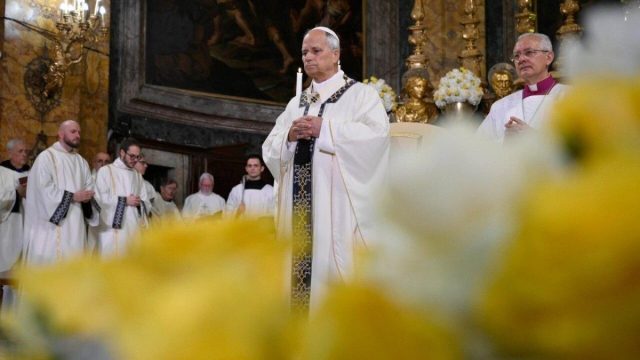
Pope Leo XIV was scheduled to visit the Roman parish of Sant'Andrea delle Fratte, a center of devotion to the Miraculous Medal, on Thursday, November 27. Two days earlier, he recalled the feast in a greeting to French-speaking pilgrims and invited them to learn from Christ.
The pope made the remarks at the general audience on November 25, 2026. "As the feast of the Miraculous Medal approaches, we ask the Virgin Mary for the grace to place ourselves in the school of her divine Son, whom we honor at Christmas as the Prince of Peace," he said. The Vatican's official English translation of his remarks left these words out.
Papal visit to Sant'Andrea delle Fratte
The pope's visit to Sant'Andrea delle Fratte, a Roman parish that is a center of devotion to the Miraculous Medal, was scheduled for November 27. The church has a particular place in the history of the devotion: it was the site of a well-known conversion linked to the medal.
The origin of the Miraculous Medal
The feast marks the anniversary of the second apparition of the Virgin Mary to St. Catherine Labouré. It took place on November 27, 1830, in the chapel of the convent of the Daughters of Charity of St. Vincent de Paul on the Rue du Bac in Paris. At about 5:30 p.m., as Catherine prayed with the other sisters, she saw the Mother of God standing on a globe and crushing a serpent beneath her feet.
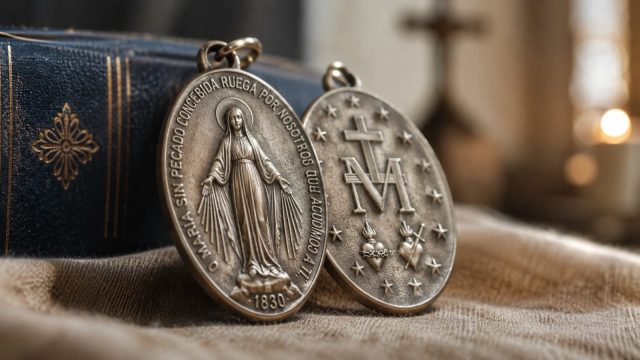
Mary wore a white robe and a blue mantle, and her face had a beauty that Catherine said she could not describe. In her hands, at the level of her heart, she held a small golden globe topped by a cross. Her fingers bore rings set with precious stones, and beams of light streamed from them.
The message and the meaning of the symbols
The Virgin explained to Catherine what she was seeing: "This globe that you see represents the whole world, especially France, and each soul in particular. These rays are the symbol of the graces that I pour out on those who ask me for them. The pearls that give off no rays are the graces of the souls who do not ask for them." The golden globe then vanished from Mary's hands. She stretched out her arms, and the rays of light kept streaming toward the globe.
An oval of light then formed around the figure of the Virgin, with an inscription in gold letters: "O Mary, conceived without sin, pray for us who have recourse to thee." The image turned, and Catherine saw the reverse side: the letter M surmounted by a cross and the Sacred Hearts of Jesus and Mary, all framed by 12 stars.
The Virgin's request
The Virgin then gave Catherine a task: "Have a medal struck after this model. All who wear it will receive great graces. The graces will be more abundant for those who wear it with confidence." The apparitions recurred toward the end of December and in January 1831, as the Virgin continued to communicate with Catherine.
Approval and spread of the medal
Once her confessor's initial resistance had been overcome, the message reached the archbishop of Paris, Hyacinthe-Louis de Quélen. He authorized the medal to be struck on one condition: that it be done with the prudence the Church recommends toward any private revelation. The goldsmith Adrien Vachette produced the design according to Catherine's instructions.
The first 1,500 medals were ready in the summer of 1832, in the middle of a cholera epidemic in Paris. The Daughters of Charity gave the medals to the sick, and accounts of healings, protection and conversions quickly multiplied. Among the healings was that of Caroline Nenain, an 8-year-old girl who recovered inexplicably from cholera after wearing the medal.
The conversion of Alphonse Ratisbonne
The best-known conversion was that of Alphonse Ratisbonne. In January 1842, in Rome, he experienced an apparition of the Virgin in the church of Sant'Andrea delle Fratte, the same church the pope was scheduled to visit on November 27. He was baptized a few days later, although until then he had been an avowed atheist and a critic of Christianity.
The "Miraculous Medal" and its worldwide spread
Ordinary people began calling the medal "miraculous" because of the countless graces received. The name is documented from February 1834. By 1835 more than 1 million medals were already in circulation, and by the time of St. Catherine's death the number had reportedly reached 1 billion. The devotion also brought new growth to the Vincentian Daughters of Charity. With an influx of vocations, they tripled the number of their houses in little more than two decades.
Link to the dogma of the Immaculate Conception
The words "conceived without sin" on the medal helped spread devotion to the Immaculate Conception, which Pope Pius IX solemnly proclaimed a dogma on December 8, 1854, in the bull Ineffabilis Deus. In 1858, when the Virgin revealed herself at Lourdes to St. Bernadette Soubirous as "the Immaculate Conception," St. Catherine said with certainty: "It is the same."
Historical and theological context
It all began in a France in turmoil. The July Revolution of 1830 had just overthrown King Charles X, and anti-religious tensions ran high. The writer Jean Guitton described the medal as "a miniature" that "sums up all of Mariology." The essayist Vittorio Messori said it "is closely bound up with Christology."
A sacramental of the Church
In Church teaching, the Miraculous Medal is not a talisman or a magic object but a sacramental: a visible sign of trust in Mary's maternal intercession. During the COVID-19 pandemic, the Central Association of the Miraculous Medal distributed more than 3,500 medals to 18 hospitals and health centers and to frontline workers.
The legacy of St. Catherine Labouré
Catherine Labouré served the poor and the elderly for decades without revealing that she was the visionary. She died on December 31, 1876, and Pope Pius XII canonized her on July 27, 1947. Her remains rest in the chapel on the Rue du Bac, which has become one of the world's major Marian shrines.
Based on reporting by Javier Ruiz Arregui for Iglesia Noticias. This article was translated and adapted from Spanish with the help of artificial intelligence.