Study finds fewer than a third of US Catholics believe in the Real Presence
A survey of 1,049 US Catholics found that 28.8 percent believe the bread and wine truly become the Body and Blood of Christ, while 58.8 percent said they are only symbols
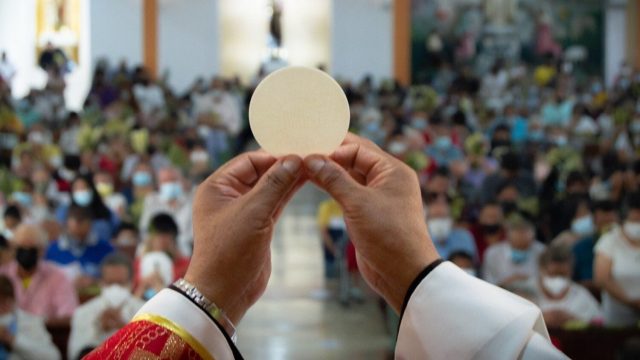
A study published in September in the academic journal Sociological Inquiry found that only 28.8 percent of the US Catholics surveyed believe that "the bread and wine truly become the Body and Blood of Christ" at Mass. The study is based on surveys of more than 1,000 Catholics in the United States, with a sample of 1,049 people. It found that fewer than a third of them hold this central dogma of the faith, known as the Real Presence. The findings come several years after the US Conference of Catholic Bishops (USCCB) launched a national initiative for Eucharistic renewal.
The study also found that 58.8 percent of respondents said the bread and wine "are only symbols," and 12.4 percent said they were unsure what happens during the consecration. Even among those who attend Mass weekly, as the precepts of the Church require, only about 60 percent said they believe in the Real Presence. Among those who described themselves as "very religious," the figure fell to 40 percent.
Little change since 1992
Mark Regnerus, one of the study's authors and himself a Catholic, discussed the results in a blog post on November 11. He said the data show "no statistically significant difference from the 2019 Pew survey's estimate of 31 percent." He asked whether anything has really changed among US Catholics since 1992, when a Gallup poll found that 30 percent of Catholics agreed with a similar statement. His answer, at first glance, was "not really."
Regnerus said that in an environment where Catholics are "saturated with information, and therefore with competitors to orthodox belief, it falls to priests to remind parishioners what the Church holds as theological truth." But he cautioned that "those who need it most are not likely to be present and listening."
The Eucharistic Revival
The study follows the USCCB's National Eucharistic Revival, launched in 2022 as a direct response to a 2019 Pew Research Center survey that found only 31 percent of Catholics believed in the Real Presence. The initiative ran until 2025 and included the 10th National Eucharistic Congress in 2024, which drew between 50,000 and 60,000 Catholics.
The new figure is close to the 2019 result. Critics of the revival had said its impact would be limited, arguing that Catholics who do not regularly attend Mass would not go to the Eucharistic Congress or to the initiative's other events either.
The Real Presence Coalition survey
In 2024, the Real Presence Coalition (RPC) released what is regarded as the largest survey of lay Catholics ever conducted on the subject. Based on a sample of 16,000 Catholics, it identified five main reasons given for the decline in belief in the Real Presence. They were the modern practice of receiving Holy Communion in the hand while standing; the scandal of giving Communion to public sinners; a lack of reverence for the Eucharist among both the faithful and the clergy; the "casual attitude" of some priests toward the Blessed Sacrament; and the failure of catechesis.
Participants were asked what their top recommendation to the bishops would be to foster belief in the Real Presence. The most popular answer, at 29 percent, was a return to the traditional practice of receiving Communion on the tongue while kneeling. Next came "catechize the faithful," at 24 percent, and "foster greater reverence for the Eucharist," at 10 percent. More than 97 percent of respondents said they attend Mass at least once a week, and the same share said they believe in the Real Presence of Christ.
Criticism of the bishops
Most US bishops chose not to even discuss the results of the survey with the Real Presence Coalition. A member of the organization who asked not to be named criticized that response: "You would think the 'listening Church' would do everything it could to hear the voices of thousands of lay Catholics on why they believe there has been a loss of faith in the Real Presence."
The same member said that "you would think those in charge of the Eucharistic Revival would be knocking insistently on the RPC's door to find out what the respondents were thinking." But, according to the member, "that was not the case." "In fact, it seemed the bishops were doing everything they could to avoid learning the results of the survey," the member said.
Based on reporting by Juana Morales for Iglesia Noticias. This article was translated and adapted from Spanish with the help of artificial intelligence.