
Cardinal Marx recalls promise to Pope Francis on the German Synodal Way
Marking 30 years as a bishop, the Archbishop of Munich said a synodal Church belongs in dioceses and local communities rather than in a national structure, and ruled out a synodal conference with authority over dioceses
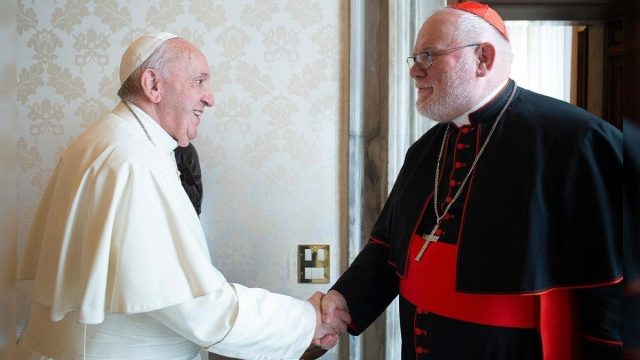
Cardinal Reinhard Marx, the Archbishop of Munich, has reflected on the German Synodal Way in an interview with the German Catholic news portal katholisch.de to mark the 30th anniversary of his episcopal ministry. He said the real focus of a synodal Church must lie in the dioceses and local communities, not in a national structure.
Marx rejected the idea of reducing the process to sending Rome a list of demands, which he called unimaginative. He also ruled out setting up a synodal conference with authority over the dioceses, calling instead for a shared sounding board that takes in local realities and represents the Church throughout Germany.
Marx was one of the architects of the Synodal Way, launched in 2019 in response to the sexual abuse crisis. He said the scale of the scandal had made the emotions at the start very intense, but that the process had been a step that was "right for naming the problems together" rather than evading the truth.
Marx said he promised Pope Francis at the time that the German Synodal Way would move in step with the synodal process of the universal Church. "And I see that this can be achieved. As for the synodal process in Rome: a great deal is underway and progress is continuing," he said.
Looking back on his three decades as a bishop, Marx said confronting sexual abuse had shaped his ministry more than anything else. He said that in 1996 he was unable to imagine "the unimaginable suffering" it meant for so many people in the Church. Even in the hardest moments, he said, he had found encouragement and enthusiasm in the communities and parishes he visits.
On his relationship with the Vatican, Marx praised Pope Leo XIV's approach, describing him as "a person who listens very well." He said the pope is not an "autocratic ruler" over the Church but the foundation of its unity, and that he radiates a "noble and great serenity."
Marx, who has episcopal responsibility for media and will leave that post at the end of September, said he was deeply concerned about the dominance of big technology companies, algorithms and artificial intelligence. "The close connection between big tech and political and economic power carries great danger," he said.
He criticized the way social media works. He said quick posts and likes badly distort how reality is perceived and give the advantage to "all the radicals and all the simplifiers," while those who think in a nuanced and objective way are left with no room in that logic.
Marx, who turned 73 as he marked his episcopal anniversary, said he intends to keep working. He is expected to submit his second resignation at 75, but said he feels no tiredness at all. "I feel absolutely able to act and full of joy," he said.


