US bishops set ethical limits on investing in artificial intelligence
At their fall assembly in Baltimore, the US Catholic bishops barred investments in AI that endangers human dignity, began rewriting their 2001 pro-life plan and criticized federal immigration policy
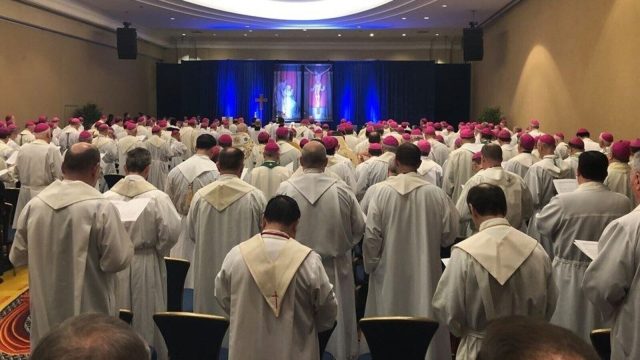
The United States Conference of Catholic Bishops (USCCB) held its fall plenary assembly in Baltimore on November 17 and 18, 2026. The bishops approved new investment guidelines that exclude companies linked to private prisons and detention centers. They also began revising the pro-life pastoral plan in place since 2001, adopted a new Bible translation for use in the liturgy and filled several leadership posts.
Investment guidelines on AI and human dignity
The updated investment guidelines bar the conference from putting money into companies whose artificial intelligence systems endanger human dignity. The conference does not rule out investing in AI altogether. It names five areas that are off-limits: autonomous weapons, or systems that automatically select military, security or immigration targets without effective human oversight; technologies designed to be addictive or to manipulate users; tools that harm the mental health of minors; applications that facilitate prohibited assisted reproduction techniques or genetic manipulation; and tools for mass surveillance or discrimination.
The guidelines draw on Mensuram Bonam, a 2022 Vatican document. They also encourage active shareholder engagement to press companies on deepfakes, pornography, privacy, labor rights and the environment. The portfolio also excludes companies that support abortion, in vitro fertilization or assisted suicide, along with companies involved in nuclear, biological or chemical weapons and those in the gambling industry.
A "Rerum Novarum moment" for Silicon Valley
Bishop Óscar Cantú of San Jose, California, who chairs the working group on human dignity and artificial intelligence, called the present a new "Rerum Novarum moment," a reference to Pope Leo XIII's 1891 encyclical. Cantú urged his fellow bishops not simply to be wary of technology but to take an active part in steering its development around the human person, in keeping with Pope Leo XIV's encyclical Magnifica Humanitas. "The Church has something Silicon Valley cannot manufacture: more than 2,000 years of wisdom about the human person, about truth and about the common good," he said.
Cantú, whose diocese lies in the heart of Silicon Valley, said the working group is already in contact with technology executives and policymakers. It plans to arrange direct meetings between bishops and engineers, as well as public discussions with parishioners, teachers, workers and community leaders. Its immediate regulatory priorities include child protection, privacy and financial security.
Immigration and mass deportations
Immigration was another point of tension with the federal government. Bishop Brendan Cahill of Joliet, Illinois, who chairs the USCCB Committee on Migration, sharply criticized mass deportation strategies as contrary to human dignity and the common good. In his address to the assembly, he cited what Pope Francis called a "culture of indifference" to explain much of the way immigrants are treated.
Cahill said differences based on national origin, language, skin color or economic and political influence "have been vigorously used by our own government through the spreading of fear, misinformation and hasty generalizations about human beings." He also warned of the risks of cutting protections and access to legal aid for noncitizen minors, services he considers essential to prevent abuse and exploitation.
In an interview with EWTN News, Cahill said the bishops have kept up an ongoing dialogue with the administration. "Sometimes they may not agree with us and they may do things differently, but we have maintained that dialogue with administration officials," he said. He added that the conference respects the nation's right to manage its borders, but said the central question is how to care for people who already live in the country.
More than 200,000 children are believed to have been separated from at least one parent because of detentions or deportations since early 2025. Nearly two-thirds of those children are US citizens. The immediate priorities include extending Temporary Protected Status (TPS) for Haitian nationals. TPS allows nationals of countries in crisis to remain and work in the United States.
Pro-life plan to be revised after 25 years
The bishops voted unanimously to begin drafting a new national pastoral plan for pro-life activities, replacing the document in force since 2001. Bishop Daniel Thomas of Toledo, Ohio, who heads the committee responsible, listed the changes of the past quarter century. He cited the Supreme Court's Dobbs decision, the growing availability of abortion drugs, the spread of assisted suicide laws, the widespread use of in vitro fertilization and the Church's increasingly firm opposition to the death penalty.
Thomas said the Church should not measure its mission mainly by election results but by how faithfully it communicates and lives the Gospel. He acknowledged that it is hard to find political allies willing to openly back Catholic positions on abortion and reproductive technologies. He insisted that the bishops' commitment comes from the Gospel and the common good, not from partisan loyalty.
New Bible translation for the liturgy
In a separate vote, 196 to 5, the bishops approved a new translation of the lectionaries used at Mass, based on the American Catholic Bible. The aim is to bring the Scripture readings proclaimed in the liturgy closer to the version the faithful use for personal reading. The American Catholic Bible was approved for private use in 2025 and is expected to be available in February 2027. It includes an Old Testament revised from the New American Bible Revised Edition, a new version of the Psalms and canticles prepared by the monks of Conception Abbey in Missouri, and a revised New Testament. The liturgical books still need approval from the Vatican's Dicastery for Divine Worship and the Discipline of the Sacraments before an effective date can be set.
Leadership changes and new initiatives
Bishop Kevin Rhoades of Fort Wayne-South Bend, Indiana, was reelected USCCB secretary by a vote of 157 to 59. He will complete his current term in November 2027 and then serve an additional three-year term, ending in November 2030. The assembly also elected new committee chairmen: Bishop James Conley for Catholic education, Bishop William Joensen for doctrine, Bishop Donald Hying for pro-life activities and Bishop Louis Tylka for communications.
The assembly also approved a proposal to designate the last Sunday of October as a National Day of Prayer for Racial Justice. The proposal passed with the support of 180 bishops, or 89 percent of those voting. Bishop Daniel García of Austin, Texas, who presented the proposal, said the day "creates a sacred space for reflection, repentance and the conversion of hearts, fostering a deeper reconciliation in the Body of Christ and in our communities."
Based on reporting by Juana Morales for Iglesia Noticias. This article was translated and adapted from Spanish with the help of artificial intelligence.