Maryland governor honors 272 people enslaved and sold by Jesuits in 1838
Gov. Wes Moore's citation honoring the GU272 and their descendants was read at a Bowie cemetery on former Jesuit plantation land, where hundreds of unmarked graves are believed to lie
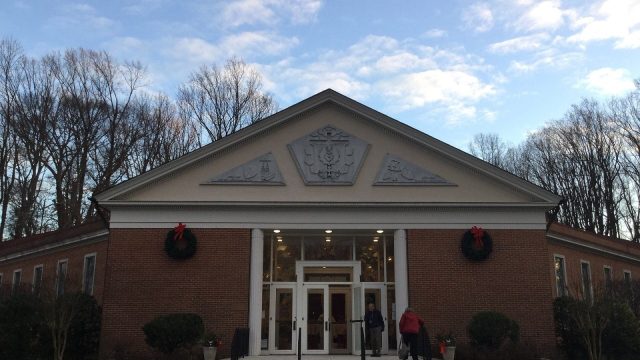
Eighty-nine of the 272 enslaved people came from the Jesuits' own plantation at White Marsh, where recent archaeological excavations have uncovered what are believed to be hundreds of unidentified graves.
Maryland Gov. Wes Moore issued an official citation on November 15, 2026, honoring the dignity, strength and resilience of the GU272 and their descendants. The GU272 are the 272 enslaved people sold by the Jesuits of Maryland in 1838. The citation was presented at a ceremony in Sacred Heart cemetery in Bowie, on land that was once part of White Marsh. The plantation was one of seven missions the order maintained in the state.
The ceremony came nearly two centuries after June 19, 1838, when the Maryland Jesuits signed a contract selling 272 enslaved men, women and children to two sugar plantation owners in Louisiana. The sale was meant to pay off the debts of Georgetown College, now Georgetown University. It brought in $115,000, the equivalent of about $3.3 million today.
State Delegate N. Scott Phillips, chair of the Legislative Black Caucus of Maryland, read the governor's citation aloud to those gathered. The text acknowledged how notorious the sale had been and declared: "On this day, Maryland honors the GU272 and their descendants, whose lives, faith, labor, suffering, courage and perseverance form an enduring part of American history." Phillips said the real cost of the sale could not be measured in money, but in its impact on the people who were sold and on the families that were separated. He noted that 89 of them came from the White Marsh land itself. "This is Maryland history, Catholic history, American history," he said. He said the past must be remembered, taught and never repeated. He acknowledged that no gesture made today can change what happened, but called it a necessary step toward reconciliation, provided it is backed by concrete action. Phillips represents a district in Baltimore County.
Phillips was introduced by Bishop Roy Campbell Jr., an auxiliary bishop emeritus of Washington, who leads an Archdiocese of Washington initiative to honor those who were enslaved. Campbell said those men, women and children died without any recognition, but that on this day they were being honored.
State Sen. Ron Watson, whose district in Prince George's County includes Bowie, also spoke. He described the site as "sacred ground" that holds the remains of those who came before, along with the memories, sacrifices, prayers and silenced stories of entire generations whose lives helped shape the Maryland of today. Watson said the 272 men, women and children were torn from their communities, their homes and their loved ones, but that their humanity was never for sale. "They were mothers and fathers, sons and daughters, brothers and sisters. They had names, dreams, faith and hopes for their children, just as we do today. And although they were denied freedom, their dignity could never rightfully be taken from them," he said. Watson said that in the year the United States marks its 250th anniversary, the country must acknowledge its injustices alongside its achievements, including the generations-long denial of the promise that all people are created equal. He asked that the event be more than a commemoration. He called for a commitment to remember those who were silenced, to honor the descendants who have preserved those memories, and to make sure the lessons of the past help build a more just future.
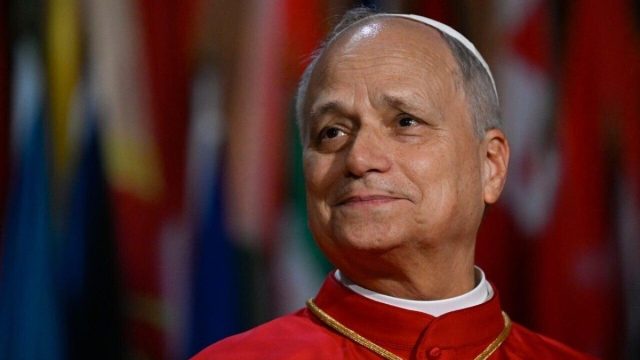
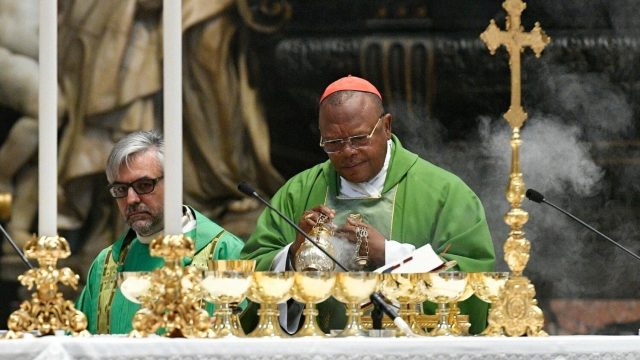
Cardinal Robert W. McElroy of Washington offered a prayer and a reflection. Earlier that morning he had celebrated a special Mass at Sacred Heart Church for the people enslaved at White Marsh and blessed a plaque in the church in their honor. McElroy said the ground had been consecrated by the lives of those who endured "that soul-crushing institution" there. He praised the enslaved people's legacy of resilience and said their spirit lives on in their descendants, who "are the truest testament to what they sustained and to their refusal to give up, even in the midst of darkness." The cardinal welcomed the descendants as "the true witness of that community that is still alive," and spoke of "the lives, the hearts, the souls, the beauty that the enslaved were able to carve out despite the darkness that descended on them."
Several descendants then shared their family histories. Kevin Porter, president and founder of the White Marsh Historical Society, recited the names of four of the earliest patriarchs and matriarchs of the enslaved community at White Marsh. They lived generations before the 1838 sale: Nelly, a cook; Isaac, a blacksmith; Tom, a carpenter; and Mary Queen, a house servant. "They were my ancestors," he said. Porter's search to recover his ancestors' names and stories led him to the Sacred Heart cemetery. It also prompted the archaeological work that has uncovered what are believed to be hundreds of unmarked graves on the cemetery hillside. "Many of my ancestors are buried in this ground. Most of their graves are marked with simple fieldstones. Only a few bear their names," he said. Porter said much work remains to be done at White Marsh. He called it his life's mission to recover more names, tell their stories and protect the place where they rest.
Robin Proudie is founder and executive director of Descendants of the St. Louis University Enslaved. The Jesuits moved her ancestors from White Marsh to St. Louis to support the order's mission in that city. "I would like to be here as a physical manifestation of my ancestors, and to say their names. We are on sacred ground," she said. The work of recovering names and stories has allowed descendants to reconnect with living relatives scattered across the country. Proudie herself learned that Kevin Porter is one of her cousins. Since then she has visited the Sacred Heart cemetery to see the neglected graves on the hillside and pay tribute to her ancestors. "The restoration has begun," she said.
Based on reporting by the newsroom of Iglesia Noticias. This article was translated and adapted from Spanish with the help of artificial intelligence.