
What the stars, hearts and serpent on the Miraculous Medal mean
The images on the Miraculous Medal, which St. Catherine Labouré said the Virgin Mary showed her in Paris in 1830, draw on Scripture, and Pope Leo XIV will celebrate the feast in Rome on November 27
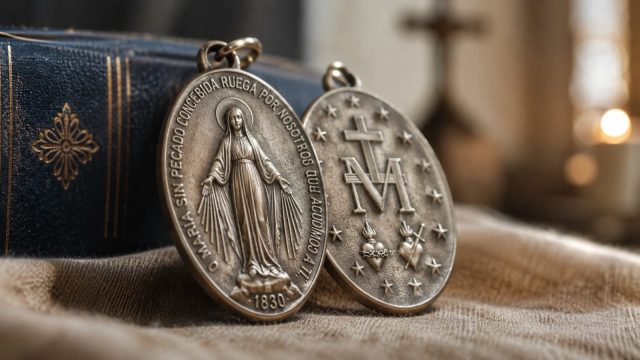
November 27 marks 196 years since the Virgin Mary appeared to St. Catherine Labouré in Paris, the apparition that led to the Miraculous Medal. The bicentenary is four years away. The medal's design contains many biblical references and brings together the main elements of Catholic devotion to Mary.
Twelve stars, a cross, two hearts, a serpent and rays of light. Each image engraved on the Miraculous Medal has a meaning tied to Sacred Scripture, salvation history and the role of the Virgin Mary in Christian life. The medal dates to 1830, when a young novice of the Daughters of Charity said the Mother of God had given her a mission in a chapel in Paris.
The apparitions to St. Catherine Labouré
In 1830, Catherine Labouré, 24, the daughter of a farming family from Burgundy in eastern France, had entered the Daughters of Charity of St. Vincent de Paul. On the night of July 18-19, she had the first of the apparitions she later described.
According to her account, a child woke her during the night and led her to her community's chapel on the Rue du Bac in Paris. There she met the Virgin Mary, who spoke with her and told her of a mission whose nature Labouré did not yet know.
The vision that gave rise to the Miraculous Medal came several months later, on November 27, 1830. Labouré said she saw the Virgin standing on a globe, her hands open, with rays of light falling toward the earth. She also saw the reverse of what would become the medal: a cross, the letter M, two hearts and 12 stars. According to tradition, the Virgin asked her to have a medal struck following that design.
Symbols of faith and salvation on the medal
The Virgin standing on the globe and treading on a serpent represents Christ's victory over sin and Mary's unique part in salvation history. The image refers to the Book of Genesis (Genesis 3:15), in which God announces enmity between the serpent and the woman.
Rays of light fall from the Virgin's open hands. They represent the graces the faithful receive from God through Mary's intercession. According to St. Catherine, the Virgin told her: "These rays are the graces that I pour out on those who ask me for them." The image is meant as an invitation to prayer and to trust in Mary's maternal intercession.
On the reverse, the letter M is interlaced with a cross. The M is the initial of Mary's name, and the cross represents the redeeming sacrifice of Jesus Christ. Together they recall the Virgin's presence beside her Son during the Passion, as told in the Gospel of John (John 19:25-27), when Jesus, before he dies, entrusts his mother to the beloved disciple.
The two hearts and the 12 stars
Below the M are two hearts, representing Jesus and Mary. The first, encircled by a crown of thorns, is the Sacred Heart of Jesus and stands for his love for humanity, shown in his self-offering on the cross. The second, pierced by a sword, is the Heart of Mary. It refers to Simeon's prophecy in the Gospel of Luke (Luke 2:35): "And a sword will pierce through your own soul also." Together the two hearts express the close spiritual union between the Virgin and her Son.
A crown of 12 stars encircles the images on the reverse. It refers to the 12th chapter of the Book of Revelation (Revelation 12:1), which describes a woman clothed with the sun, with the moon under her feet and a crown of 12 stars on her head. In Christian tradition, the number 12 is also associated with the apostles and with the 12 tribes of Israel. The stars therefore evoke the people of God and the mystery of the Church.
A prayer that came before the dogma of the Immaculate Conception
An inscription surrounds the figure of Mary on the front of the medal: "O Mary, conceived without sin, pray for us who have recourse to thee." The prayer came before the dogma itself. When the apparitions took place in 1830, the Immaculate Conception had not yet been solemnly proclaimed a dogma. That happened on December 8, 1854, when Pope Pius IX defined it in the bull Ineffabilis Deus, declaring that the Virgin Mary had been preserved from original sin from the first instant of her conception.
The Miraculous Medal helped spread among the faithful a belief that was already part of Catholic tradition, 24 years before it was defined as dogma. The devotion also came 28 years before the apparitions at Lourdes, which began in 1858 and whose message is also tied to the Immaculate Conception.
Why it is called the Miraculous Medal
The first medals were not made until 1832, two years after the apparitions, when a cholera epidemic hit Paris hard. The Daughters of Charity, who cared for the sick and the poor, began handing out the first ones to the city's residents.
As the medal spread, people began to attribute healings, conversions and other graces to the intercession of the Virgin Mary. The faithful themselves started calling it the Miraculous Medal, and the name eventually replaced its original one, which was linked to the Immaculate Conception. Historical records compiled by the Congregation of the Mission, the order of priests and brothers founded by St. Vincent de Paul, show how quickly the devotion spread: from a first batch of 2,000 medals in 1832, more than 500,000 were in circulation by the fall of 1834.
The medal is not an amulet
The Catholic Church distinguishes between using religious objects as an expression of faith and attributing magical powers to them. The Directory on Popular Piety and the Liturgy, issued by the Congregation for Divine Worship and the Discipline of the Sacraments, devotes section 206 to Marian medals.
The document says such objects allow the faithful to express their devotion to the Virgin outwardly and remind them of God's love. But it warns that true Marian devotion requires, above all, "a consistent witness of life." Wearing the medal, then, does not guarantee automatic protection against illness, accidents or life's difficulties.
In the Church's understanding, the medal's spiritual purpose is to strengthen trust in God, recall Mary's intercession and help the faithful keep their Christian commitment in mind in daily life. Its value lies not in the material it is made of but in the faith and inner disposition of the person who wears it.
St. Catherine Labouré: discretion and service
Catherine Labouré was born May 2, 1806, in Fain-lès-Moutiers, in Burgundy. She lost her mother as a child, which shaped her life and her particular devotion to the Virgin Mary. In 1830 she entered the Daughters of Charity, a congregation founded by St. Vincent de Paul and St. Louise de Marillac and devoted especially to serving the poor and the sick.
Despite the medal's wide circulation, Labouré did not seek attention for her experiences. After leaving the motherhouse on the Rue du Bac, she was assigned to the Enghien hospice, where she spent her life caring for people in need. For decades, as the medal spread to other continents, she kept her identity as the visionary out of public view.
She died December 31, 1876, at 70. Pope Pius XII canonized her in 1947.
The 2026 feast
In 1894, Pope Leo XIII granted the Vincentian Family, the network of religious congregations and lay groups inspired by St. Vincent de Paul, the liturgical celebration of Our Lady of the Miraculous Medal on November 27. This year, Pope Leo XIV will celebrate Mass for the feast on Friday, November 27, at 5 p.m. at Sant'Andrea delle Fratte, a parish in Rome.
The Vincentian Family keeps several devotional traditions: the novena to Our Lady of the Miraculous Medal (which begins November 18), the rosary, Masses and the blessing of medals. Vincentian spirituality ties these practices to works of charity, especially care for the sick, the elderly, people who live alone and families in need.
Based on reporting by Javier Ruiz Arregui for Iglesia Noticias. This article was translated and adapted from Spanish with the help of artificial intelligence.


