Italian bishops' study examines 378 reports of clergy sexual abuse of minors
A pilot study for the Italian Bishops' Conference covers 378 reports of clerical sexual abuse of minors made between 2001 and 2021, but its authors say it offers only a partial snapshot
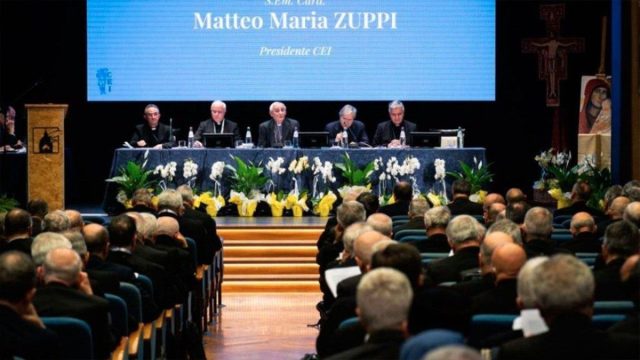
The Italian Bishops' Conference, Italy's counterpart of the USCCB, has presented a study of 378 reports of sexual abuse of minors by clergy made between 2001 and 2021. The reports describe 880 acts of abuse. The conference acknowledges that the study is only a partial "snapshot" of the problem. In other European countries, the Church is moving toward compensation for victims.
The conference, known by its Italian initials CEI, presented the pilot study on November 25 at its 83rd General Assembly in Assisi. It covers sexual abuse of minors by clerics in Italy from 2001 to 2021. The CEI commissioned the report from the Istituto degli Innocenti in Florence and the University of Bologna's Center for Victimology and Security. It is the first analytical study of the problem at the national level. Cardinal Matteo Zuppi, the CEI's president and archbishop of Bologna, presented it. He called the abuse "an open wound in the body of the Church."
An apology
"We feel shame for this and we do not want to hide it," Zuppi said. He criticized both "the superficiality of those who minimize and shut themselves away in self-defense" and "the punitive zeal driven by a sense of guilt or by media pressure." He also spoke of the mothers and fathers who "have knocked on our doors and received evasive answers." He said the abuses are "crimes" that reveal an evil that has run through the Church.
"To move forward, we need, first of all, those who have suffered abuse," he said. Addressing every victim and survivor, he renewed "the request for forgiveness, aware that no word can erase what they have suffered." Zuppi did not mention compensation.
The study's data
The 2001-2021 period refers to the years in which the cases were reported, not necessarily the years in which the abuse took place. Of Italy's 226 dioceses, 198 took part, or 87.6 percent. Of the participating dioceses, 65 said they had received no reports. The researchers collected 426 reports in all. They set aside 48, leaving 378 for the study.
The report's authors warn that the data offer a partial "snapshot," not "a full picture of the phenomenon." There is no way to know or estimate how many cases actually occurred compared with the number reported. All 28 dioceses that did not take part are in central and southern Italy. Of the reports, 56.1 percent came from the north, which has about 47 percent of the country's population.
The number of reports rose over time, from 52 in 2001-2006 to 133 in 2017-2021. In the most recent period, victims themselves made 41.4 percent of the reports, while reports made directly to the civil authorities fell.
The accused
Most of the alleged abusers were Italians who had gone through the usual path of priestly formation. The most common age range was 35 to 44, and the average age at the time of the abuse was 42.9. Four out of five had attended a seminary, and three-quarters were ordained before turning 30. Eight out of 10 held positions that put them in direct contact with the faithful or with minors.
The alleged abusers had one trait in common: they belonged to what the study calls the circle of trust, the victims' family and acquaintances. In 39 percent of cases, the alleged abuser was the pastor. Of the accused, 18.3 percent had already been reported to their ordinary for behavioral problems or other personal difficulties.
The victims
The study examined records for 385 victims. Of those, 69.8 percent were male and 86 percent were Italian citizens. The most common age at the time of the first abuse was 15 to 17, which accounted for 43.9 percent of cases. Among boys, abuse involving penetration or genital contact made up the largest share, approaching 80 percent of their cases. Among girls, the most affected age group was 11 to 14, and abuse involving physical contact was more common. Between the ages of 3 and 10, the proportion of girls was twice that of boys. Of the victims, 62.9 percent regularly took part in parish activities or diocesan programs.
The study records 880 reported acts of abuse. Physical contact accounted for 55.6 percent and penetration or genital contact for 28.4 percent. More than a third of the incidents took place in private settings such as homes, offices or vehicles, and 24.2 percent on church premises.
Most of the abuse was not a single event. In 80.5 percent of cases it was repeated, while 19.5 percent involved a single incident. In 59 percent of cases, the abuse lasted less than a year.
The Church's response
The study looked at the measures Church authorities took against 356 accused clergy. Of those, 44.6 percent were moved to another ministry assignment and 12.4 percent were given a different role in the same place. Another 41.5 percent, or 148 people, were neither moved nor reassigned. Church authorities opened a preliminary investigation in two-thirds of the cases. Church courts became involved in 61.2 percent of cases, or 218 people.
Verdicts are known in 56 percent of the cases, and most of those ended in conviction: 70.4 percent, or 86 cases. Dismissal from the clerical state was imposed in one in three convictions.
Proposed measures
The Italian bishops presented a motion acknowledging "with sorrow and shame" their past failures to listen to and protect victims. The measures they proposed include a National Observatory on Abuse, a nationwide Interdiocesan Criminal Tribunal and stronger initial formation for clergy.
Elsewhere in Europe: Diocese of Trier documents 783 victims
France, Germany, Spain and Belgium have carried out investigations covering several decades, while the Italian study covers 20 years. In several of those countries, the discussion has already moved on to institutional responsibility, how abuse was covered up and compensation for victims. The CEI did not address those questions this time.
On Wednesday, the Diocese of Trier in Germany presented the final report of a study conducted over several years. It identified at least 783 minors and vulnerable adults who were sexually abused between 1946 and 2021, and 252 accused members of the Catholic Church. The researchers warn that these figures are a minimum and that the true number is probably higher. Thirty-five of the accused allegedly abused at least 438 minors, so this group of alleged repeat offenders accounts for 56 percent of all identified victims.
Historian Lena Haase said that "the abuse was not a failure" but was "made possible by transfers instead of sanctions." The study concludes that for decades, protecting the Church's public reputation took priority over protecting minors. According to the study, that changed only after the abuse revelations of 2010.
Based on reporting by the newsroom of Iglesia Noticias. This article was translated and adapted from Spanish with the help of artificial intelligence.