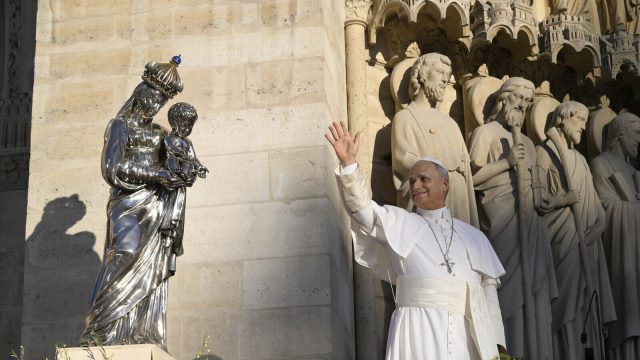
Albanian Cardinal Ernest Simoni survived communist prisons and has spent decades as an exorcist
Ernest Simoni Troshani, 98, was twice sentenced to death in communist Albania before Pope Francis made him a cardinal in 2016, and he says he has performed exorcisms for more than six decades
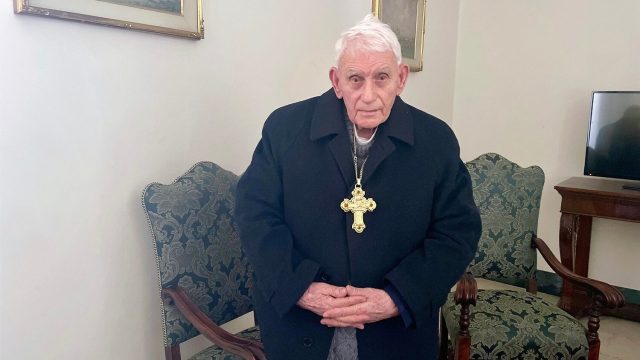
Ernest Simoni Troshani is a 98-year-old Albanian priest. Pope Francis made him a cardinal on November 19, 2016, after he had spent 18 years in prison under Albania's communist regime. He was born on October 18, 1928, in Troshani, a village near Shkodrë in northern Albania. He has been in the news again recently for his ministry as an exorcist, a role the Code of Canon Law regulates in detail.
Imprisonment under the communist regime
According to his official Holy See biography, Simoni was ordained a priest on April 7, 1956, in Shkodrë for the Archdiocese of Shkodrë-Pult, while the Albanian state was persecuting religion. He was arrested on December 24, 1963, after Christmas Mass, and held in solitary confinement in Shkodrë.
The regime's courts sentenced him to death, but the sentence was commuted to 25 years of forced labor. In 1973 he received a second death sentence after being accused of instigating a revolt. That sentence was not carried out either, because his own jailers testified in his favor.
Prison and personal sacrifice
He spent 18 years in prison in all, 12 of them working in mines. He was released in 1981 but was still considered an "enemy of the people" and was forced to work in the sewers of Shkodrë. He ministered as a priest in secret until the regime fell in 1990.
Made a cardinal
Francis made him a cardinal at the consistory of November 19, 2016, and assigned him the deaconry of Santa Maria della Scala in Rome. He has lived in Florence, Italy, since then.
Exorcism in the Catholic Church
The Code of Canon Law counts exorcisms among the sacramentals, which it defines as "sacred signs" through which "effects, especially spiritual effects," are signified and obtained through the intercession of the Church. The Catechism of the Catholic Church describes exorcism as a specific form of prayer in which the Church asks, with authority and in the name of Jesus Christ, that a person or object be protected from the devil's power.
Canonical rules and requirements
The Church sets apart solemn, or "major," exorcism, which is reserved for people who are possessed and may be performed only by a priest with the bishop's permission. The current rite is De exorcismis et supplicationibus quibusdam, published in January 1999 by the Congregation for Divine Worship and the Discipline of the Sacraments. It replaced the section on exorcisms in the 1614 Roman Ritual.
The central rule is Canon 1172, which states that "no one can perform exorcisms legitimately upon the possessed unless he has obtained special and express permission from the local ordinary." The ordinary is to grant that permission only to a priest "endowed with piety, knowledge, prudence, and integrity of life." Being a priest is not enough: the bishop must give an express mandate.
Simoni's ministry as an exorcist
The cardinal has spoken openly about this ministry. When he was 90, he said he was performing four to five exorcisms a day by cellphone. He has also said he has carried out the ministry for more than six decades, and he has kept up the work in old age from his home in Florence.
On October 25, 2025, during a pontifical Mass in St. Peter's Basilica celebrated by American Cardinal Raymond Burke, Simoni recited aloud the Prayer to St. Michael the Archangel, which Pope Leo XIII composed.
Based on reporting by Laura Clavería for Iglesia Noticias. This article was translated and adapted from Spanish with the help of artificial intelligence.