Pope Leo XIV's first 18 months bring six trips, an AI encyclical and Curia changes
Since his election in May 2025, Pope Leo XIV has traveled from Lebanon to Peru, issued an encyclical on artificial intelligence, made Curia appointments and kept Pope Francis' restrictions on the traditional Latin Mass
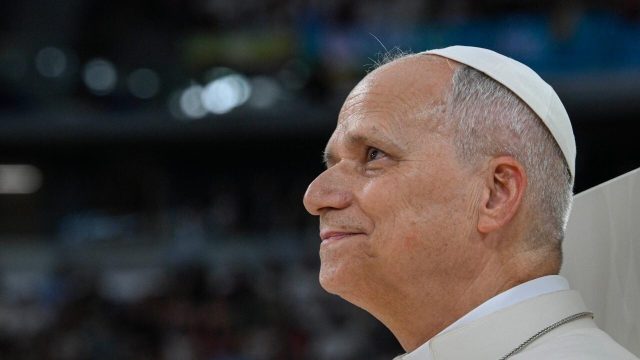
Pope Leo XIV has made six international trips, published his first encyclical, on artificial intelligence, and made changes to the Roman Curia in the 18 months since his election. He has also said he will keep in place the restrictions on the traditional Latin Mass.
He was elected on May 8, 2025, and began his pontificate with a Mass on May 18. As of November 25, 2026, he has been pope for 18 months.
Travels
His first trip was to Turkey and Lebanon, from November 27 to December 2, 2025. On March 28, 2026, he spent a few hours in Monaco, and from April 13 to 23 he toured Africa, visiting Algeria, Cameroon, Angola and Equatorial Guinea. From June 6 to 12 he was in Spain, with stops in Madrid, Barcelona, the mountain monastery of Montserrat and the Canary Islands. He visited France from September 25 to 28. He also visited San Marino on August 22.
His sixth trip, to Uruguay, Argentina and Peru, ran from November 6 to 17. In Peru he visited Lima, Chiclayo, Cusco and Pucallpa, in the Amazon. At Saqsaywamán, the Inca site above Cusco, he addressed representatives of popular devotions and told them that festivals, pilgrimages and processions "are not just cultural expressions." Meeting with Amazonian peoples, he spoke of "the cry of the earth and the cry of the poor" as inseparable.
Documents
His first major text was the apostolic exhortation Dilexi te, on love for the poor. On October 9, 2025, the Holy See released the letter in which the pope sent it to the bishops. His first encyclical, Magnifica humanitas, is dated May 15, 2026, and was presented on May 25. It deals with artificial intelligence. At the presentation, the pope said AI must be "disarmed," drawing an explicit comparison with nuclear disarmament, and called for a future of justice and human dignity that serves the common good rather than a few.
Curia appointments
The pope has made gradual changes to the Curia. He kept Cardinal Pietro Parolin as secretary of state, and Parolin continues to preside at Holy See events. One of the pope's first major appointments was Filippo Iannone as head of the Dicastery for Bishops. In 2026 he named Petar Rajič prefect of the Papal Household and Alessandra Smerilli head of the Dicastery for Promoting Integral Human Development. His most recent move came this week: on November 21 he named Bonino theologian of the Papal Household.
He has also convened the cardinals for extraordinary consistories in 2026, including one on June 26, as part of a strategy of governing with the College of Cardinals.
Traditional Latin Mass
At the in-flight press conference on the way back to Rome from Lima, a journalist asked whether he would ease the restrictions on the Latin Mass that predates the liturgical reform. "No, not for now. Traditionis custodes was a decision of Pope Francis, and we will continue to follow it," the pope said. He noted that the current rules allow bishops to grant dispensations to celebrate with the old missal.
The Society of St. Pius X responded that its objection is less to the specific restrictions than to the principle that this liturgy should be an exception requiring permission.
Abuse: listening to victims
On March 16, 2026, during an audience with the Pontifical Commission for the Protection of Minors, the pope said listening to victims can open "a credible path of hope and renewal." He said prevention should not be treated as an obligation imposed from outside but as part of the Church's mission. He praised the Memorare initiative, launched in 2023 to help local Churches, and named two areas that still need work: the link between vulnerability and abuse, and the use of technology against minors.
On November 12, in Peru, he met with six victims of abuse by clergy and Church institutions at the apostolic nunciature in Lima. Several of them were connected to the Sodalitium Christianae Vitae, a Catholic society founded in Peru. The meeting lasted more than an hour, and the pope called for justice and reparation. But some victims' organizations are demanding "deeds, not words," saying concrete action is needed and not only symbolic meetings.
Next steps
The pope is waiting for the final proposal for universal guidelines on the protection of minors, which he intends to publish after studying it. This week he is holding audiences with the Vienna Philharmonic, the Catholic Near East Welfare Association, a New York-based papal agency, bishops from Ecuador and young people from Lazio, the region around Rome. He is also issuing a message on peace as a "gift of God" and a "tireless human commitment."
Based on reporting by Juana Morales for Iglesia Noticias. This article was translated and adapted from Spanish with the help of artificial intelligence.