Pope Leo XIV asks Brazil's Shalom community to bring young people to Christ
Pope Leo XIV met about 3,000 members of the Shalom Catholic Community on its 45th anniversary and said its priority in the coming years should be helping young people encounter Jesus
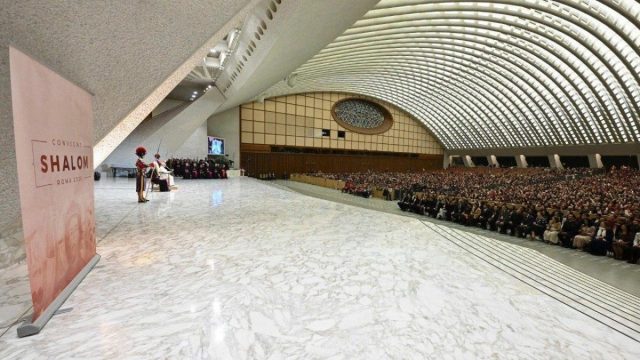
On Thursday at the Vatican, Pope Leo XIV received about 3,000 members of the Shalom Catholic Community from more than 40 countries. The audience took place in the Paul VI Audience Hall during the Convegno Internacional Shalom 2026, the community's international convention. The weeklong program runs from November 15 to 21 in Rome and Assisi and marks 45 years since the community was founded. The pope gave its members a priority mission for the coming years: to accompany young people in their personal encounter with Jesus Christ.
In his speech, which he gave in English, the pope singled out the community's founder, Moysés Louro de Azevedo Filho, and its co-founder, Emmir Nogueira, and thanked them for their dedication. He recalled that Shalom began on July 9, 1982, in Fortaleza, in the Brazilian state of Ceará, when a young man felt moved to consecrate his whole life to God. The Holy See recognized Shalom in 2007 as a private association of the faithful, affiliated with the Catholic Charismatic Renewal. It is now present in more than 160 dioceses in more than 40 countries. Its headquarters, the Diaconía General, is in Aquiraz, also in Ceará.
The spiritual meaning of Shalom
The pope said that for the community, the name Shalom, which means peace, does not refer to a program of social action or to a project of civil or political reconciliation. "It is rooted in the encounter with the Risen Jesus," he said. Just as Christ gave his disciples peace as an Easter gift, the fruit of his victory over sin and death, Shalom's members experience that peace above all as a spiritual reconciliation and a deep consolation, he said. That peace comes from the proclamation of Jesus and transforms the lives of those who accept it. "Jesus, in fact, is our peace," the pope said.
That transforming experience, the pope said, is the source of the drive to evangelize that defines the community's charism. Meeting Christ moves its members to share their joy with others and to make Jesus known "in a simple and direct way, through friendship and trust, to all those the Lord has placed on their path."
A visible identity: the tau and a life of prayer
The same experience, he said, has led them to go out to meet people, especially the young, "with openness and without fear, joyfully bearing witness to their Christian identity." They do so even through outward signs such as the tau, the T-shaped cross that expresses their belonging to Jesus and that they share with some Franciscan communities. The pope said that priests, married couples and people living celibacy for the sake of the Kingdom of Heaven share life within the community, creating a unique spiritual environment. Many people there have grown in faith and in their life of prayer, becoming instruments of peace through contemplation, unity and evangelization, he said.
The pope explicitly acknowledged the fruits of four and a half decades: the communities of life and of covenant, the evangelization centers in several countries, and vocations to the priesthood and to marriage. He also cited many initiatives of fellowship, formation and mission that have brought thousands of young people closer to Christ.
Advice for the future
Alongside that recognition, the pope offered a fundamental piece of advice: to keep their eyes fixed on Christ as the center of everything. "The charism that drew you, the community itself, those who serve as your points of reference and the spiritual method you follow have saving value only through Christ," he said. He added that the spirit of faith enables members to see what could be improved in how they act and how the community is governed. Those who have discovered their vocation through the movement, he said, must be accompanied with full respect for their freedom and their conscience. "Everything refers to him, and everything is at the service of the people we are called to accompany, to lead them to God and to the discovery of their vocation," he said.
The challenge of young people today
The pope devoted a large part of his speech to the challenge young people present. He acknowledged that young people today are very different from those of the 1980s, when the community was founded. But he said that does not mean their deepest longings have changed: they are still searching for true love, authentic beauty and God. "An immense mission field opens before you: many young people need to be accompanied toward an encounter with the Lord Jesus," he said.
He extended that responsibility to family life. Today's young people will be tomorrow's fathers and mothers, he said, and they need support to take on the task of building Christian families able to live the faith, pass it on and bear witness to it. "The Church is also counting on you, on your young people and on your families, as co-workers in the mission of evangelization in the years ahead," he said. He added that it is especially important to form all members in a mature sense of belonging to the Church and of communion with its pastors, above all those responsible for accompanying or leading others in the community.
Pilgrims' stories
Among the thousands of pilgrims who waited in the rain in St. Peter's Square to enter the Paul VI Audience Hall was Déborah Cristina de Oliveira Fernandes, a missionary from the state of Pará, in northern Brazil. The audience with the pope was one of the moments she had most looked forward to in her vocational journey. "For me, the Convention is a place of encounter: encounter with God, encounter with our brothers and sisters, encounter with the Church, of unity with the Church. It has that sense of being a family. The Shalom family, the Church family," she said. Déborah belongs to the Community of Life, whose members consecrate their entire lives to the evangelizing mission of the Shalom charism.
Her vocation grew out of a deep spiritual experience. "I discovered that God had a plan for my life and that he was calling me to go out on mission," she said. In 2022 she was sent on her first mission, to the Brazilian state of Paraíba, and since then she has served wherever the community has needed her. She currently works in pastoral ministry in Arapiraca, in the state of Alagoas.
Further back in the line to enter the Vatican was Kátia Nery, who first came into contact with Shalom in 1996, at a conference in Fortaleza. Eleven years passed before she reconnected with the community through one of its signature activities, the Youth Camp. Kátia turned to Shalom at one of the hardest times of her life. "I was badly hurt by various personal situations," she said. "The community helped me find that path again, to move from a state of guilt to a state of freedom." The experience transformed her relationship with God. "The Shalom vocation has precisely that mission: to reconcile the human heart with God. I identify with that very much, especially because of the work it does with young people and with the poorest," she said. She had taken part in earlier Shalom conventions with Pope Benedict XVI.
The rest of the day
The pope ended his speech by entrusting the community to the intercession of St. Teresa of Jesus and St. Francis of Assisi, who inspire its spirituality, and to the motherly guidance of the Virgin Mary. Before the audience, participants watched a performance of the musical "Francisco: el canto que brota de los estigmas" ("Francis: The Song That Springs From the Stigmata"), which was preceded by a time of praise. The day's program also included liturgies in St. Peter's Basilica. The community holds its international convention every five years.
Based on reporting by Almudena Buenadicha for Iglesia Noticias. This article was translated and adapted from Spanish with the help of artificial intelligence.