Pope Leo XIV cites 1986 Assisi meeting in new encyclical on peace
The encyclical Magnifica humanitas, dated May 15, 2026, draws on the legacy of the interreligious prayer gathering John Paul II convened in Assisi 40 years ago and on the teaching of the popes who followed him
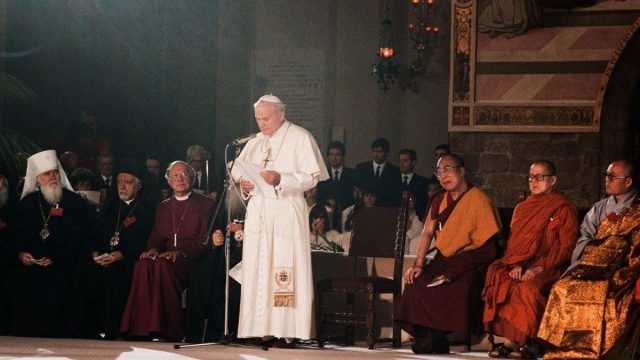
Pope Leo XIV's encyclical Magnifica humanitas, dated May 15, 2026, takes up the spirit of Assisi that John Paul II set in motion 40 years ago. In paragraph 223, Leo XIV writes that "believers can drink again from the most authentic sources of their spiritual traditions, where there is no place for sacralized hatred," referring directly to the meeting of October 27, 1986, and to the way later popes carried it forward.
That gathering brought representatives of the world's major religious traditions to Assisi, in central Italy, for a day of prayer for peace. Cardinal Roger Etchegaray, appointed by John Paul II to lead the initiative, presided over the day. Young Jews offered olive branches to Muslim leaders, Christian bishops exchanged the sign of peace in the Cathedral of San Rufino, and a rainbow broke across the sky as the morning ended. Each community prayed according to its own tradition, with no blending of rites or beliefs. Etchegaray summed up the guiding principle in John Paul II's own words: "Being together to pray, but not praying together."
Verifying the faith through encounter
On December 22, 1986, John Paul II gave a theological reading of the event to the Roman Curia. He said the Catholic Church's identity had been strengthened at Assisi because it had verified its faith in a setting of mutual respect, not because it had scored a diplomatic success. He also said the relationship with the Second Vatican Council ran both ways: the Council shed light on the meeting, but the meeting made it possible to read the Council more deeply. Four years later, in the encyclical Redemptoris missio, he linked Assisi to the work of the Holy Spirit: "Every authentic prayer is prompted by the Holy Spirit, who is mysteriously present in the heart of every person." Interreligious dialogue had a theological basis, not merely a diplomatic one.
On January 20, 2002, John Paul II returned to Assisi against a background of terrorism and the attacks of September 11, 2001. Prayer became a matter of public responsibility: religious communities had to reject violence that sought to justify itself by invoking God. "Whoever uses religion to foment violence contradicts its most authentic and deepest inspiration," he said. The meeting was not an escape from history but a responsible way of facing it.
Widening the circle and examining consciences
On October 27, 2011, for the 25th anniversary, Benedict XVI extended the invitation to people who profess no religious faith but seek truth and goodness. He called them "pilgrims of truth, pilgrims of peace." Benedict raised a further question: the image of God can be obscured by the way religions are lived. It was not enough to condemn those who used religion as an instrument; believers had to ask whether their own way of presenting the faith showed the face of a God of peace or distorted it.
On September 20, 2016, Pope Francis described the continuity in a single sentence: "On the contrary, we have prayed with one another, for one another." He ruled out syncretism and relativism and stressed the fraternal dimension. Dialogue had to give a voice to the victims of war, to refugees and to the poor. Prayer had to be matched by concrete cooperation and by efforts to attack the roots of conflict. The threat was not only fanaticism but also indifference.
Magnifica humanitas closes a cycle of reflection
In Magnifica humanitas, Leo XIV brings that 40-year legacy into the present. Religions can counter the culture of violence, he writes, not by watering down their own convictions but by returning to their most genuine origins.
Based on reporting by Almudena Buenadicha for Iglesia Noticias. This article was translated and adapted from Spanish with the help of artificial intelligence.