Congo's Cardinal Ambongo says authorities blocked youth Mass at Kinshasa stadium
Cardinal Fridolin Ambongo called it a political provocation after officials in Kinshasa, Democratic Republic of Congo, canceled a stadium Mass for young people the night before. The governor denies there was any ban
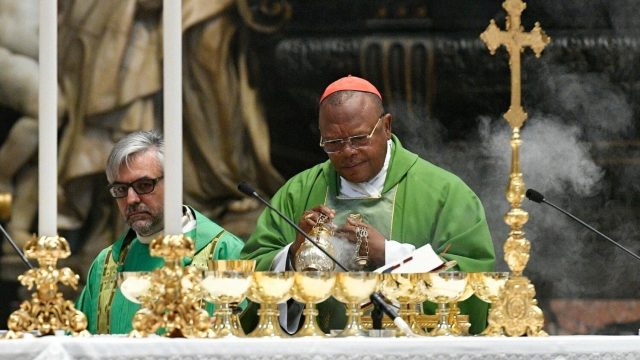
Cardinal Fridolin Ambongo, the metropolitan archbishop of Kinshasa, said on Sunday, November 22, that authorities in the capital of the Democratic Republic of Congo had stopped the Mass for the solemnity of Christ the King at the last minute. The Mass was to be held at the Tata Raphaël stadium, where thousands of young people were expected. Ambongo is a member of the Council of Cardinals, which advises Pope Leo XIV.
Ambongo called the decision a "provocation" and "a purely political decision," and asked publicly what the government had to gain by provoking the Catholic Church. He said the archdiocese had completed all the required paperwork. The Ministry of Youth had authorized it to use the stadium free of charge, and the Interior Ministry had asked the police to provide security for the event.
Despite those assurances, a member of the government, whose name has not been made public, told the organizers after 10 p.m. on Saturday that the Mass could not go ahead. The chancery received no written explanation. It said it had obtained "all the required authorizations" for an event that parishes had been announcing for weeks.
Stadium closed, Mass moved
On Sunday morning, young people arriving at the stadium found the gates locked and a large police contingent blocking the entrances. Some had been there since 7 a.m. and waited for hours without knowing whether the Mass would take place. The archdiocese then moved the Mass to the grounds of the Saint-Raphaël school in the municipality of Limete.
The stadium holds about 60,000 people and has tiered seating. The school grounds had no chairs, because nothing had been set up there. Thousands of young people still came, and the Mass took place without incident. Early on Sunday, the National Episcopal Conference of Congo (CENCO), the country's bishops' conference, posted a video on social media saying that "the Kinshasa city authority is preventing the celebration of Mass with the young people at the Tata Raphaël stadium."
Security argument rejected
Ambongo flatly rejected the security argument a minister put forward afterward, which held that the decision was needed to protect the archbishop himself. The cardinal said the official reasoning did not hold up: it assumed the stadium, where people are spread across separate sections, was riskier than the school grounds. At the school, the crowd was packed into a small space and there was no incident. "Let the government take responsibility and not hide behind false pretexts," he said.
Despite his indignation, he asked the faithful to stay calm and not give in to provocation, and said dialogue with the authorities was still possible. He said that "Christ has known worse" and framed what had happened in spiritual terms.
The governor's account
The next day, Kinshasa Governor Daniel Bumba gave an entirely different account. "There was never a ban. There was never any obstruction," he said. He attributed the change of venue to a mutual agreement between the provincial authorities and Church officials, prompted by ongoing work at the stadium. The Church's account contradicts his on every point.
Ambongo and Congolese politics
The Democratic Republic of Congo has the largest Catholic population in Africa, and Pew Research Center projections indicate that by 2070 it will have more Christians than any other country. The Church in Congo takes an active part in national debates on elections, corruption, justice and the armed conflict in the east of the country.
Ambongo has repeatedly criticized decisions by President Félix Tshisekedi's government, which has led to threats to prosecute him for sedition. In an interview with Vatican News, the cardinal suggested that the Church's independence makes the authorities uncomfortable. "They are not very happy with the way the Catholic Church operates in Congo, but let them explain to us why," he said.
Christ the King
The solemnity of Christ the King closes the liturgical year on the Sunday before the first Sunday of Advent. Ambongo chooses that day each year to gather young people for a large Mass. The 2026 diocesan youth day was the 41st, and the event is one of the pillars of the archdiocese's youth ministry.
Pope Pius XI established the solemnity in 1925 with the encyclical Quas primas, to affirm that Christ's authority transcends temporal powers.
Based on reporting by José García for Iglesia Noticias. This article was translated and adapted from Spanish with the help of artificial intelligence.