Vatican doctrine chief publishes Pope Francis' private diary, which describes encounters with the devil
Cardinal Víctor Manuel Fernández has released a book drawn from the notes Francis kept by hand from 1992 to 2024, describing mystical experiences, a spiritual crisis and three encounters with the devil
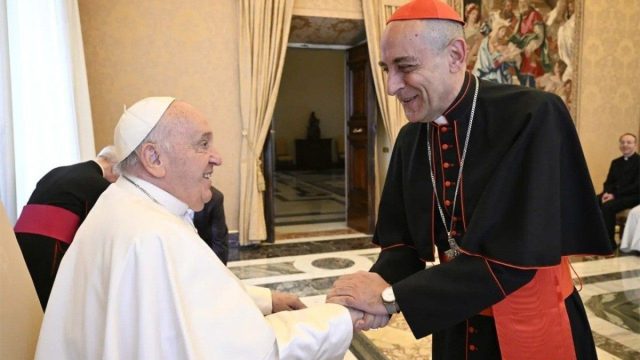
Cardinal Víctor Manuel Fernández, prefect of the Dicastery for the Doctrine of the Faith, the Vatican office responsible for Church doctrine, published a book in 94 countries this week. It collects the private notes Jorge Mario Bergoglio wrote by hand from December 1992 to August 2024. The Spanish title is "El diario personal del Papa Francisco" ("The Personal Diary of Pope Francis"). In it, Francis recounts three encounters with the devil. The first two took place in Argentina and the third in Rome, after his 2018 trip to Chile. The book costs 16 euros. Penguin Random House is publishing it in English, Spanish and Portuguese, Albin Michel in French and the Libreria Editrice Vaticana, the Vatican's publishing house, in Italian.
The original diary has 86 pages of entries written before Francis was elected pope and 55 pages written afterward. Cardinal Fernández said it contains "his feelings, his moods, his joys, his weariness, his crises, his most personal and sincere concerns." Francis wrote the most confidential passages in a code of symbols because he did not want anyone to be able to read them in the future. The cardinal has respected that wish. The 141-page book has three parts: the diary entries, with interpretation and context; an analysis of the artworks in Francis' study; and the passages Francis underlined in four books after he was elected pope. It also includes an account of a private conversation between Francis and former German Chancellor Angela Merkel.
How Cardinal Fernández came to have the diary
Fernández explained how he learned the diary existed. He and Francis were at the Casa Santa Marta, the Vatican guesthouse where Francis lived, talking privately about what to do if the pope were to lose consciousness irreversibly. Francis then pointed him to a place where he kept documents and a datebook. When Fernández opened the datebook, he saw that Francis was using it as a diary. Francis told him, "You will see what to do with this," and asked him, when the time came, to select whatever might help people "for their edification."
After Francis died and Pope Leo XIV was elected, Fernández went to the new pope to tell him about that conversation. "Who knows where that material might be, whose hands it might fall into," he said, describing his concern. Leo was curious, found the box and sent it to the cardinal so he could do the work. The pope agreed to publication but asked that sentences mentioning "confusing things about living people" be removed.
Mystical experience and an intimate relationship with God
The diary reveals the inner life of the Argentine pope for the first time. It describes encounters with the devil, a serious spiritual crisis in 2021 and 2022, mystical visions and a constant awareness of being a sinner sustained by God's mercy. One passage that particularly struck the cardinal reads: "I felt with certainty that the Lord loved me with special tenderness. It was a long moment in which the Lord showed me the love he feels for me... It seemed like a mattress that wrapped around me and saved me from disintegrating."
Francis wrote about Jesus and Mary with everyday familiarity, using phrases such as "smiled at me," "spoke to me with a look" and "I dozed off in his loving presence." His devotion centered on Our Lady of Luján, the patroness of Argentina, as well as St. Joseph and St. Thérèse of Lisieux. The biblical text that stands out most in the diary is Chapter 16 of the Book of Ezekiel. Francis got up at 4 a.m. to read the Bible and kept another copy on his nightstand for when he woke during the night.
His sense of himself as a sinner also appears in specific entries. On April 18, 2010, Francis wrote that the Lord had allowed him to see how great his wretchedness was, and added: "How shameful." On January 15, 2017, he admitted he had spent several days "in a very bad mood, full of anger and discontent." At the end of 2022 he was still reproaching himself as "the proud, self-sufficient, cynical and lying Jorge."
At other times that burden took the form of a wish to die. On August 3, 1997, he wrote, "I offered my life to the Lord," adding that this might be best so that he would stop doing harm. On March 11, 1998, he wrote: "I suggested to him that he take me so I would stop doing harm."
Encounters with the devil and dark visions
The diary describes encounters with the devil. Francis presents them as physical presences, not as ordinary temptations. In an entry dated January 24, 2021, he recalls three of these experiences. The first two happened during his years in Argentina, and the third appears to have taken place in Rome after his 2018 trip to Chile. Francis wrote that during the third appearance a voice told him: "Now I have gotten everything I wanted."
In the last entry, dated August 18, 2024, he wrote: "In a brief review of my life, I saw the moments when the devil showed himself. I cannot forget his gaze the first two times: from the car, when I was coming home, and in the choir during Mass."
He describes "threatening and, at the same time, seductive eyes," and "burning eyes" that "were like flashes of fire." He ends: "He tried to come closer and I walked away clutching the rosary in my hands, praying." Cardinal Fernández says the visions mark moments when God allowed Francis to feel called to leave superficiality behind and not lose the true direction of his mission.
A spiritual crisis and a long struggle with aridity
The diary shows a spiritual crisis that Francis places in 2021 and 2022. He describes it as a time of "aridity, desolation, a dark period." He also wrote that he often felt he had little time left to live, even when he was only 62. He did not fear death, but he found it hard to accept growing old. The diary also records that on December 24, 2009, the Buenos Aires police chief warned him of "a possible attack."
Compiling the diary and the decision to publish
Cardinal Fernández spent a year selecting the most relevant passages of the diary and writing commentary that places them in theological context. He says that opening the box and reading the diary left him deeply shaken: "I was shocked, because there was information there that I had never heard, not gossip but essential facts for understanding the person and the soul of Francis firsthand."
The book does not reproduce the diary in full, for three reasons only: some sentences are repeated, some paragraphs touch on the privacy of living people, and long sections are written in indecipherable symbols that Francis wanted kept secret. Apart from those cases, the cardinal says he included "everything worthwhile, even very provocative and destabilizing things, without hiding anything."
The book will be presented on Saturday, November 28, at 5 p.m. at the church of San Fedele in Milan, Italy, as part of the city's BookCity book festival. Cardinal Fernández will speak with Father Luigi Ciotti in a conversation moderated by Andrea Tornielli, editorial director of the Vatican's Dicastery for Communication.
Based on reporting by Javier Ruiz Arregui for Iglesia Noticias. This article was translated and adapted from Spanish with the help of artificial intelligence.