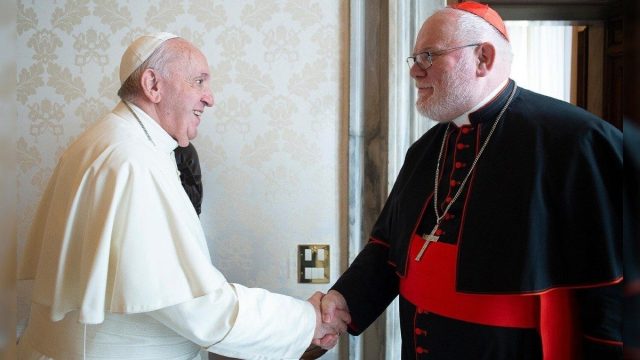
Vatican halts German diocese's plan to merge 70 parishes until new bishop takes office
The apostolic nuncio told the Diocese of Speyer, which has had no bishop since August, to suspend a plan to merge 70 parishes into nine. He said continuing the preparations would create expectations that would limit the next bishop's freedom
On November 9, the Vatican ordered the Diocese of Speyer, in Germany, to suspend its parish reorganization plan immediately. The plan would merge 70 parishes into nine units, and it must now wait until a new bishop takes canonical possession of the diocese. Archbishop Hubertus van Megen, the apostolic nuncio to Germany, sent the instruction after consulting the relevant Vatican offices. The diocese made it public on November 11.
Speyer has been without a bishop since August, when Pope Leo XIV accepted the resignation of Bishop Karl-Heinz Wiesemann for health reasons. Markus Magin, the former vicar general, is governing the diocese as administrator. He had planned to continue the preparatory work and leave legally binding decisions to the next bishop. The Vatican objected even to that partial continuation.
Canonical basis and the Vatican's concerns
Van Megen argued that moving ahead with the reorganization, even at a preparatory stage, could raise expectations that would be hard to reverse. He said it could also set off de facto changes and create commitments that would limit the incoming bishop's freedom. The legal basis is Canon 428 of the Code of Canon Law, which sets out the principle sede vacante nihil innovetur: while a see is vacant, no innovations are to be made. Van Megen said that only the diocesan bishop can create, suppress or substantially alter parishes. He added that diocesan councils cannot make binding decisions while the see is vacant.
The administrator's response
Magin complied with the instruction but said he was disappointed. He said the Vatican's decision fails to recognize the work already done and the urgency of the problems Speyer faces. The reform began in the fall of 2024 under the motto "Be a blessing." The proposal drew more than 3,500 submissions and was examined by five working groups. In June 2026, the diocesan assembly unanimously backed its basic principles, which Wiesemann had formally adopted.
Magin said continuing the preparations would not have weakened the next bishop's authority, because legal decisions had been expressly reserved to him. He said the material already produced would have given the new bishop a solid foundation. Stopping everything, he warned, risks damaging the trust of the clergy, staff and volunteers who have devoted themselves to the process for more than two years. He said he fears the next bishop will have to spend valuable time rebuilding that trust before he can address the underlying structural problems.
Structural problems
Speyer, in southwestern Germany, has about 423,000 Catholics. The diocese faces a steady decline in parishioners, a shortage of priests and increasingly tight finances. Magin argues that the current parish structure is becoming less and less sustainable. Magin said he found it hard to understand why he had not been consulted before the instruction was issued. He also said that halting a reform developed with broad local participation is incompatible with the stated commitment to listening and discerning together.
The Vatican's position and the wider context
The Vatican maintains that synodal consultation cannot take the place of the canonical responsibilities that belong to the office of bishop. In its view, the incoming bishop must be free to judge whether the reorganization is advisable. He should not face a process so far along that changing or abandoning it would carry a political cost. The Vatican distinguishes between consultation, which can guide a bishop, and the authority reserved exclusively to the diocesan bishop, which no assembly or administrator can take on.
The intervention comes as several German dioceses carry out large-scale restructurings. In January 2026, the Archdiocese of Freiburg cut its 1,048 parishes to 36. The Archdiocese of Paderborn is preparing to reorganize 603 parishes into 21 pastoral areas. The Vatican had already expressed reservations in 2020, when it opposed a plan by the Diocese of Trier to reduce 887 parishes to 35. It warned then that some of the new units could have 100,000 faithful and that rural Catholics might have to travel 80 kilometers (50 miles) or more to reach their church.
Father Fabian Schneider leads a recently merged parish in Freiburg that combines 40 former parishes and serves 36,000 Catholics. In October, he said some priests feel they have lost authority and been reduced to mere parochial vicars.
Speyer's reorganization remains on hold. The next bishop will decide its direction and pace.
Based on reporting by Lucas Alonso for Iglesia Noticias. This article was translated and adapted from Spanish with the help of artificial intelligence.