How families can prepare and bless an Advent wreath at home
Advent begins Sunday, November 29, and the Church's book of blessings allows any family member, not only a priest, to lead the blessing of the wreath at home
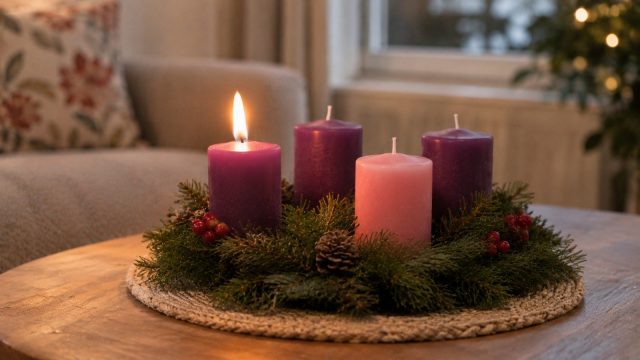
Advent begins on Sunday, November 29, with the lighting of the first candle on the Advent wreath. Under the Bendicional, the Church's book of blessings, any member of the family can lead the blessing rite at home without a priest.
The wreath is blessed and lit for the first time on Sunday, November 29, the start of the season of preparation for Christmas. It is a circle of green branches holding four candles, which are lit one at a time, a new one each Sunday. Families can carry out the whole ritual at home by following the Bendicional, the Spanish-language edition of the Church's official book of blessings, known in English as the Book of Blessings.
The wreath is a ring of green foliage with four candles spaced evenly around it. The foliage is usually pine or fir branches, though any evergreen will do. Traditionally three candles are purple and one is pink, but some families use candles of a single color "because what matters is the meaning of the wreath, not the color." Extra decorations such as pine cones, berries or a red ribbon are optional.
Symbolism and liturgical meaning
According to the Bendicional, the wreath is a sign of the joy of the season of preparation for Christmas. The light represents Christ, and the green stands for life and hope. The three purple candles are for the first, second and fourth Sundays, since purple is the color of preparation and conversion. The pink candle is lit on the third Sunday, which in 2026 falls on December 13. It is called Gaudete Sunday, from a Latin word that calls on the faithful to rejoice.
The circle has no beginning and no end, and is understood as a sign of God's eternity. As Christmas approaches, lighting the candles one by one lets the family see the light grow, a symbol of drawing closer to Christ. The Holy See includes the practice in the Directory on Popular Piety and the Liturgy, issued by the Congregation for Divine Worship. The directory devotes numbers 96 to 105 to Advent and mentions the wreath specifically in number 98.
Preparing it as a family
Ideally, the whole family makes the wreath together so the children understand what it is for. It should go somewhere visible in the house, such as the dining table, where the family can gather each Sunday. It does not call for expensive materials: green branches, four candles and, if desired, a few simple decorations are enough.
The blessing rite at home
The Bendicional provides a form for blessing the wreath specifically in the home (numbers 1238 to 1240). Where the rite refers to the "minister," that can be a priest, a deacon or a member of the family. A priest does not need to be present.
The rite opens with an invocation. The minister says, "Our help is in the name of the Lord," and the others respond, "Who made heaven and earth." A brief introduction and a short Scripture reading follow. In the home rite, the reading is Isaiah 60:1. Then comes the prayer of blessing, which begins: "The earth, Lord, rejoices in these days, and your Church overflows with joy before your Son, the Lord." All respond, "Amen." The rite ends with the lighting of that week's candle.
Those who would rather have the wreath blessed in their parish can do so at Mass. The Bendicional allows the blessing at the start of the celebration, after the opening greeting, in place of the penitential act.
The lighting schedule
On the first Sunday, November 29, the wreath is blessed and the first candle is lit. Two candles are lit on December 6, three on December 13 with the pink Gaudete candle, and all four on December 20, the fourth Sunday. This year Christmas falls on a Friday, December 25.
By custom, the family gathers around the wreath, lights the week's candle and says a short prayer, along with a Bible reading, a hymn or a brief reflection. The task can be shared so that a different person leads each Sunday, children included. The candles are put out when the prayer ends and lit again at the next one.
Based on reporting by Almudena Buenadicha for Iglesia Noticias. This article was translated and adapted from Spanish with the help of artificial intelligence.