Priest in Venice publishes book on faith after the loss of a child
Father Roberto Donadoni, pastor of the Marcian community in Venice, has published "Dentro la ferita," a book drawn from years of pastoral accompaniment of parents who have lost a child, with a prologue by the patriarch of Venice
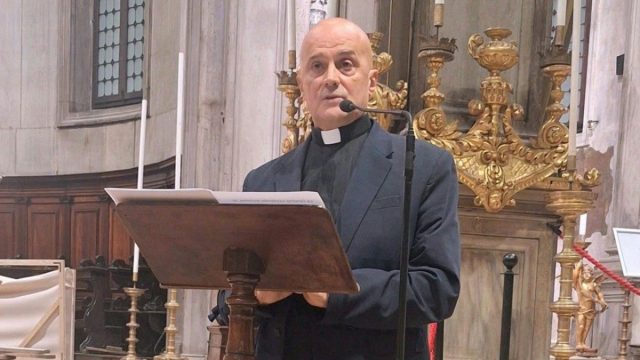
Father Roberto Donadoni, a priest from Bergamo in northern Italy, is pastor of the Marcian community in the historic center of Venice. He has published "Dentro la ferita" (Marcianum Press, 192 pages), a book that grew out of years of pastoral accompaniment of mothers and fathers who have lost a child. The book avoids easy consolation and theories about suffering. It works instead through the deepest parts of Christian experience to show that faith does not erase tears, but does keep them from turning into despair.
The book was presented at the church of San Salvador in Venice. Father Luigi Ciotti, founder of the Italian associations Libera and Gruppo Abele, and Gian Guido Vecchi, Vatican correspondent for the Italian daily Corriere della Sera, took part. The evening also included music from the Ensemble Orchestra del Concentus Musicus Patavinus, conducted by Matteo Boischio.
The patriarch's prologue: faith that protects in grief
The prologue is by the patriarch of Venice, Francesco Moraglia, who writes that Christian hope does not consist in removing suffering but in the certainty that grief is not inhabited by emptiness or by the absence of meaning. Christ did not come to explain human suffering in theory, Moraglia writes, but to pass through it and to save people from it.
"The cross of the Lord does not erase wounds, but it keeps them from becoming a place of absolute solitude," the patriarch writes. For Moraglia, faith is not the opposite of grief but the space in which grief is not left to itself: a faith that does not claim to understand, but chooses to stay.
Ciotti: turning grief into love
Over his career, Ciotti has supported many families whose children died through drugs, the mafia or violence. He spoke about the tendency of society today to hide suffering and to numb it, as though it were a disease to be eradicated rather than a part of life that reaches everyone in one way or another.
Grief is not overcome, Ciotti said, but it can be turned into love for others, provided a person first has the courage to live inside it without running away, to remain inside the wound. "The greatest task," he said, is to make sure that no one has to face suffering alone.
Parents who walk in hope
Marina Vianello, who coordinates the group of parents Donadoni works with, said the priest has walked alongside them for many years and has helped them understand that going on living does not mean forgetting. It means learning to carry with them their love for the children they lost, while holding on to the hope of meeting them again.
Vianello said the pain cannot be erased and that death has changed their lives for good, but that the life that remains is still a life that asks to be lived, supported and loved.
The wound as a place of hope
Donadoni thanked those same parents, whom he called the real authors of the book. "Without them, the book would never have been possible," he said. They have taught him, he said, that faith can guard a hope that refuses to go out, even inside the wound.
Donadoni said the greatest task is to make sure no one faces suffering alone. He closed by saying that living after the loss of a child is possible. "Inside the wound," he said, "a greater hope is born."
Based on reporting by Laura Clavería for Iglesia Noticias. This article was translated and adapted from Spanish with the help of artificial intelligence.