Pope Leo XIV calls for an end to war at All Souls Mass in a Rome cemetery
At Mass for the Commemoration of All the Faithful Departed at Rome's Verano cemetery on November 2, the pope said faith in Christ transforms the bond between the living and the dead, and appealed to those with the power to end armed conflicts
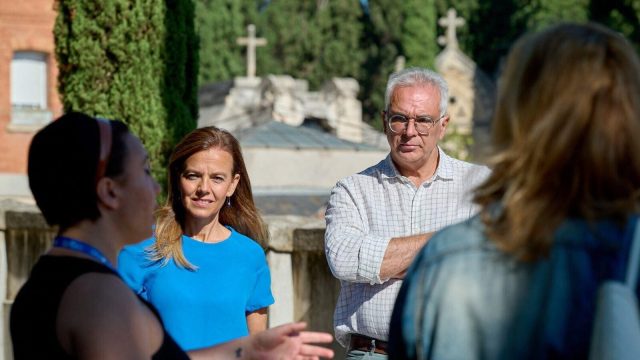
Pope Leo XIV celebrated Mass for the Commemoration of All the Faithful Departed on Monday, November 2, at the monumental Verano cemetery in Rome, taking up a tradition St. John Paul II began in the late 1970s and that Leo XIV himself followed last year. About 1,500 people attended, according to Holy See figures. The altar was set up on the cemetery's main avenue, flanked by a row of tombs.
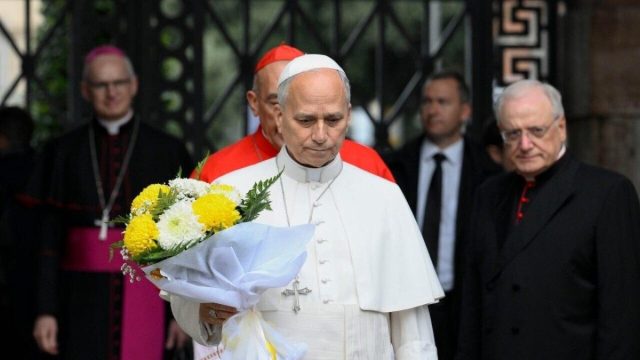
On arriving, the pope laid a bouquet of white and yellow roses on the marble slab of a tomb chosen at random, that of an Italian family bearing the name Antonia Coccia Nicolini. Wearing purple vestments, a sign of penance, prayer and hope in the Resurrection, Leo XIV began his homily by recalling why those present had come: "We have gathered to celebrate the Eucharist in this place of prayer and remembrance, of affection and hope."
Faith transforms the bond with the dead
The pope gave much of his homily to the Gospel of the Beatitudes, which he called the "self-portrait of Jesus" and the path to a fully realized life, on earth and in eternity. That message takes on a particular resonance in a cemetery, he said, describing it as "a threshold between the here and the hereafter, between earthly existence and what awaits us afterward."
"Faith in Christ tells us that our bond with the faithful departed is not broken, but transformed," he said. Prayers of suffrage accompany loved ones toward full communion with the Lord, he said, a communion believers already anticipate in the sacrament of the Eucharist.
Grounded in Scripture
Leo XIV based that hope on several biblical texts. From the Book of Wisdom he recalled that the souls of the just are safe in the hands of the Lord and that no torment will touch them. From the Book of Revelation he took the promise that God will dwell with his people forever: "They will be his peoples and he will be God with them, their God." He also recalled the Good Shepherd's assurance that no one will snatch his sheep out of his hand.
An appeal to those who can stop the violence
One beatitude stood at the center of the homily: "Blessed are those who mourn, for they shall be comforted." From that beatitude, the pope turned his thoughts to those who have recently lost a loved one, and in particular to those whose loved one was taken by the absurd violence of war.
"At this moment we want to pray for those who have recently lost a loved one; in particular, for those whose loved one has been taken from them by the absurd violence of war," he said. He then renewed his appeal for peace: "May the tears of so many mothers, so many children, so many elderly people touch the consciences of those who have the power to silence the weapons!"
St. Francis and bodily death
Marking the eighth centenary of the death of St. Francis of Assisi, Leo XIV recalled the passage the saint added to the Canticle of the Creatures when he understood that his end was near. In it the saint praised God for "our sister bodily death" and called blessed those who die doing God's will, because "the second death will do them no harm."
A line of papal custom
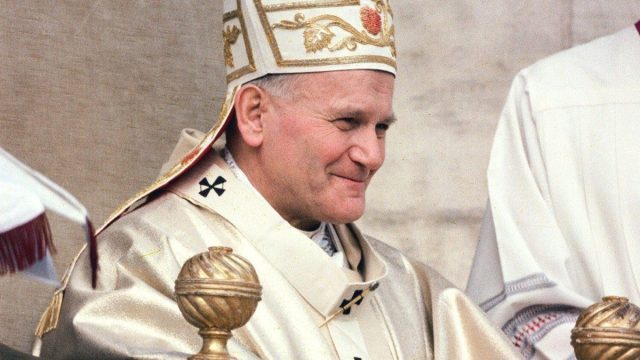
The Verano celebration follows a line of papal custom. John Paul II visited the same cemetery 12 times for the Commemoration of All the Faithful Departed. Benedict XVI chose instead to celebrate the Mass in the Basilica of St. Lawrence Outside the Walls, next to the cemetery, without walking among the graves. Francis presided at the Mass for the dead in various Roman cemeteries throughout his pontificate. Leo XIV did the same last year.
Doctrinal background: the Magisterium and popular piety
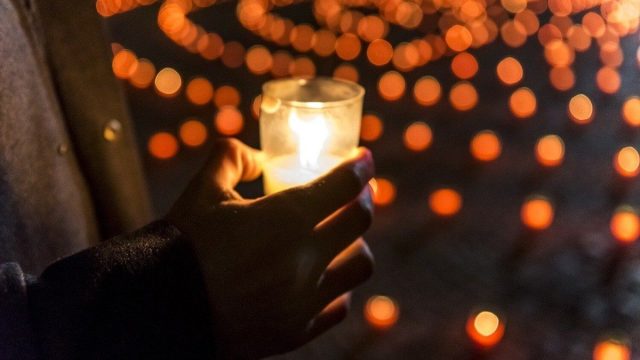
The visit to Verano is in line with the teaching the Congregation for Divine Worship and the Discipline of the Sacraments set out in the Directory on Popular Piety and the Liturgy, published in December 2001. That document states that visits to the cemetery, including cleaning graves, placing flowers and lighting candles, are neither superstitions nor mere social routine. They are expressions of faith and of communion between the living and the dead, provided they are joined to prayer and to suffrages for the deceased.
No. 260 of the Directory says care for the grave takes on its full meaning when it is joined to prayer. Flowers express grateful remembrance and paschal hope, lights recall the light of Christ, and prayer, the psalm De profundis, the Requiem aeternam or the Holy Rosary, raises intercession for eternal rest. The document also warns that these practices should not become "the expression of an obligation that one fears to neglect out of a kind of superstitious fear."
Nos. 256 and 257 of the same text say popular piety toward the dead should be formed in the principles of the Christian faith, particularly in the paschal meaning of death and in the certainty that union with those who have departed "is in no way interrupted." No. 258 calls for that religiosity to be purified of anything that could turn it toward a pagan cult of ancestors or toward a denial of the immortality of the soul.
Coming days
The pope is also scheduled to preside on Thursday, November 5, at a Mass in St. Peter's Basilica for the cardinals and bishops who died over the past year. It will take place the day before he leaves on an apostolic journey to Uruguay, Argentina and Peru.
Based on reporting by Almudena Rodrigo for Iglesia Noticias. This article was translated and adapted from Spanish with the help of artificial intelligence.