Pope Leo XIV says praying for the dead 'means celebrating life'
At a Mass in St. Peter's Basilica for cardinals and bishops who died over the past year, Pope Leo XIV preached on the resurrection, the communion of saints and the Church's practice of prayer for the dead
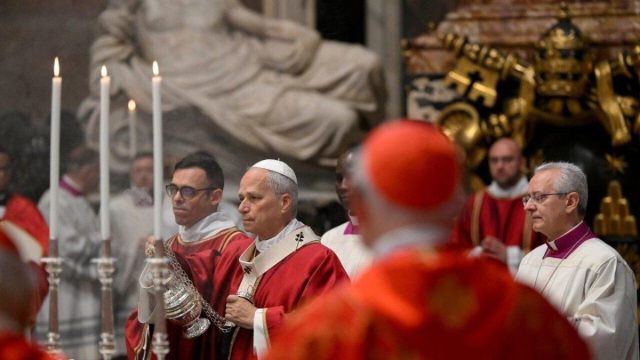
In a homily at St. Peter's Basilica on Thursday, Pope Leo XIV spoke about Christian hope in the resurrection and the communion of saints, reflecting on the spiritual meaning of death and on prayer for the dead. He began with the words of Jesus in the Gospel of John: "Whoever serves me must follow me, and where I am, there will my servant be also" (Jn 12:26).
Following Christ through the cross
The pope said that following Jesus requires taking "the path of glory through the cross." Those who follow Christ become his servants and remain united to him, above all in trials and suffering. To support this teaching, the pope turned to the apostle Paul: "If we have died with him, we will also live with him" (2 Tm 2:11).
The homily came at a Mass offered for cardinals and bishops who died over the past year. The pope presented prayer for the dead not as an isolated gesture but as an expression of the "certainty of faith and hope" that animates the entire life of the Church.
The spiritual value of remembrance
The pope reflected on the place of memory in the Christian tradition, citing the words of St. Monica, the mother of St. Augustine, spoken shortly before her death: "All I ask of you is that you remember me at the altar of the Lord, wherever you may be" (St. Augustine, Confessions, IX, 11, 27).
The pope said the mystery of death is closely bound to prayer for the dead, a practice that the Church, "from its origins, has always practiced as one of its fundamental duties."
The resurrection as the foundation of hope
The pope examined two doctrinal truths that give meaning to prayer for the dead: hope in the resurrection and the communion of saints. He drew on the account of Judas Maccabeus (2 Mc 12:43-46), in which the Jewish leader offers an expiatory sacrifice for companions who fell in battle, basing his act "on the certainty that the communion among us lived on earth, even when marked by limits and faults, is not weakened if it is placed in the hands of God."
That gesture, the pope said, was "an act of faith, because he offered his sacrifice with the firm hope that the dead would rise again." In the light of the risen Christ, the Church also prays for its dead "by virtue of this great hope that has been given to us in the paschal mystery."
The pope cited the apostle Paul's exhortation, delivered with "urgent zeal": "If there is no resurrection, then Christ has not been raised! And if Christ has not been raised, then our preaching is in vain and your faith is in vain too" (1 Cor 15:13-14). Prayer for the dead, he said, makes no sense if it is cut off from the promise of the resurrection.
The Eucharist as paschal memorial
The pope said that "to pray in suffrage for the dead means to celebrate life": the risen life of Christ and, by his grace, the life of all the baptized who rise in him. He presented the eucharistic sacrifice as "the memorial of his Passover, through which he saved us by giving himself for us."
The pope asked that "the memory of the dead not be reduced to mere nostalgia" but be considered in the light of faith. He recalled the words of Jesus in the Gospel of John: "the Lord is alive, he awaits us and has already prepared a place for us in his Father's house" (cf. Jn 14:2-3).
The communion of saints
One of the central ideas of the homily was that "when we pray for the dead, we do so not only for them, but also with them," in a reciprocity given life by the Holy Spirit. The Church, the pope said, is a "mystery of communion between Christ, the head, and us, his members; from him we receive life."
That communion unites "the blessed spirits who already contemplate the face of God" with all those who, in heaven or on earth, are moving toward "the luminous goal."
Bonds transformed in Christ
The pope closed with a theological statement: "In Christ death does not undo bonds, but transfigures them into a new dimension, which is understood only in the mystery of his love given to the end on the cross and poured out after the paschal victory."
He encouraged the faithful to guard this communion by receiving in the Eucharist "the charity of the Risen Lord," so that when their hour comes they may "receive the suffrages of their pilgrim brothers and sisters and rejoice with all the saints in the joy of the heavenly homeland."
Based on reporting by Almudena Buenadicha for Iglesia Noticias. This article was translated and adapted from Spanish with the help of artificial intelligence.