Pope Leo XIV says God's justice rescues the oppressed and proclaims mercy
At the Angelus on the solemnity of Christ the King, the pope drew on Jesus' words in Matthew 25 to describe divine justice and said the Last Judgment is salvation
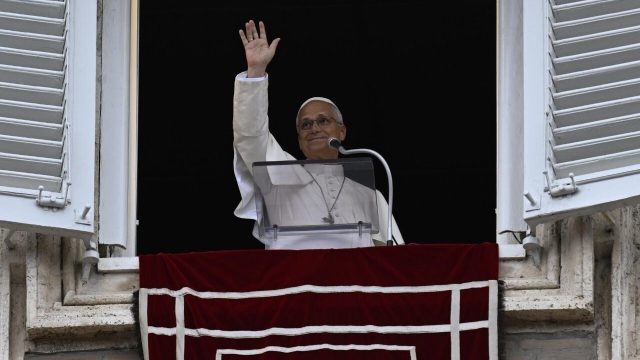
Pope Leo XIV led the Angelus on Sunday, November 22, the solemnity of Our Lord Jesus Christ, King of the Universe, from the window of the Apostolic Palace overlooking St. Peter's Square. In his reflection before the prayer, he spoke about Christ's kingship as the foundation of justice, mercy and salvation for all peoples. He described the Lord's justice as the rescue of the oppressed and the proclamation of mercy.
The reflection centered on Chapter 25 of the Gospel of Matthew, in which Jesus describes the Last Judgment of the righteous and of sinners. The pope said Christ reveals the true meaning of justice through a dialogue that leaves no one out. "Christ is the criterion of justice because he is the author of salvation," he said. He added that in Christ the truth is revealed against every form of corruption.
Four dimensions of justice
The pope set out four specific dimensions of justice, drawing on Jesus' own words. The first sustains life: "I was hungry and you gave me food." The second forms a bond of fraternity among peoples: "I was a stranger and you welcomed me." The third promotes human dignity: "I was naked and you clothed me." The fourth heals freedom: "I was in prison and you came to visit me." The pope said this message holds for all times and all peoples, because everyone is equal before God's law.
The true nature of kingship
The pope also explained the nature of Christ's kingship. "The one who speaks to us is not a despot who threatens, nor a tyrant who crushes with his power; he is the true King, who in his omnipotence rescues us; he is the true man, a Master in humanity," he said. The Son, he said, raises peoples from the dust of passing time and calls them to a new life. In that work he is identical to the Father, who gives existence to everything out of nothing and gives it life through his Holy Spirit, revealing the justice of the one God.
Judgment as salvation
The pope presented the Last Judgment not as a sentence of condemnation but as the horizon of salvation toward which all of history points. "This judgment is salvation. The word God speaks to the world is a proclamation of mercy: it is his Word made man for us, Jesus Christ," he said. He warned that the same judgment also means the condemnation of all wickedness, and cited Jesus: "What you did not do for one of these least ones, you did not do for me."
For that reason, he said, the King of the universe takes the side of the least and the oppressed to free them from every evil. The pope also recalled the origin of the solemnity. His predecessor Pius XI instituted it at a time shaken by tensions and conflicts, to proclaim that the Lord of history is King of peace and justice for all the peoples of the world.
The pope's appeals
After the Angelus, the pope turned his thoughts to the people of Papua New Guinea and other Pacific countries hit by drought, and expressed his closeness to those suffering through the emergency. He asked for prayers for the victims of the many armed conflicts that continue to cause death and suffering around the world, and for those responsible for opening paths to reconciliation and peace.
He noted that churches around the world were celebrating World Youth Day that Sunday under the theme "Take courage, I have overcome," the theme of the international gathering scheduled for August next year in Seoul, South Korea. He encouraged young people to embrace the meekness and humility of Christ, saying the King's victory is not a worldly one. The pope greeted the pilgrims in the square, including groups from Ireland and the United States, as well as companions from the Monastery of San Lorenzo de El Escorial, near Madrid in Spain.
He said that at midday he would have lunch with about 1,300 poor people at the Vatican. The meal had been postponed from an earlier date because of his apostolic journey to Latin America. He said he hoped it would be a sign of an everyday habit of fraternal sharing that leaves no one alone in need.
Based on reporting by Juana Morales for Iglesia Noticias. This article was translated and adapted from Spanish with the help of artificial intelligence.