John Paul II's words at Madrid's Almudena cemetery recalled ahead of All Souls' Day
On November 2, 1982, during his first visit to Spain, Pope John Paul II spoke at the Almudena cemetery in Madrid about the memory of the dead, prayer for them and the Christian hope of eternal life
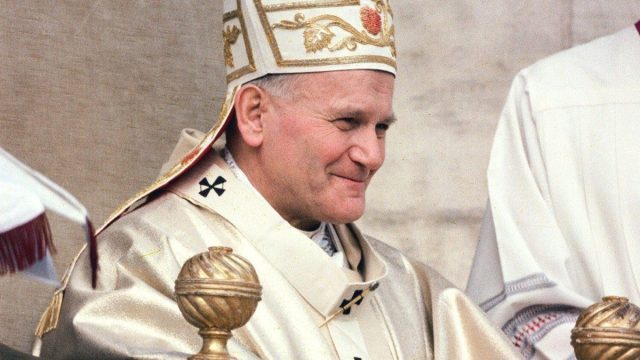
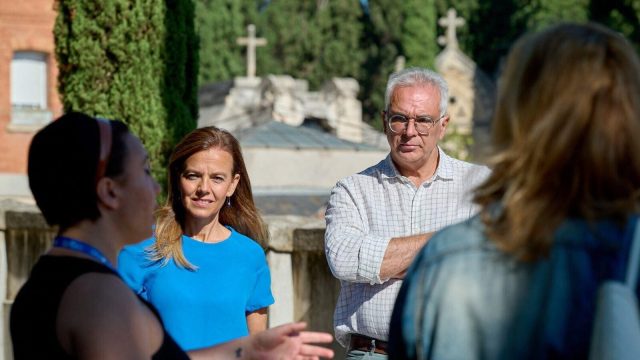
On November 2, 1982, Pope John Paul II was at the cemetery of Nuestra Señora de la Almudena in Madrid during his first apostolic visit to Spain. Speaking to the faithful gathered for the commemoration of All Souls, he devoted his remarks to the memory of the dead, and in particular to the parents and relatives who had shaped the lives of those present.
Nearly 44 years later, with All Saints' Day and All Souls' Day approaching, the text records how John Paul II spoke about the absence of loved ones and the Christian hope of eternal life.
The return of the dead in memory
Rather than opening with an abstract reflection on death, John Paul II addressed those who had relatives buried in the Madrid cemetery and invited them to remember the people who had marked their lives.
He recalled parents and relatives who had died, and whose memory returns particularly during visits to cemeteries.
"They return at this moment to the memory of each one, emerging from the past, as if wishing to resume a dialogue that death abruptly interrupted," he said.
The pope pointed to a deeply human experience: the memory of those who are no longer present and the desire to recover the conversations and the moments shared with them.
A communion that remains beyond death
John Paul II described the cemetery as a meeting place for the living and the dead. There, he said, an assembly was formed in which the living met their dead and strengthened the bonds of a communion that death had not been able to break.
He linked that memory to one of the central teachings of Christianity: the resurrection of Jesus Christ and the hope of eternal life.
To explain that conviction, he recalled the announcement made beside the empty tomb of Jesus on Easter morning and the words of St. Paul on Christians sharing in the death and resurrection of Christ. On that basis, he presented the spiritual bond between the living and the dead as grounded in Christian faith, and not only as a sentimental memory.
Sadness and hope in the cemetery
John Paul II also spoke of the sadness that accompanies the memory of the dead.
He acknowledged the longing caused by the visible absence of loved ones, and set it alongside the Christian hope of their final encounter with God. Even in a cemetery, he said, Christians could sing the Alleluia as an expression of Christ's victory over death.
He did not present religious hope as a denial of human suffering, but as a conviction that stays with the believer in the midst of loss.
Prayer for the dead
The last part of his remarks was devoted to the importance of praying for the dead, a practice closely tied to the liturgical commemoration of November 2.
John Paul II said that everyone shares in the frailty of the human condition, and that prayer for the dead responds both to a conviction of faith and to affection for those who have died. He presented that prayer as spiritual help offered to the dead, in line with Catholic teaching on purification after death.
He announced that the Eucharist would be offered for those buried in the Almudena cemetery, and extended the prayer to the dead in other cemeteries in Madrid, in Spain and around the world.
A message from the first apostolic visit to Spain
The remarks were delivered during John Paul II's first apostolic visit to Spain, which ran from October 31 to November 9, 1982. He spoke at the Almudena cemetery in Madrid on the commemoration of All Souls.
The text is preserved in full in the official archive of the Holy See.