
Pope Leo XIV cites St. Josemaría Escrivá's canonization homily in catechesis on work
At his general audience in St. Peter's Square, Pope Leo XIV quoted John Paul II's 2002 canonization homily for the founder of Opus Dei, a saint Pope Francis did not cite in any encyclical or apostolic exhortation
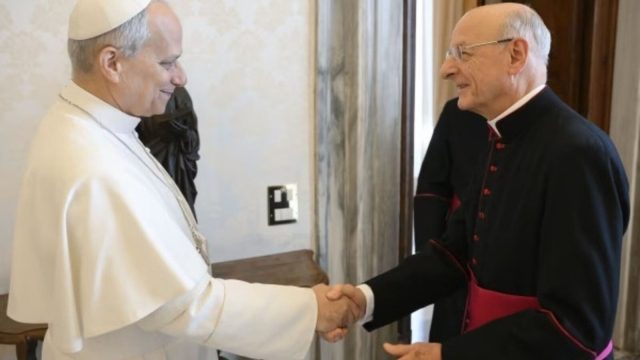
Pope Leo XIV said at his general audience in St. Peter's Square on Wednesday that people do not need to abandon their earthly occupations to find God, and that a person can live out his vocation fully "by doing his daily work well and sanctifying it."
The phrase comes from the homily St. John Paul II gave on October 6, 2002, at the canonization of St. Josemaría Escrivá de Balaguer. The reference appears as a note in the official text of the catechesis published by the Holy See.
Absent from Francis's documents
In 12 years, Francis did not cite St. Josemaría in any of his encyclicals or apostolic exhortations, not even in those that dealt directly with his message.
In Gaudete et exsultate (2018), his exhortation on the call to holiness in today's world, Francis defended holiness in ordinary life and popularized the expression "the saints next door," the same insight Escrivá preached from 1928. He did not mention him in Laudato si' (2015), which devotes a specific section to the value of work, or in Evangelii gaudium (2013), his programmatic document on the mission of all the baptized.
In an interview with the Italian daily Avvenire when Gaudete et exsultate was published, the prelate of Opus Dei, Fernando Ocáriz, was asked about the exhortation's close resemblance at many points to the founder's teaching. Francis also reformed Opus Dei's legal structure in 2022.
A saint to explain the Council
The pope used the citation to explain the Second Vatican Council. It came in his series of catecheses on the conciliar documents, devoted this time to the third chapter of the pastoral constitution Gaudium et spes, on the meaning of human activity in the world.
The pope began by recalling the moon landing in July 1969, less than four years after the close of the Council. From there he asked what value work and technical, social and scientific progress have.
The pope rejected the idea that such progress weakens a person's relationship with God or runs counter to faith. He warned that post-Christian humanisms wrongly present God and the human being as rivals, and that denying the relationship with God also ends in the loss of the transcendent value of the person. Citing the Council, he said human achievements are a sign of God's greatness and the fruit of his design.
The pope also linked human work to the Eucharist: bread and wine, fruit of the earth and of human work, are placed on the altar each day to be transformed into the Body and Blood of Christ. Work, he said, is not foreign to the life of faith but a path toward God. At that point he introduced the quotation from Escrivá's canonization.
Continuity with John Paul II
In that 2002 homily, John Paul II presented Escrivá as the saint of ordinary life. The anniversary of the canonization falls on October 6.
At the end of the catechesis, the pope called for sharing knowledge and know-how so that all peoples can develop their potential and build a better future together. He also made an appeal for the World Day of Migrants and Refugees, which falls on Sunday, September 27, with particular attention to children forced to leave their homeland.


