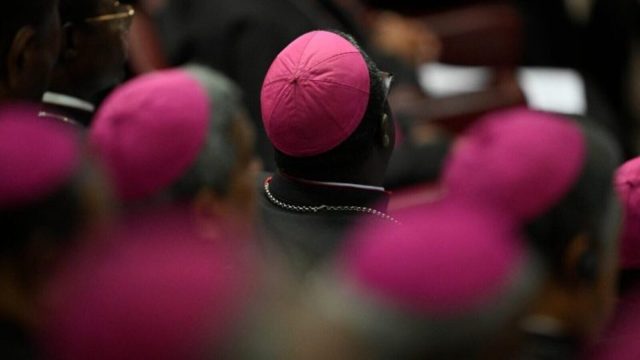
Pope Leo XIV tells Panama's bishops to stay close to the most vulnerable
Panama's bishops met Pope Leo XIV at the Vatican for their ad limina visit and reported on earthquake relief, migration and clergy burnout. They also moved forward the canonization causes of two priests
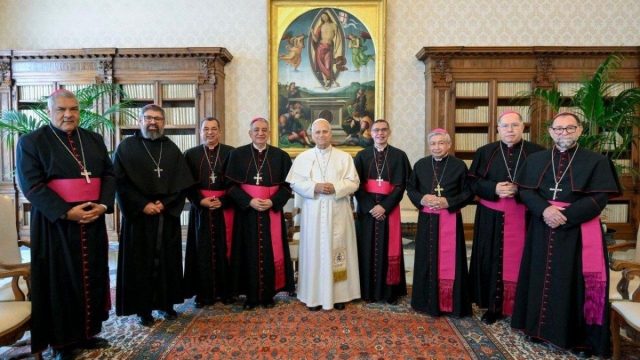
Pope Leo XIV received the bishops of Panama this week for their ad limina apostolorum visit, the periodic trip bishops make to Rome to report on their dioceses. He raised three themes with them: dialogue as a way of building society, priority care for the most vulnerable, and strengthening trust in God as the foundation of the Church's mission.
Archbishop José Domingo Ulloa, president of the Panamanian Bishops' Conference (CEP), the country's counterpart of the USCCB, called the meeting a "wonderful experience" in remarks to Vatican News. Ulloa said the bishops were able to pass on the affection and prayers of the Church in Panama, at a time when the pope's health had caused concern in the preceding days.
Earthquake response and social ministry
The pope asked the bishops to act as bridge builders in Panama, to promote dialogue and to remain close to those most in need of support. He expressed his solidarity with the communities affected by the earthquake that struck the country and asked that his prayers and closeness be conveyed to the population, especially in the worst-hit areas. He thanked the Panamanian people for their response, and the Church's social ministry and Caritas for their work on behalf of those affected.
Faced with the material damage caused by the quake, Church bodies mobilized resources through their social ministry offices and the diocesan Caritas organizations. Ulloa said many individuals, anonymous benefactors and companies have chosen to channel their donations through this Church network, which operates across the country.
Migration and family life
The bishops also discussed the situation of Panamanian families, especially those facing economic hardship, unemployment and poverty. Ulloa said one of the main pastoral challenges is helping families recognize the value and the richness of their vocation even when circumstances are against them. The Church's mission cannot be limited to preparing couples for the sacrament of marriage, he said; it has to include formation and accompaniment in love over time.
Ulloa also raised the Church's care for migrants. In recent years Panama received flows of people from Colombia, Venezuela and Ecuador, but the pattern has changed and more migrant families are considering settling in the country permanently. That shift calls for a renewal of the ministry for human mobility, with support that addresses not only the immediate needs of new arrivals but also their integration and settling in.
Care for creation
The bishops told the pope about their work on care for creation. Ulloa said the Church in Panama has joined ecumenical initiatives to mark the Day of Creation with the celebration of the Eucharist and with activities on the responsibility to care for the common home.
Progress on canonization causes
The bishops' visits to the Vatican dicasteries also produced news about two priests who have left a mark on the history of the Church in Panama. At the meeting with the Dicastery for the Causes of Saints, the delegation obtained the nihil obstat to open the process for Father Guillermo Sosa, remembered for his missionary and pastoral work in rural communities. The step is a Church authorization to proceed with the process and does not yet involve any declaration of holiness.
The Panamanian Bishops' Conference also spoke with the dicastery about a possible cause for Father Jesús Héctor Gallego Herrera, presenting material on his life and witness. Born in Colombia, Gallego arrived in Panama in 1967 and worked among the farming communities of Santa Fe, in the province of Veraguas. He devoted himself to organizing rural workers and defending the poorest.
On the night of June 9, 1971, he was disappeared in circumstances linked to the repression of the period. His whereabouts are still unknown. Ulloa said the Church has kept asking what happened to him and has not let the question be forgotten. He said Gallego's legacy was bound up with the option for the poorest and with a way of living the Gospel rooted in concrete reality.
Emotional strain on the clergy
The challenges facing the Church also include the overall care of priests themselves. In July 2026, the Archdiocese of Panama surveyed 61 priests anonymously using the Maslach Burnout Inventory. The survey was part of a joint project with the Universidad Católica Santa María La Antigua and the digitalization company FUTUVER, aimed at preventing emotional burnout among the clergy and strengthening pastoral work.
The results were described as a warning sign about the situation priests are living through, though the full report with all its indicators would be needed to know the precise scope of the findings.