Pope Leo XIV opens 12-day Latin America trip in Uruguay, the region's least Catholic country
The pope lands in Montevideo on November 6 for a stay of less than 48 hours that takes him to Paysandú, the Borro neighborhood of Montevideo and the city of Florida, in a country where about 38 percent of people call themselves Catholic
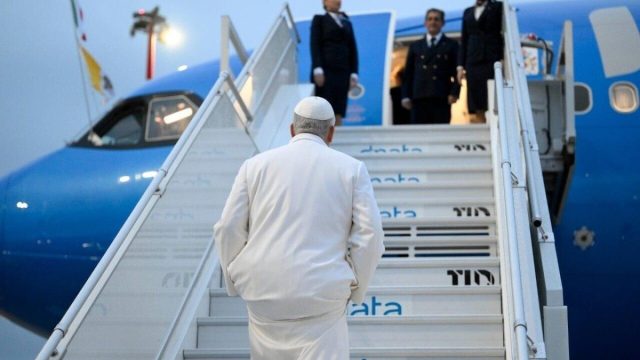
Pope Leo XIV will begin a 12-day, nearly 19,000-mile trip through Latin America on November 6, starting in Uruguay, the country with the smallest Catholic presence in the region. Only St. John Paul II had visited Uruguay before, twice: two days in 1987 and four in 1988. Leo XIV will stay less than 48 hours, but his schedule takes in several settings that show the country's social and religious situation.
Uruguay and secularization
Uruguay has 3.4 million people, and close to two million of them live in Montevideo, where the pope will stay at the apostolic nunciature. It is one of the most secularized countries in Latin America: about 38 percent of citizens identify as Catholic and 44 percent as Christian, while more than 50 percent profess no religion. The regional polling firm Latinobarómetro puts the share who identify as Catholic even lower, at 33 percent, against a regional average of 54 percent.
The decline has been steady. In 1997, 60 percent of the population was Catholic. Vatican statistics for 1980 to 2024 record 41,673 baptisms in 1980 and 11,066 in 2024. The most recent Church figures, from 2025, show that only 2,200 of the 30,000 children born that year were baptized. Catholic marriages fell from 8,673 in 1980 to 1,649 in 2024.
Only 42 percent of Uruguayans say they trust the Church, compared with 63 percent across Latin America. The Uruguayan bishops have reflected on the decline and said that, after more than a century of secularized culture, "religion is banned in public schools" and "religious ignorance is frequent."
The theme of the visit
The theme chosen for the visit is "Les Anuncio Una Gran Alegría" (I bring you news of great joy), taken from the angel's announcement to the shepherds in Bethlehem (Lk 2:10). The official logo shows Christ crucified and risen, flanked by Leo XIV and Our Lady of the Thirty-Three, the patroness of Uruguay. Above them is the sun, based on the "Sol de Mayo," a symbol of Uruguayan national identity, and the blue recalls the country's flag.
Itinerary: from Paysandú to Casavalle
The pope will leave Rome at 7 a.m. Friday and, after a flight of more than 13 hours, land at Carrasco International Airport in Montevideo at 4:30 p.m. local time. President Yamandú Orsi will greet him there. He will then go to Plaza Independencia for the welcome ceremony, then to the Metropolitan Cathedral Basilica of the Immaculate Conception and Saints Philip and James. There he will lead vespers with bishops, priests, deacons, consecrated men and women and seminarians.
On the morning of Saturday, November 7, Leo XIV will fly to Paysandú, a city in western Uruguay on the Uruguay River. He will be the first pope to visit the city, where he will celebrate Mass in Parque París Londres. Many Argentines are expected to join Uruguayans at the Mass. That afternoon, back in Montevideo, the pope will meet the Augustinians who work in the country.
The parish in Casavalle
Leo XIV will then travel to the Borro neighborhood in the north of the capital to meet the Casavalle community at the parish of Our Lady of Guadalupe. The parish is an exception in Uruguay: more than 50 people of all ages attend the daily evening Mass, more than at the cathedral in central Montevideo. The pews fill at Sunday Masses, and parishioners take part in numerous parish initiatives.
"What you see is the fruit of our work. A systematic, organized pastoral plan that has brought many people to the life of faith," said the pastor, Father Pablo Coimbra, who has led the parish for five years. Coimbra arrived as the COVID-19 pandemic was easing and built up the existing ministries while adding new ones. One parishioner, Cecica Gómez, 47, put it this way: "Father Coimbra doesn't like us to praise him, but he has prompted many good things. I was a drug addict, but he and the parish took me in and helped me turn things around for me and my two daughters."
Social programs in the neighborhood
The parish hosts Alcoholics Anonymous and Narcotics Anonymous meetings and runs programs for people with legal problems stemming from crime, including former prisoners. It works with the Missionaries of Charity to run a school and offers educational and sports activities, especially soccer. According to Coimbra, more than 15 religious congregations or Church-linked organizations operate in Casavalle.
The parish provides a daily meal to those who need it and helps support a soup kitchen that serves three meals a day. On housing, the Mejores Hogares (Better Homes) program has improved at least 60 houses, replacing roofs and electrical wiring and in many cases adding indoor plumbing.
The Vivienda Digna (Decent Housing) program has built 22 houses for homeless low-income families, each about 50 square meters (540 square feet). The most recent project, the Guadalupe Family Complex, begun this year, consists of housing blocks with 18 condominium-style units each. "The housing problem here is urgent. Many houses are in terrible condition, with no water or sanitation. This is not how people should live," Coimbra said.
Rosana Elias, 52, another beneficiary, said: "The parish has helped me have a home of my own, and now I need to give back what I received. I help with different programs, because there are many people who need support." Braulio Carrasco, 68, who lives in Casavalle, said: "This is a neighborhood where people don't have much, but they look after each other. We are all waiting for the pope's visit to show him what our faith has achieved."
Social challenges
The neighborhood's situation is difficult. Official figures show that more than 46 percent of the 98 homicides recorded in Montevideo through September 2026 took place in Borro and the surrounding area. Residents carry the wounded to the parish church because it is the farthest point ambulances will reach. Uruguay faces a double problem with drug trafficking in 2026: its growing role as a transit and export platform for cocaine bound for Europe and Africa, and rising domestic consumption along with the local violence that comes with it.
Closing in Florida
After Casavalle, Leo XIV will go to the Catholic University of Uruguay, run by the Jesuits, to meet faculty and students. On Saturday evening he will lead a prayer vigil at the Estadio Centenario, built to host the first FIFA World Cup in 1930.
On Sunday, November 8, Leo XIV will close his visit to Uruguay in the city of Florida, about 90 kilometers (56 miles) from Montevideo, where he will celebrate Mass in Plaza Asamblea, in front of the Cathedral Basilica of Florida. The basilica houses the national shrine of Our Lady of the Thirty-Three, the small Marian image venerated by the Thirty-Three Orientals, the revolutionary group that launched the insurrection against Brazil in April 1825 that ended in the country's independence.
Based on reporting by Lucas Alonso for Iglesia Noticias. This article was translated and adapted from Spanish with the help of artificial intelligence.