Cardinal Reina warns of structural poverty in Rome as Caritas issues 2026 report
Caritas Rome's 2026 report, presented on November 13, says poverty in the Italian capital now reaches employed workers and households once considered stable, with housing and loneliness among the main drivers
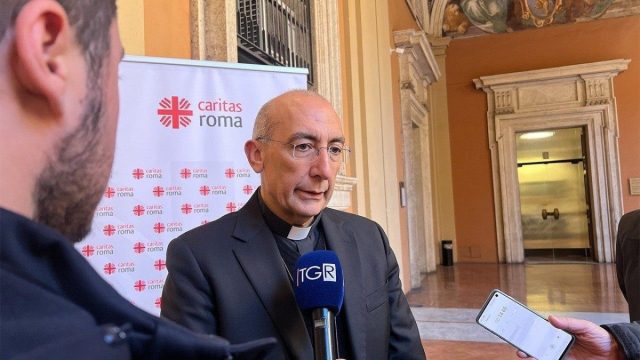
Caritas Rome, the charitable agency of the Diocese of Rome, presented its 2026 report on November 13 at the Palazzo del Vicariato, the diocese's administrative headquarters. The report, titled "Ricomporre la speranza" ("Putting hope back together"), combines economic data, first-hand testimony and the daily experience of church-run services to describe a city that produces wealth while inequality grows and thousands of families slide into widening forms of vulnerability.
The document says Rome faces a risk of structural poverty that reaches even people in work and households that until recently were considered economically stable. Cardinal Baldassarre Reina, vicar general of the pope for the Diocese of Rome, wrote the preface. He places the report in a tradition that goes back to Monsignor Luigi Di Liegro, the first director of Caritas Rome, who in 1984 promoted the first study of poverty in the Italian capital.
"An act of pastoral love and of truth"
Reina writes that for Di Liegro, meeting the most disadvantaged was not simply assistance but the place where faith became concrete commitment to social justice. Listening to Rome, the cardinal says, requires "setting aside every distracted gaze and learning to recognize what slips to the margins of public attention."
The report, Reina writes, is not "a neutral statistical inventory" but "an act of pastoral love and of truth" that can give back a face and dignity to those who have no voice. He says "the proclamation of the Gospel always passes through the wounded flesh of the poor," and proposes "intelligent charity" as the way to build a more fraternal and just city.
Rome's paradox: wealth and insecurity
The figures in the report point to a basic contradiction. Rome records an average declared income of 32,501 euros per capita, well above the national average of 25,820 euros, yet 30.5 percent of Roman families say their financial situation worsened over the past year.
The employment rate stands at 73.4 percent among people aged 20 to 64, but having a job does not keep people out of poverty. Low pay affects 13.5 percent of wage earners, above the national average of 10.4 percent. Insecure contracts and the high cost of living feed a poverty that reaches workers and families who until recently stayed above the risk threshold.
Housing as the main driver of impoverishment
Housing is one of the main drivers of impoverishment. Caritas estimates that about 114,000 families are in a fragile housing situation: 92,000 at high risk and 22,000 already in emergency. Housing costs take more than 40 percent of net family income for 8.6 percent of residents.
During 2025, 1,516 evictions were carried out, 54 percent of them for arrears the tenants could not avoid. At the same time the city has more than 96,000 empty homes and more than 40,000 tourist apartments and vacation rentals. Public housing is under particular strain: by the middle of 2025 more than 17,000 applications for social housing had been accepted, while over the past four years an average of only 308 homes a year have been allocated.
Caritas Rome's work in 2025
The Caritas network in Rome assisted 23,416 people during 2025 through listening centers, soup kitchens, health services and shelters. The listening centers alone supported 12,136 people, with almost 50,000 interviews. Italian nationals make up 42.9 percent of those who come for help, and 34.4 percent live alone, a figure the report links to the growing weight of relational poverty.
The three diocesan soup kitchens served 310,554 meals to 9,973 people. Health services provided 17,112 treatments to 3,707 patients, many of them shut out of the health system by financial, bureaucratic or language barriers. These figures measure both the extent of need and the difficulty of obtaining rights that exist on paper.
Specific emergencies: mental health and loneliness
The report identifies psychological suffering, the isolation of older people and distress among adolescents as specific emergencies. At the Don Luigi Di Liegro shelter, of the 366 people seen by the in-house doctor during 2025, 113 had psychiatric problems, and 43 of them were not receiving care from any mental health service.
The document also looks at migrants and refugees, warning that being granted international protection does not automatically bring independence. Without stable housing, with insecure contracts and weak social networks, people can fall back into marginal situations even after years of living in Italy.
"Loneliness multiplies the impact of any deprivation"
The director of Caritas Rome, Giustino Trincia, said that "in Rome people also become poor because they are alone, and loneliness multiplies the impact of any material deprivation." Responses therefore cannot stop at financial assistance, he said, but must include stronger local services, help into work and the rebuilding of community ties.
Reina takes the same view and asks the Church in Rome not to give in to discouragement: "Witness comes before denunciation, and denunciation must always become a proposal and a sign of hope." That, he says, is the meaning of the report's title. Putting hope back together means mending the fractures of a city where economic growth and marginalization live side by side, and turning the act of listening to the poor into a shared responsibility, a challenge addressed to institutions, the Church community and Roman society as a whole.
Based on reporting by Juana Morales for Iglesia Noticias. This article was translated and adapted from Spanish with the help of artificial intelligence.