Pope Leo XIV condemns sexism and violence against women in Peru
Speaking to about 40,000 people in Lima's Plaza de Armas on November 12, Pope Leo XIV said a sexist mentality persists in Peru and called for women to be respected and included in every area of society and the Church
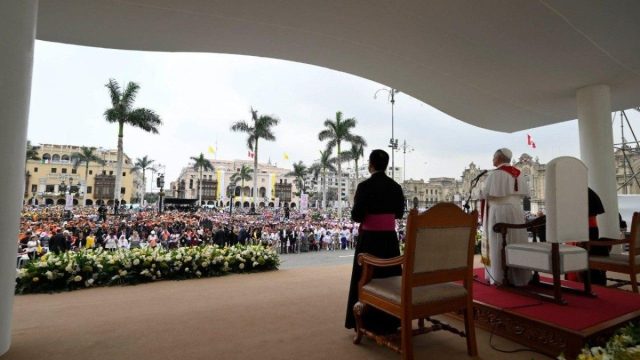
Pope Leo XIV said on Thursday, November 12, that a sexist mentality persists in Peru, speaking at a meeting with the Peruvian people in Lima's Plaza de Armas, also known as the Plaza Mayor. The event came during his apostolic journey through Uruguay, Argentina and Peru. Before a crowd of about 40,000 people who waved colored scarves and sang popular songs to him, the pope urgently called for effective steps to promote the presence, respect and participation of women in every area of society and of the Church.
"It is sad to see that a sexist mentality persists, one that shows itself in the absence of the father from family life and in abuse and violence against women, ignoring the newness of Christianity, which recognizes and proclaims that both have equal dignity and responsibility," Leo XIV said. The speech was also a summary of the Church's social doctrine, organized around four main themes: the family, business, cultural diversity and the role of women. The pope said none of these problems can be addressed in isolation, because all belong to a single human reality that is deeply interdependent.
Peru's National Institute of Statistics and Informatics reports that about 53 percent of women in the country say they have suffered violence from a partner or former partner at some point in their lives. Between 2016 and 2024 there were 1,261 victims of femicide, a figure that rose 44 percent over that period. So far this year, 96 femicides have been recorded.
Violence against women and their marginalization
"It pains us to see that violence against women, who could be our grandmothers, mothers, sisters, daughters, remains a reality that wounds all of humanity," the pope said. He added that women living in poverty or belonging to Indigenous or Afro-American communities suffer a double marginalization.
His closing appeal was direct: "Let us value women! Let us protect and respect girls!" The words drew loud applause from the thousands of women in the square, many of them wearing scarves on their heads against a temperature above 30 degrees Celsius (86 degrees Fahrenheit). Leo XIV did not speak of feminism or of women's rights in political terms. He based his argument on the recognition of human dignity proclaimed by Christianity.
He also said women's contribution to the Church is indispensable, in an institution where women cannot preside at the Eucharist and hold almost no senior positions in the hierarchy. The pope questioned cultural changes that have altered traditional roles for men and women, some of which, he said, have come about "by mistaken paths," without specifying which ones he meant. In the face of those changes, he said, the Church must "propose with greater insistence that God created the human being male and female," and he restated the Catholic understanding of marriage as a union between one man and one woman.
The family: the first natural society
On the family, Leo XIV said it is "the first natural society with rights of its own," which comes before any written law and which public institutions should support without trying to replace. He said the conception of every child by natural means is a requirement of human dignity. Living according to one's condition as a man or a woman, he said, justifies no inequality in the division of household tasks and no subordination of one spouse to the other. He called for men and women to be recognized as jointly responsible for building the future of society.
He offered words of encouragement to "so many mothers who often suffer and find themselves alone," and to aunts and grandmothers who pass on faith and hope to the next generations "with great courage." He acknowledged that many families are marked by financial hardship, emigration, moral corruption, gambling and betting addiction, alcoholism, drug addiction, abuse and domestic violence. He told them: "Do not give up in the face of difficulty!"
The pope also warned that technology risks taking the place of real time together and exposing family members to distractions and harmful content. He said an alliance among politics, educational institutions and families is essential to face these challenges together, rather than leaving the responsibility to parents alone.
Business as a community directed to the common good
On the economy, Leo XIV described business as a community of persons called to play a genuine role in building the common good, in which capital, management and labor should serve integral human development. He called on the relevant authorities to set a fair legal framework that protects workers and employers and guarantees a reasonable balance among work, rest and family life.
He rejected the idea that a society's wealth and resources should go solely to the benefit of a few. A state lays the foundations of a just society, he said, when it promotes the equal dignity of persons, supports families, guarantees an education aimed at human and intellectual formation, and advances a labor policy that protects both the dignity of work and private initiative.
Peru, beauty in cultural diversity
On cultural diversity, Leo XIV praised the country's "cultural, linguistic, historical and regional plurality," said Peru is "a most beautiful country" precisely because of it, and called for sensitivity in dealing with its different groups. He said expressions or behavior used to classify, insult or judge people by their appearance, origin or social status cannot be accepted under the pretext of certain "jokes" or popular slang.
He proposed that cultural diversity become a tool for building peace once the person who is different stops being seen as a threat and is recognized as a brother who deserves respect. "Aggressive attitudes are disarmed by meekness," he said, adding that such meekness "is not weakness but interior strength that tempers anger and resentment, turning it into patience, dialogue and a readiness to be reconciled."
Testimony: María Poma
Before the speech, the pope listened to several testimonies. One came from María Poma, a fruit seller in the Lima district of La Victoria, who migrated from Satipo, in the central jungle, carrying her first daughter. "Your Holiness, our people are very hardworking. Millions of us Peruvians have been forced to get ahead as entrepreneurs. Today we work under the shadows of fear, suffering extortion and killings," Poma said, referring to the wave of organized violence whose main victims include shopkeepers, traders, transport workers and small business owners.
Homes, businesses and encounter
The meeting took place in the Plaza de Armas, founded by Francisco Pizarro in 1535 and surrounded by historic palaces and wooden balconies decked with balloons and banners in the papal colors. Cardinal Carlos Gustavo Castillo Mattasoglio, the metropolitan archbishop of Lima, welcomed the pope with brief remarks before the testimonies began.
Leo XIV closed with a direct appeal: turn homes into schools of fraternity, businesses into communities of dignified work and social responsibility, and cultural differences into opportunities for encounter. "Just structures are necessary, but not sufficient. Honest hearts seeking the common good are also needed to overcome corruption, violence and individualism," he said.
Leo XIV stays in Peru until Monday
The pope holds Peruvian citizenship after serving as a missionary and bishop in the country for nearly two decades. During that time he was bishop of Chiclayo and the point person on care for abuse victims for the Peruvian Bishops' Conference. He will remain in Peru until Monday, the final stage of an 11-day apostolic journey through South America.
Father Goicochea, a priest and member of the committee organizing the visit, said close to three million people cheered the pope on his arrival in Lima. Cardinal Pedro Barreto, president of the conference of Amazonian bishops and a close friend of Leo XIV, said the pope will pay particular attention to a recent case in the province of Condorcanqui, in the northern jungle. Several teachers there sexually abused Indigenous girls from the Awajún and Wampis communities.
Based on reporting by Laura Clavería for Iglesia Noticias. This article was translated and adapted from Spanish with the help of artificial intelligence.