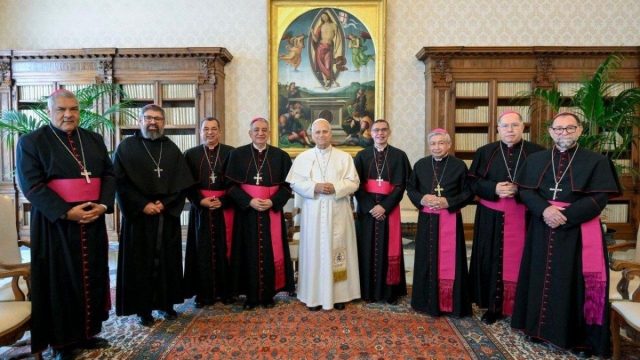
Venezuelan bishops review earthquake relief and mission collections at plenary assembly
The Venezuelan Bishops' Conference devoted the third day of its 126th plenary assembly to the Church's earthquake response, a Caritas report and the funds raised for the missions, as CELAM closed a call for research proposals on poverty
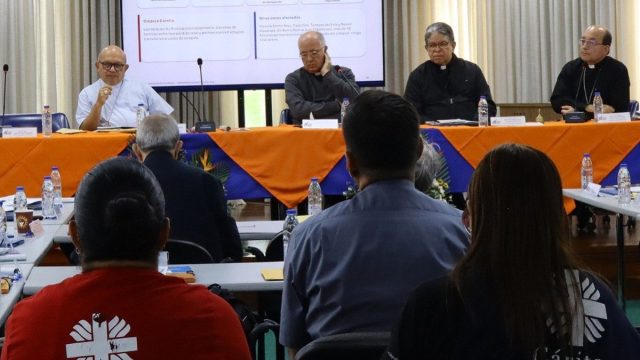
The 126th Ordinary Plenary Assembly of the Venezuelan Bishops' Conference (CEV) devoted its third day of work to reflecting on, assessing and renewing the Church's commitment to supporting the Venezuelan people, with particular attention to its social, humanitarian and missionary response. The bishops discussed the effects of the recent earthquakes on local communities, a report on social ministry and an accounting of the collections taken up for the universal mission.
After the earthquakes: Caritas and church repairs
The bishops received a detailed report on the pastoral and social work carried out in the areas of Venezuela hit by the recent earthquakes. It included an update on repairs and on the structural condition of damaged churches and parish buildings.
Bishops from several dioceses spoke about the situation, the challenges and the hope in their communities. They included the bishops of Coro, San Felipe, Puerto Cabello, Valencia, Maracay, Guarenas, Los Teques, Caracas and La Guaira.
Janeth Márquez, executive director of Caritas Venezuela, presented the 10th bulletin on the response to the humanitarian emergency, prepared after the June 24 earthquake. The report described the technical and human resources deployed and the aid delivered in the most vulnerable areas, and allowed the bishops to see the scale of the response the Church in Venezuela is sustaining for the groups worst affected.
The day closed with the national office of the Pontifical Mission Societies, which presented its accounts for the 100th DOMUND, the annual World Mission Sunday collection, including the figures and the funds raised. The financial report recorded the contributions of Venezuelan parishioners and the missionary commitment to continue supporting the work of the universal Church.
CELAM closes call with 60 proposals on vulnerable populations
The Latin American Episcopal Council (CELAM) formally closed the call for proposals it ran with the Organization of Catholic Universities of Latin America and the Caribbean (ODUCAL), under the title "Sobreviviendo en la pobreza: experiencias de vida y solidaridad de empobrecidos, vulnerables y excluidos" ("Surviving in poverty: experiences of life and solidarity among the impoverished, vulnerable and excluded"). By October 15 CELAM had received 60 applications, 20 percent more than in 2024 and 2025.
The initiative forms part of CELAM's Global Plan 2023-2027 and restates the preferential option for those most in need, with the aim of projecting a "compassionate and transformative fraternity in the heart of a wounded world". The work with ODUCAL is intended to gather scientific evidence to analyze current realities, give a voice to people on the margins and document community efforts of solidarity aimed at overcoming social inequality.
Geographic spread and priority populations
The proposals come from different regions of Latin America and the Caribbean. The Southern Cone accounted for 24 projects, the Bolivarian region for 23, the CAMEX region, covering Central America and Mexico, for 11, and the Caribbean for two.
The studies address residents of poor neighborhoods and urban peripheries (22 percent), indigenous and Afro-descendant populations (20 percent), rural and farming communities (12 percent), women living in poverty (8 percent) and older adults (7 percent). They also cover people with disabilities, prisoners, victims of violence, people affected by natural disasters, children in vulnerable situations, urban waste pickers, mine workers, homeless people and migrants.
The project will produce 10 final research reports, 10 infographics and 10 audiovisual productions in micro-documentary format. The evaluation committee is made up of members of ODUCAL and of CELAM's Knowledge Management Center. It will score the proposals on a 100-point scale, weighing social and pastoral relevance, methodological rigor, communication strategy, capacity for integration within the Church and the experience of the research team.
Ten proposals will be selected, with all four regions represented. The official award of the approved projects will be announced on November 15, 2026.