Jordan sentences three men to death over attack on Orthodox church funeral
A Jordanian court has ordered the hanging of three men convicted of the October 23 shooting that killed nine people at a funeral in a Greek Orthodox church in Hammoud. A higher court must still review the sentence
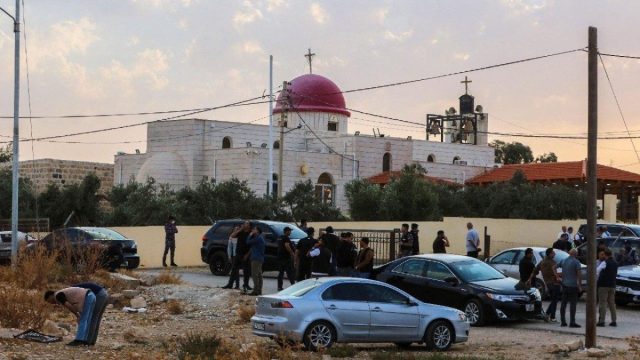
Jordan's State Security Court has sentenced three men to death for the October 23 shooting at St. George Greek Orthodox Church. The sentence can be appealed to the Court of Cassation.
The court handed down the sentences, to be carried out by hanging, on Sunday, November 15. The three men attacked people attending a funeral at the church in Hammoud, a town in Karak governorate in southern Jordan. Nine people were killed and between 25 and 40 were wounded. Between 150 and 200 people were inside the church when the shooting began.
The three convicted men are Jordanian brothers Hazza and Mishal Al-Thneibat and Ahmed Sami Hussein, a relative of both by marriage. Jordanian authorities said all three held a radical takfiri Islamist ideology, a doctrine under which other Muslims can be declared apostates. The court found them guilty of six offenses. They were convicted of terrorist acts that caused the deaths of nine people, with a separate count for each victim. They were also convicted of possession of weapons and ammunition for terrorist purposes, conspiracy to carry out armed attacks and promoting the ideas of a terrorist group. One of the men was also convicted of financing terrorist activities. The charges were brought under Anti-Terrorism Law No. 55 of 2006 and Penal Code No. 16 of 1960.
A sentence subject to mandatory appeal
The sentence does not become final automatically, according to a statement from Jordan's public prosecutor's office. The Court of Cassation, the kingdom's highest court, must review it, and the law treats the sentence as having been appealed. Two other defendants were each sentenced to six years in prison. The court also reclassified one of the charges as illegal possession of a firearm.
The St. George attack and Jordan's response
Gunmen burst into the grounds of St. George Church and opened fire on a funeral procession for a member of Hammoud's Christian community. Three days later, Jordanian security forces arrested the three suspects in an abandoned house in Karak governorate where they had barricaded themselves. King Abdullah II visited the wounded in a hospital in Karak. He called the shooting a "terrorist attack" and warned that those responsible would face "the harshest retaliation." The government declared three days of national mourning. Violence of this kind against religious communities is rare in Jordan, which usually presents itself to the international community as a model of coexistence among faiths.
Jordanian authorities blamed the jihadist group Islamic State for the attack, though the group has not claimed responsibility. In response, Jordan bombed several positions in southern Syria that it said were linked to the group. The strikes caused diplomatic friction with Damascus. The Syrian government complained that Jordan had not coordinated with it in advance and called the strikes a violation of Syrian sovereignty. Syrian authorities said at least seven people were killed in the bombing, including three children and an elderly man. Amman said it had killed more than 20 Islamic State members.
Tougher anti-terrorism laws
The attack also led to legal changes. The Jordanian government began reviewing several terrorism-related laws to toughen penalties. The review aims to raise minimum sentences from five to 10 years in prison and allow sentences of up to 15 years, or even the death penalty, in certain cases.
Jordan never abolished the death penalty, but it carried out no executions for nine years. That pause ended in June, when six people were hanged, also for terrorism offenses.
Jordan's churches cancel festive Christmas celebrations
The verdict comes as the Council of Church Leaders in Jordan has decided to cancel all festive Christmas events this year in solidarity with the victims' families. The council said liturgical and pastoral life in all the communities will go on as normal and that only festive celebrations are suspended.
The bishops asked that Christmas be marked "with simplicity and dignity, preserving the spirituality of the glorious Nativity and its human dimensions." They encouraged the faithful to put prayer, works of mercy and social solidarity first. They also proposed that Christmas trees become signs of hope, unity and peace, and that lit candles be placed in a memorial area to honor those who died.
The council referred to 10 "martyrs": the nine people killed in the Hammoud attack and a security officer who was stabbed to death on November 5 outside the Sri Lankan Embassy in Amman, the Jordanian capital.
Based on reporting by José García for Iglesia Noticias. This article was translated and adapted from Spanish with the help of artificial intelligence.