Archbishop Gallagher calls on Europe to forgive and ask forgiveness
The Vatican's foreign affairs chief spoke on September 21 at the Polish embassy to the Holy See, at the launch of a book marking 60 years since Polish bishops sent a message of reconciliation to their German counterparts
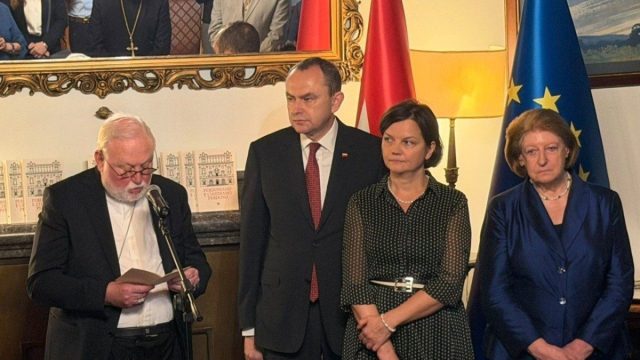
Archbishop Paul Richard Gallagher, the Vatican secretary for Relations with States and International Organizations, took part in the presentation of the book "Perdonemos y pidamos perdón" ("Let us forgive and ask forgiveness") at the Polish embassy to the Holy See on September 21. The book takes as its starting point the message Polish bishops addressed to the German bishops on November 18, 1965. It gathers the papers of an academic colloquium held last year at the Pontifical Gregorian University in Rome for the 60th anniversary of that gesture.
Gallagher said the words "let us forgive and ask forgiveness" still carry particular force in a Europe that continues to bear the wounds of war. Reconciliation does not come from forgetting, he said, but from the ability to face the past truthfully and to open up to dialogue with courage. For Christians, he added, forgiveness is above all a gift of the risen Lord, as St. Paul teaches: "God has reconciled us through Christ."
Gallagher said the book invites reflection on the value of that witness at a time when new divisions and conflicts persist. "It reminds us how valuable it is to safeguard what has been patiently built over decades," he said. He also thanked the Polish and German embassies to the Holy See for their efforts to keep alive the memory of the 1965 message.
Poland's ambassador, Adam Kwiatkowski, thanked Gallagher for his reference to the bishops' message and said that "for us, for Poland and for Germany, this is of enormous importance." He added: "The world needs something more. It needs bolder gestures and decisions, ones that are ahead of their time." He encouraged people to reach out to their neighbor and to show respect and gratitude toward others despite their differences.
Germany's ambassador, Bruno Kahl, agreed that it was urgent to look to the gesture of reconciliation made by the bishops of both countries. "Reconciliation is difficult, but it is possible; still, someone has to take the first step," he said. He said he hoped the book would help make institutions more aware of those values.
Andrzej Jerie, director of the Remembrance and Future Center in Wroclaw, Poland, and organizer of the anniversary events, said the book brings together all the activities linked to the 60th anniversary of the Polish bishops' letter to the German bishops. "If we read carefully what is written there, we will see the concrete fruits of our joint activities to build good relations between Poland and Germany," he said. Jerie said the events held in Wroclaw helped bring about an almost unanimous vote in the Bundestag to fund the Polish House and the monument in Berlin to Polish victims of the Second World War.
Also attending were Archbishop Antonio Guido Filipazzi, apostolic nuncio to Poland; former Prime Minister Hanna Suchocka; Professor Marek Inglot, president of the Pontifical Committee for Historical Sciences; and around 15 ambassadors and heads of diplomatic missions accredited to the Holy See.