Synod report proposes canon law changes to open governance roles to lay people and women
The General Secretariat of the Synod has published the final report of its Canonical Commission, which proposes amendments to the Code of Canon Law to expand the participation of lay people, both men and women, in ministries and in the governance of the Church
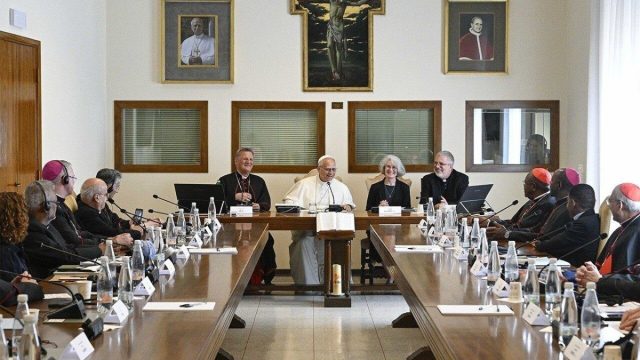
The General Secretariat of the Synod published the final report of its Canonical Commission on September 30, 2026. The report proposes changes to the Code of Canon Law that would expand the participation of lay people, both men and women, in offices, posts and ministries in the Church, including Church governance. It comes out of the 2021-2024 synodal process, whose stated purpose was to promote "greater co-responsibility among all the baptized in the life of the Church."
Theological grounding: from the Final Document to canon law
The report builds on the conclusions of the Final Document approved on October 26, 2024, which gathered the results of the synodal process begun three years earlier. The commission worked to identify how the theological and ecclesiological insights of that process can be translated into canon law.
Cardinal Mario Grech, secretary general of the Synod, said that "without a corresponding canon law, theology would remain incomplete." Grech said the report seeks to "begin a reflection on the rules that sustain the organization of the Church and the relations among its members," so that "the voice of all the faithful is heard in decision-making within the Church."
Three timeframes for implementation
The report sets out a phased timetable for the reforms. In the short term, it proposes specific amendments to current law that could be applied immediately. In the medium term, it identifies areas to be taken up with the competent dicasteries, which will require institutional dialogue. In the long term, it raises "the need for a comprehensive revision of the two Codes of Canon Law, both the Latin and the Eastern."
Lay people in Church governance
The first part of the document deals with "the proposals to amend the canons concerning the capacity of lay people to serve in the Church." That includes "the possibility that lay people take on responsibilities in Church governance," with the aim of giving legal backing to decisions already taken in practice.
The report cites two recent precedents: the appointment of Simona Brambilla as the first woman prefect of the Dicastery for Institutes of Consecrated Life, and of Paolo Ruffini as the first layman to head the Dicastery for Communication. Both appointments have already been made, and according to the report they lacked the canonical grounding needed to reflect that institutional change clearly.
Particular councils and bishops' conferences
The second part of the report takes up "the revision of certain canons governing particular councils and bishops' conferences," bodies that foster "collaboration among the local Churches." The report says the aim is to strengthen these structures as places of real participation rather than nominal consultation.
Under the proposals, particular councils and bishops' conferences would become bodies in which the voice of lay people and women carries real weight in decisions affecting the local Churches.
Participatory bodies
The document also addresses "the participatory bodies already established in the Code, proposing amendments that strengthen their participatory dimension and their missionary orientation." These are existing structures that, the report says, need canonical reconfiguration to work more effectively.
The document presents "missionary orientation" as a central concept: the proposals are not limited to internal participation, but would enable lay people and women to carry out the Church's evangelizing mission with shared authority and responsibility.
A working document, not an approved reform
The text states that "the final report of the Canonical Commission should be considered a working document and not an approved reform." The proposals remain subject to discussion and evaluation in the wider context of the life of the Church, and are a starting point for a broader institutional debate rather than a definitive text.
The report presents the inclusion of lay people and women in governing posts as recognition that "every baptized person shares in the mission of the Church" with dignity and the capacity to lead. The proposed reforms seek to make canon law reflect what, according to the document, sacramental grace has already given: the gift of the Holy Spirit to all members of the Body of Christ.