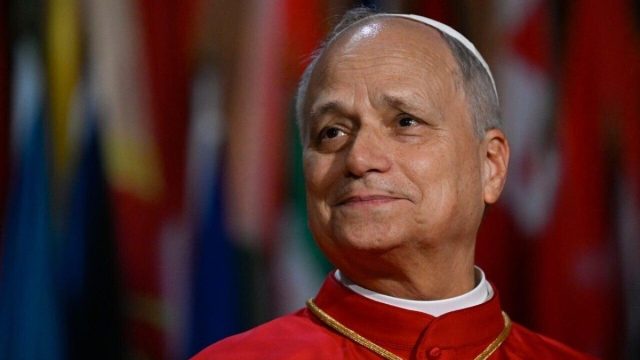
Pope Leo XIV warns young people in Buenos Aires against modern idols
At a vigil in Buenos Aires attended by an estimated 1.3 million people or more, Pope Leo XIV told young Argentines not to kneel before success, money, image or substances that enslave them
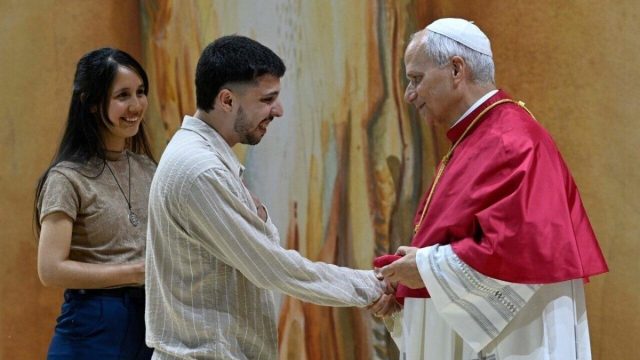
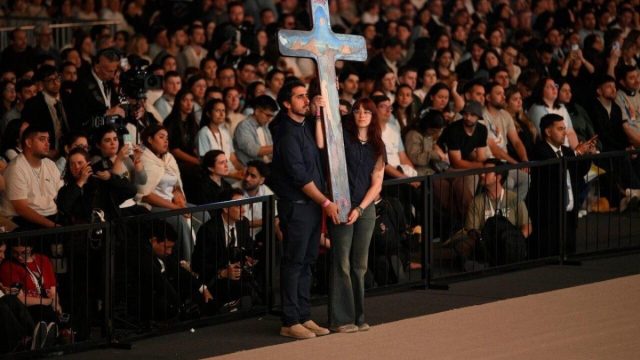
Pope Leo XIV led a vigil with young Argentines on November 10 at the Monumento de los Españoles in Buenos Aires, at the junction of Avenida del Libertador and Avenida Sarmiento in the Palermo neighborhood. Attendance was estimated at more than 1.3 million people, who had come from across the country. The pope had landed at Jorge Newbery Airport shortly after 6 p.m. from Córdoba, in central Argentina, where a Mass celebrated on the grounds of the Fábrica Argentina de Aviones aircraft plant drew 650,000 people. After stopping at the nunciature, he rode through the crowd in the popemobile at 8:15 p.m. and went up on stage with the archbishop of Buenos Aires, Jorge Ignacio García Cuerva.
The evening opened with testimonies from young people who described the situations the pope would address later. Agustín Cristian Schinca, 25, said that bullying at school as a child and trouble fitting in led him to start using cocaine at 15. The addiction damaged his family relationships, and after his grandfather died he spent several months living on the street. He began to recover after arriving at the Hogar de Cristo center in Moreno Sur, a Church-run addiction recovery home, though the process included relapses and fresh starts. He now helps other young people in similar situations. "Today I am standing," he said in front of the pope. A 31-year-old woman, a postulant with the Sisters of the Presentation, said she had rejected religious life for years until a priest asked her: "Who told you it is too late?"
The three young men of Babylon as an image of resistance
The pope built his address around the biblical account of Hananiah, Azariah and Mishael, the three young men deported to Babylon. They refused to bow before King Nebuchadnezzar's golden statue even at the risk of being thrown into a blazing furnace. Leo XIV presented them as an image of resistance to today's idols. He listed them: success at any price, money, obsession with image and popularity, humiliating people on social media to gain followers, and those who do business offering pleasures that end up enslaving us, such as pornography and various substances.
"Do not kneel before what cannot give you life! And if you have ever fallen, get up! Do not let anything or anyone take away the freedom God has given you," he said. He took three movements from Pope Francis's cry at World Youth Day in Lisbon in 2023, "Everyone, everyone, everyone!", and developed them as "everyone toward Christ, everyone with Christ, everyone like Christ."
Everyone toward Christ: open doors with no entry conditions
The first movement was an invitation without conditions. There is room in the Church for those who grew up close to Jesus, the pope said. There is also room for those who have only just begun to look for him, who have not prayed in a long time, who have drifted away or who have been hurt by the people who should have walked with them. "With your questions, your wounds and your story: this is your home too," he said. He repeated the question that had changed the postulant's life and addressed it to anyone who believes they are too far away: "The Lord is looking for you!"
He recalled Jesus's encounter with Zacchaeus, who climbed a tree to see him and discovered that the Master was looking for him too. Jesus called him by name and wanted to stay at his house, which moved Zacchaeus to make amends for the injustices he had committed. "No one has fallen so low that Christ cannot lift him up," the pope said. He asked communities to keep their doors open to welcome those who arrive with questions, to help those who suffer and to walk patiently with those who are searching for God.
Everyone with Christ: support in times of trial
The second movement, "everyone with Christ," drew on the image of the three young men in the furnace, where a fourth figure sent by God stayed with them through the ordeal. Leo XIV linked the account to Christ's incarnation and his passover, in which he shared human hardship, bore sin and rose on the third day. "Christ offers you a life that not even death can take from you," he said.
He said divine mercy does not mean staying trapped in what causes harm: "Christ loves us as we are, but his love is too great to leave us prisoners of sin, of what destroys us." He encouraged young people to go to the sacrament of Reconciliation, to read the Gospel and to receive the Eucharist regularly.
Everyone like Christ: holiness and service
The third movement, "everyone like Christ," was a call to holiness and service. The pope recalled Jesus washing his disciples' feet, saying, "The Lord of all became the servant of all!" He urged young people to share bread with the hungry, open their doors to those without a home and visit the sick and those no one visits. He also pointed to less visible forms of suffering: people who need advice, a word of comfort or simply to know that they are loved.
"May your life be like the pages of the Gospel, written with the ink of mercy, so that those who meet you may recognize in you something of the love and joy of Jesus," he said. At the end of the vigil, Leo XIV gave the young people a missionary mandate: "Go and proclaim!" He urged them to reach every corner and every periphery so that people who feel far from God could discover through them that Christ is looking for them.
Interreligious meeting at the Palacio San Martín
The day before, Leo XIV took part in an interreligious meeting at the Palacio San Martín with about 100 representatives of Christian and non-Christian traditions. They included Jews, Muslims, Orthodox Christians, evangelicals, Protestants, Sikhs, Buddhists, Afro-descendant communities and representatives of indigenous peoples, along with provincial officials responsible for religious affairs.
At the meeting, the pope described religions as guardians of human dignity, an expression of freedom and places where hope can be cultivated. He warned against three idols that threaten that freedom: domination, which leads people to want to place themselves above others; vainglory, because possessions confer no divine status; and war, since there is only one Lord and judge of history. He called for defending life "from conception to its natural end" and promoting that dignity in the family, education, work and care for creation.
The pope said interreligious dialogue must take place without falling into relativism or syncretism. On Argentine history, he said religious diversity has coexisted in peace and that religions have served as a meeting point and a source of commitment to society. He ended with a prayer taken from Francis's encyclical Fratelli tutti, then lit a candle and kept a minute of silence for peace in the world.
Mass at Our Lady of Luján: "Argentina, arise and walk"
The visit to Argentina ended at the shrine of Our Lady of Luján, where Leo XIV celebrated Mass before a crowd that came to join the successor of Peter for the final stage of the trip. In the homily, the pope took the prophet Isaiah's image of the desert and the steppe blooming to behold the glory of God and applied it to Argentina's geography: "All the land at the 'end of the world,' in its splendor and beauty, sings the glory of the Lord."
He thanked Argentines for their hospitality and for sharing their bread and their music. He recalled Francis, who "always carried the Patroncita morena in his heart," a popular Argentine name for Our Lady of Luján, and who taught by his life how to love and venerate Mary. The core of the homily was a four-step path lived out in every celebration of the Eucharist: reconciliation, enlightenment by the Word of God, communion and being sent on mission.
Speaking about reconciliation, he listed forms of suffering that many people go through: illness, poverty, unemployment, discrimination and broken families. He invited his listeners to receive God's grace and begin a process of forgiveness: "We also need to be reconciled with our history and with our present, to create a new future." He presented communion as openness to those most in need: the poor, the hungry, migrants, the sick and prisoners, with whom Christ identifies himself. The Eucharist, he said, cannot leave us closed in on our own concerns or free us from responsibilities to the community.
He closed the homily with a call to mission, "Go and proclaim!", and quoted St. Augustine: "Love, and do what you will," because when love is the root of what people do, only good can come from it. The pope then addressed the country directly: "Argentina, arise and walk." He entrusted his pontificate and the mission of the Argentine people to Our Lady of Luján, recalling that his election as successor of Peter took place on May 8, her feast day. He asked the patroness of Argentina to walk with the people on their pilgrimage and to help them "to build bridges of charity and networks of solidarity."
Based on reporting by Almudena Rodrigo for Iglesia Noticias. This article was translated and adapted from Spanish with the help of artificial intelligence.