Pope Leo XIV presents Golden Rose at Argentina's shrine of Our Lady of Luján
On the last day of his trip to Argentina, Pope Leo XIV celebrated Mass before a crowd local authorities put at more than two million, recalled Pope Francis and presented a Golden Rose at the shrine of the country's patroness
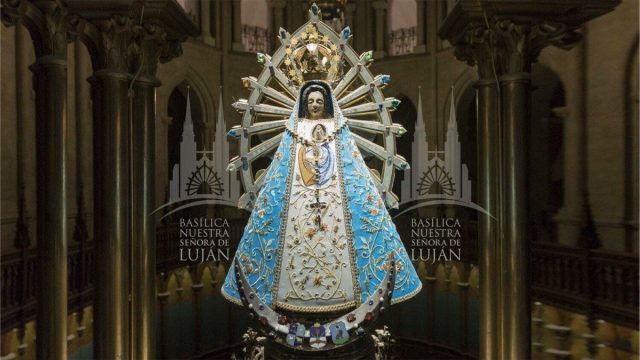
Pope Leo XIV visited the shrine of Our Lady of Luján on November 11, 2026, the final day of his apostolic trip to Argentina. Local authorities estimated that more than two million people gathered in front of the basilica, according to figures cited by the Holy See. During the celebration, the pope recalled Pope Francis and his close attachment to the devotion, which he called the "Patroncita morena."
In his homily, Leo XIV set out a spiritual path built on four elements: reconciliation, listening to the Word of God, communion and mission. He spoke of the hardships facing many Argentine families, among them poverty, illness, unemployment, discrimination and family breakdown, and said Christian life requires attention to those who need it most. At the end of the Mass he presented a Golden Rose, a papal honor given to certain Marian shrines as a sign of special recognition and veneration.
The mystery of the cart: a devotion almost four centuries old
The story of Our Lady of Luján began in 1630, when a small painted terracotta image of the Immaculate Conception, only 38 centimeters (15 inches) tall, arrived from Brazil at the request of a Portuguese landowner. According to tradition, the image was part of an expedition traveling inland by cart. It was at a spot known as Árbol Solo, near the Luján River, that what religious memory has passed down for centuries as the "miracle of the cart" took place.
When the carters tried to set off again, the oxen refused to move the cart carrying the image. They went through the load and found that the problem disappeared when they took out the crate holding the Virgin, and returned when they put it back. People understood this as a sign that Mary wished to remain in that place. The travelers left the image there, while a second image continued on to Sumampa. The devotion that began that day has lasted almost four centuries.
El Negro Manuel: an enslaved man who cared for the image
One figure stands out in the early years of the devotion: Manuel Costa de los Ríos, known as el Negro Manuel, an enslaved African man born in the Cape Verde Islands. Tradition places the episode of the cart in 1630, when Manuel was living on the estate where the image stayed. Bernabé González Filiano, who managed those lands, put him in charge of it.
For decades Manuel looked after the faithful who came to venerate the image and cared for the small chapel where it was kept. Traditional accounts also credit him with tending the sick, anointing them with the tallow of the candles that burned before the Virgin. He was so devoted that his owners eventually tied him directly to the service of the image. Ana de Matos paid 250 pesos, a payment linked to his status as an enslaved person, to keep Manuel in charge of its care. He remained with the image until his death, traditionally dated to 1686.
From a rural estate to a monumental basilica
As the devotion grew, a better site was needed. Ana de Matos arranged for the image to be moved to land she owned, which was better suited to receiving the faithful. In 1682 she formalized the donation of the property.
The first buildings were modest. During the 18th century work went ahead on a new church, which opened on December 8, 1763, the feast of the Immaculate Conception. The decisive change came at the end of the 19th century with the priest Jorge María Salvaire, who pushed for the construction of a large neo-Gothic basilica. Work began in 1890 and produced a church with towers and pointed arches modeled on the great European cathedrals. The basilica was blessed in 1910 and was given the title of minor basilica in 1930.
National patroness
Devotion to Our Lady of Luján developed long before Argentina became an independent state. Through the 18th and 19th centuries it grew in importance among different sectors of the population until it became one of the country's leading religious devotions. Our Lady of Luján is venerated as patroness of Argentina, and her feast is celebrated every May 8.
Official recognition came late. In 1930 Pope Pius XI formally recognized Our Lady of Luján as patroness of Argentina, Paraguay and Uruguay.
For many of the faithful, Luján is a place of thanksgiving, petition and gathering. The devotion draws people of different ages and backgrounds who take part in religious celebrations and pilgrimages throughout the year.
The popes and the devotion to Luján
John Paul II visited Luján in 1982 during his trip to Argentina. Decades later the devotion gained international attention under Francis, the first Argentine pope. Francis was closely attached to Our Lady of Luján and spoke of her on a number of occasions during his pontificate, as he had when he was archbishop of Buenos Aires.
There is also a coincidence of dates: Leo XIV was elected pope on May 8, 2025, the feast of Our Lady of Luján. During the Mass on November 11, 2026, he mentioned this in his closing prayer to the Virgin, asking her protection for his apostolic mission and for the Argentine people, whom he urged to move forward along paths of reconciliation, communion and solidarity.
Based on reporting by Juana Morales for Iglesia Noticias. This article was translated and adapted from Spanish with the help of artificial intelligence.