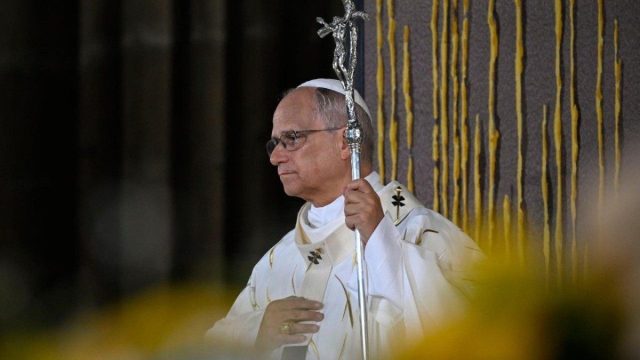
Pope Leo XIV returns to Peru, where he spent more than 20 years as a missionary and bishop
Pope Leo XIV landed in Lima on November 11 for a six-day visit to Peru, where victims of state violence and of the Sodalicio are seeking justice and hope to be heard during his stay
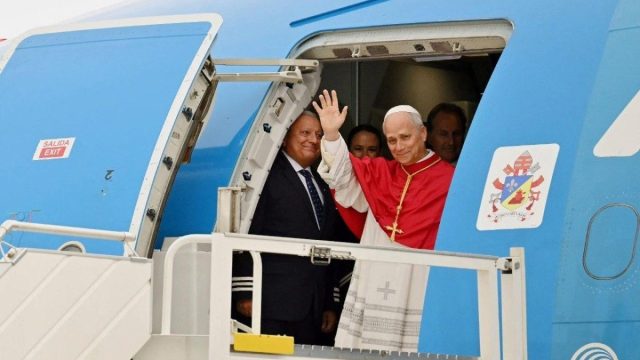
Pope Leo XIV landed at Callao Air Base in Lima at 5:10 p.m. local time on November 11, after a five-and-a-half-hour flight from Argentina. He began a six-day visit to Peru, the country where he lived for more than 20 years as an Augustinian missionary and bishop and where he was granted citizenship in 2015. He is the third pope to visit Peru, after St. John Paul II in 1985 and Francis in 2018, and the first to come as a naturalized Peruvian.
President Keiko Fujimori met him on the tarmac, along with the apostolic nuncio to Peru, Archbishop Paolo Rocco Gualtieri, and a crowd of civil and religious officials. A children's choir sang songs of welcome among Vatican and Peruvian flags. The control tower radioed an official greeting: "Welcome home." About three million people lined the route from Callao into Lima, with raised hands, singing and intertwined flags.
At the Government Palace, also known as Casa Pizarro, the pope received military honors and listened to Peru's national anthem, sung by a choir of children and young people; he joined in. After the presentation of delegations and a private meeting with Fujimori, the two went to the Gran Teatro Nacional for an event with government officials, civil society and the diplomatic corps. María Montserrat Alvarado, the Vatican's new prefect for communications, who is traveling with the pope, had told reporters that Leo XIV was "so excited" about returning to a land that "was so important for his ministry."
Thirty years in the country: missionary, bishop, pope
Robert Francis Prevost's history with Peru began in 1985, when he was 30 and the Order of St. Augustine sent him as a missionary to Chulucanas, in the Piura region. He returned in 1988 to work at the Augustinian house in Trujillo. In 2001 he was elected prior general of the order in Rome, and in 2014 Francis named him bishop of Chiclayo, a post he held until 2023, when he was called to Rome to head the Dicastery for Bishops. In all, he spent half of his life as a priest in Peru.
On May 8, 2025, when he became the 267th successor of Peter under the name Leo XIV, his first words from the balcony of St. Peter's Basilica included a greeting: "To my beloved diocese of Chiclayo, in Peru, where a faithful people have accompanied their bishop, shared their faith and given so much, so much, to go on being a faithful Church of Jesus Christ."
The living memory of "Monseñor Roberto" in Chiclayo
In Chiclayo, where the pope arrives on November 13, the memory of "Monseñor Roberto," or simply "Padre Roberto," remains strong. The date falls on the anniversary of the birth of St. Augustine and the feast of all the saints of the order. Father Juan Mechán Sánchez, parochial vicar of Santa María Cathedral, described his former superior as "a father in that gesture of welcome, patience, help and also correction, but a prudent man for everyone," whose closeness was clearest in moments of greatest collective suffering.
During the COVID-19 pandemic, Prevost did not just receive reports. He was present with people and families in difficulty, and he led a campaign to get companies in the region to pay for an oxygen plant that, according to the priest, saved many patients from death. He also organized a Corpus Christi procession around the city's main park, walking alone with the Blessed Sacrament, accompanied by the clergy, while the faithful stayed shut in their homes.
Wendy, a Chiclayo resident who knew him at the Inmaculada Concepción Catholic school and at Sunday Mass, remembered him as "a humble, welcoming person with the gift of knowing how to listen and reach every kind of audience." Raúl, an elderly man from Piura, knew him first as a missionary priest in Chulucanas and later as bishop of Chiclayo. He said that seeing him in his third stage, missionary, bishop, pope, was "a joy." He recalled his attention to the poorest and quoted a line he attributes to him: "The presence of God is found in the needy: let us not push them aside, but love them, because in doing so we love God."
A six-day schedule
The Peru program includes meetings with bishops and clergy on November 12 in Lima and a prayer vigil with young people at the National Stadium. On November 13 the pope travels to Chiclayo, where he will visit the chapel of St. Óscar Romero in the La Victoria neighborhood. On November 14 he goes to Santa Cruz de Succhabamba, a provincial capital at 1,980 meters (6,500 feet) that no pope has visited before. On November 15 he will be in Cuzco, more than 3,300 meters (10,800 feet) above sea level, where he will see expressions of Andean popular religiosity at the Saqsaywamán National Archaeological Park. He will also travel to Pucallpa, in the Amazon, to meet missionaries and representatives of indigenous communities facing deforestation, drug trafficking and human trafficking. The final day, November 16, is given to Callao, with a visit to a nursing home and a Mass at the Las Palmas air base.
Victims of state violence hope to be heard
Among those hoping to be heard during the visit are victims of state violence during the internal armed conflict of the 1980s and early 1990s, which was marked by the actions of the terrorist group Shining Path and by state repression. Also waiting are victims of the protests of 2022 and 2023, which were put down with force that left at least 50 people dead. Almost four years later, no trial has been held.
Elisabeth Santisteban, 52, lost her brother in 2023 when a tear gas canister fired at point-blank range by a police officer struck him in the head during a demonstration. Santisteban said the pope's schedule in Lima sets aside no official time for the victims, and she said that "some people, from within the church, make decisions so that our stories do not reach you," in the words of a letter the victims sent the pope the day before he arrived. They have been barred from bringing photographs of their relatives to Thursday's event, but some plan to attend anyway. Other organizations of relatives wrote to Leo XIV asking that "our memory have a place," that their pain be recognized and that their hope for justice stay alive.
As bishop of Chiclayo, Robert Prevost publicly criticized Alberto Fujimori, the father of the current president, for apologizing for his crimes only "in a generic way, if some have felt offended." He added that "perhaps it would be much more effective to ask forgiveness, personally, for some of the great injustices that were committed and for which he was tried and sentenced." Prevost had also collected signatures in the late 1990s for the creation of the Truth and Reconciliation Commission.
The Sodalicio: assets not liquidated, victims without justice
Inside the Peruvian Church, victims of the Sodalicio are also waiting for a response. The ultraconservative group, deeply rooted in Peru, was dissolved by Francis with the cooperation of the then prefect of the Dicastery for Bishops, Robert Prevost. The victims say the assets the organization built up remain "beyond the effective reach of the Church's liquidation process," because properties were sold without authorization from the Holy See while the financial network that sustained it keeps operating.
Some 250 people came forward to give testimony at the listening office the Vatican set up between May and August, far more than the number known until then. The abuses reported include the removal of ovaries, the administration of psychiatric drugs to homosexual men, physical punishment and spiritual manipulation. The survivors are asking for a meeting with the pope, who met victims of child sexual abuse while in Argentina.
Political instability
Since Francis visited in January 2018, Peru has had eight different presidents, in a cycle of institutional instability marked by clashes between the executive and the legislature and by systemic corruption scandals. Fujimori, elected in June, has been in office barely 100 days and governs a sharply polarized society, with several areas of the country under a state of emergency because of rains linked to El Niño. Her approval ratings are low and her message centers on security and a hard line against organized crime. Fujimori called Leo XIV's visit "a balm."
Peru is one of the most Catholic countries in Latin America, with between 67 and 76 percent of the population identifying as Catholic, according to different sources, but Vatican statistics record a significant drop in baptisms and church marriages between 1980 and 2024. Poverty affects more than 25 percent of the population, about nine million people.
Based on reporting by Almudena Buenadicha for Iglesia Noticias. This article was translated and adapted from Spanish with the help of artificial intelligence.