Irish synodal assembly votes to keep exploring women's ministry, including the diaconate
Delegates at Ireland's first National Synodal Assembly, meeting in County Meath on October 17, asked the country's bishops to continue studying women's ministry, 10 months after a Vatican commission said research did not allow a move toward admitting women to the diaconate
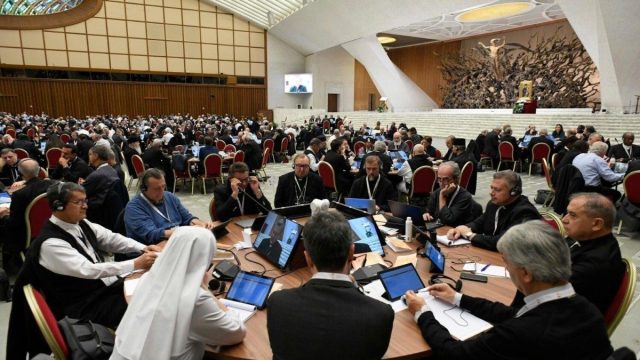
The first National Synodal Assembly of the Church in Ireland, held on Saturday, October 17, in Gormanston, County Meath, voted in favor of the Irish bishops continuing to explore women's ministry, including the possible "ordination" of women to the diaconate. The vote contradicts the conclusions of the Vatican commission that studied the same question and rejected it just 10 months earlier.
More than 300 delegates, including laypeople, priests and religious, all of them carefully selected, voted on 35 proposals grouped into five pathways. Archbishop Eamon Martin of Armagh presided, and 23 bishops attended.
Majority support for women's ministry
On women's ministry, 42 percent of delegates rated the proposal to call for continued exploration of the question, including the diaconate, as "highly recommended," and another 12 percent called it "recommended," for combined support of 54 percent. Another 19 percent asked for further discernment before taking a position, and the remaining 27 percent were opposed. The working document the delegates used began from the premise that women's access to the diaconal ministry remains an open question.
That is not the Vatican's position. The commission entrusted to Cardinal Giuseppe Petrocchi published its conclusions on December 4, 2025, holding that the current state of historical and theological research prevents any move toward admitting women to the diaconate. The commission maintains that assessment in the light of Scripture, Tradition and the Magisterium, while noting that, unlike priestly ordination, the matter does not yet allow a definitive judgment.
Sister Mary Barron's appointment
On October 8, Pope Leo XIV appointed Sister Mary Barron OLA, who is Irish, as adjunct secretary of the Dicastery for Evangelization and president of the Pontifical Mission Societies. Barron, who was president of the International Union of Superiors General from 2023 to 2025 and took part in the Synod on Synodality, has restated her earlier support for the ordination of women, saying that women "hear the call to priesthood."
LGBT+ language and women's visibility
The Gormanston assembly also took up the language the universal Church uses about LGBT+ people. Asking Rome for more respectful vocabulary when speaking about homosexuality was rated "highly recommended" by 41 percent of delegates and "recommended" by 20 percent, for combined support of 61 percent. Another 26 percent asked for further discernment, and 13 percent rejected the proposal.
A proposal to give women greater visibility and a larger role in the liturgy and in public prayer drew the support of 61 percent of delegates. A proposal to make healing a priority of the synodal process reached 89 percent. The only proposal clearly turned down was the creation of a national office for women: 56 percent of delegates did not recommend it.
Archbishop Martin and next steps
Defending the process, Martin said that "many of our parishes, and even our dioceses, are unsustainable with the current model and will struggle to survive." He recalled that the bishops themselves launched the synodal path in 2021, and said the Irish Bishops' Conference would study the recommendations at its meeting the following week.
Cardinal Mario Grech, secretary general of the Synod, spoke by video and warned of the risk that managing decline could become the pastoral paradigm. The approved recommendations are not binding: it is for the bishops to decide which ones they take up and on what timetable. The Irish synodal process began in 2021, and by 2022 the national synthesis already included calls to open ordained ministry to women and to review priestly celibacy.