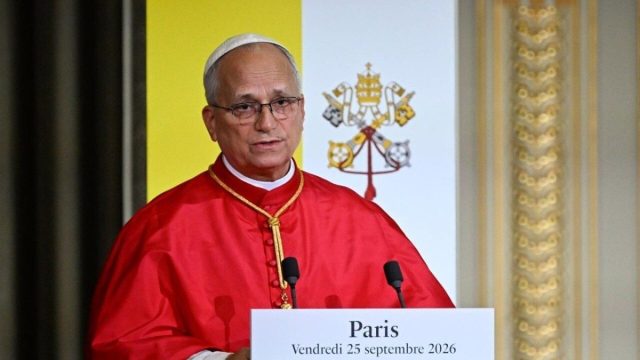
Pope Leo XIV tells French authorities the right to life underpins every other right
In his address at the Elysee Palace, Pope Leo XIV linked human rights, technology and suffering, warned about tendencies that risk turning science and technology into profit-making enterprises, and called the protection of the right to life the foundation of every other right
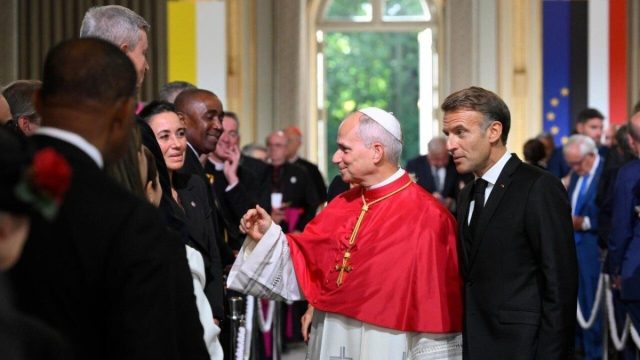
Pope Leo XIV put the defense of life at the center of his address at the Elysee Palace, the French presidential residence in Paris. Human rights, technology and suffering converged in a single idea: "the protection of the right to life is the indispensable foundation of every other human right."
The underlying question he posed can be summed up this way: what is the use of proclaiming human dignity if that dignity stops being unconditional when a person is fragile, dependent or suffering?
1. France, human rights and a dignity that does not depend on progress
Leo XIV began with one of the most recognizable elements of French political identity: human rights. He recalled that the Universal Declaration of Human Rights was proclaimed in Paris, and he noted the part played in drafting it by the French jurist René Cassin.
Before reaching that document, the pope linked French history to the recognition of rights "inscribed in the nature of the human person," mentioning religious freedom. He then turned to the three words that sum up the French republican ideal: liberty, equality and fraternity.
They "are not merely words engraved on the pediments of your public buildings," he said, but "universal ethical demands." He did not open by discussing specific practices. He opened by asking what makes rights genuinely universal.
His answer was the "dignity inherent in every human person."
Recalling the Universal Declaration, he quoted St. John Paul II, who called it "a milestone on the path of humanity's moral progress," and then added another of John Paul II's warnings:
"Every threat to human rights, whether in the field of material goods or in that of spiritual goods, is equally dangerous for peace, because it always affects the human person in his integrity."
One idea that ran through the whole address appeared there: the person must be considered in his integrity. Rights were presented not only as legal achievements but as the consequence of a prior recognition of a dignity that belongs to the human being.
Leo XIV then connected human rights with social and technological change. The question of dignity, he said, "arises in every age" and must accompany both "the changes in society" and "technical advance."
For the pope, new advances do not make reflection on human rights unnecessary. The greater a society's technical capacity, the more pressing the question of what it may legitimately do with the person.
2. Progress does not remove the need to distinguish the possible from the good
Leo XIV did not present science and technology as adversaries. He said that "over the centuries, technological development has contributed to a significant improvement in humanity's living conditions."
He immediately added a second part:
"Every stage of progress has also brought to light the ambiguous side of instruments capable of causing harm when they are not directed toward the good."
The decisive word is "good." Technical development can expand what human beings are able to do, but it does not automatically supply the criterion for deciding what they should do.
That is one of the central lines of argument in the address. Scientific capacity answers the question of what is possible. Leo XIV called for a different question: what is morally good.
To illustrate the danger of confusing the two, he returned to the French writer Georges Bernanos and his image of the "Paradise of Machines." Bernanos had warned about a society in which blind obedience and irresponsibility could become the real masters of progress.
Leo XIV brought that warning up to the present and said it was precisely this concern that led him to address artificial intelligence in his first encyclical.
The aim he set out is not to halt technological development but "to place the human person once again at the center of all reflection."
"So as not to lose our humanity in the midst of the 'Paradise of Machines' that invade and condition our daily lives, it is urgent to form minds in an ethical discernment capable of distinguishing what is morally good."
The risk he identified is not simply that a technology might malfunction. It is "to lose our humanity."
His proposed response is not only technical regulation. He spoke of "forming minds," of ethical discernment and of "unconditional" respect for interior freedom and for the "sacred dignity" of the person.
Progress is thus subject to a criterion that precedes it: technology must serve the person and must not become the measure of how much a person is worth.
3. From recognizing dignity to defending life in practice
After speaking of human rights, progress and artificial intelligence, Leo XIV took a further step. Dignity stopped being an abstract concept and was set against a concrete situation: human fragility.
The pope recalled the Church's charitable tradition in France, especially St. Vincent de Paul, and turned to the Catholic institutions that today accompany "our brothers and sisters weakened by suffering."
His measure of dignity was not the autonomous, healthy individual able to manage on his own. He placed it where that autonomy diminishes.
He described the work of those who care for such people as a:
"true school of humanity about the greatness of care and a moving reminder of the unique and irreplaceable value of every human being."
Two words carry the argument: "unique" and "irreplaceable." If every person has that value, fragility cannot become a reason to reduce their dignity.
The pope moved from recognizing that value to a series of obligations:
"To welcome life unconditionally, to sustain fragility with tenderness, to accompany every stage of existence with respect and mutual trust, and to defend, with courage and compassion, those who have no voice or who do not feel sufficiently supported."
The sequence shows what defending life means for Leo XIV. It is not limited to preventing certain actions. Welcoming, sustaining, accompanying and defending are active verbs. The protection of life he proposed also requires taking responsibility for the vulnerability that life can bring with it.
Only after building that argument did he state one of the address's central lines:
"I strongly reaffirm that the protection of the right to life is the indispensable foundation of every other human right."
4. Why the right to life is the "indispensable foundation"
The wording goes beyond a general defense of life. The pope used two strong terms: "foundation" and "indispensable."
A foundation does not occupy the same place as the rest of a building. It is what the other parts rest on. Applied to human rights, the phrase places life as the necessary condition for other rights to be recognized and exercised.
This also explains why he had begun with liberty, equality and fraternity. His argument did not set them against the right to life but placed them on a single understanding of the person.
Freedom needs a subject whose dignity is recognized. Equality requires that this dignity not depend on each individual's particular circumstances. Fraternity calls for a relationship with the other that does not vanish when that other becomes dependent or vulnerable.
Leo XIV did not spell out this relationship term by term. But the structure of his address placed the two lines of thought in continuity. He first recalled France's universal principles and the Declaration of Human Rights, then asked how to preserve dignity in the face of technical advance, and finally stated that the right to life is the foundation of every other right.
His statement about life cannot be separated from what he had just said about care. If dignity is truly inalienable, it must remain when a person can no longer sustain himself.
An understanding of human rights is tested not only by those who can demand them but also by those who need others to protect them.
5. Suffering tests that understanding of dignity
Immediately after presenting the right to life as a foundation, Leo XIV raised the problem of suffering.
"In our day there is a temptation to expect science to give us a solution and a consolation for all our sufferings. The risk is often to fall into that illusion."
The order matters again. The pope had just spoken of people weakened by suffering, of care and of accompaniment. He then asked what happens when a society expects technology to resolve all suffering.
He did not argue that suffering should go untreated, and he did not set medical care against accompaniment. He had already acknowledged the benefits of progress. His warning was directed at the claim that technology can be a complete answer to human vulnerability.
Science can relieve much suffering. But on the pope's account, the existence of suffering does not suspend the moral question about the solutions proposed.
He put it this way:
"When science and technology are not guided by conscience, they can propose immediate solutions that would seem to answer the desires and sufferings of men and women but that in fact divert them gravely from the good to which they deeply aspire."
An immediate answer to a desire is not necessarily the same as the integral good of the person.
The pope acknowledged the existence of desire and of suffering. He neither denied nor trivialized them. What he rejected is that their existence alone makes any available solution morally acceptable.
6. When life enters an economic logic
It was after that reflection that Leo XIV delivered one of the strongest paragraphs of his address in France:
"At times I note with concern certain tendencies in today's societies that risk turning science and technology into profit-making enterprises that favor genetic manipulation, surrogacy, the purchase of organs or the offer of a programmed death."
The pope brought four distinct realities together in a single warning. He did not explain each one separately or equate their particular circumstances. The link he drew appears in the sentence itself: the risk that science and technology become "profit-making enterprises" applied to areas that bear directly on human life and the human body.
The vocabulary of the paragraph is economic. Leo XIV spoke of "profit-making enterprises," of "purchase" and of "offer."
Those words are hard to separate from the argument around them. Having defended the "unique and irreplaceable value" of every human being, the pope warned about situations in which matters closely bound up with life can enter economic dynamics.
The tension he set out is clear: what has an "irreplaceable" value should not end up treated only as a matter of offer, purchase or profit.
The address does not develop an economic theory of these practices, and attributing one to him would go beyond his words. It does explicitly state the connection between profit, technology and certain interventions on life.
7. Surrogacy within that criticism
Among the practices Leo XIV named is surrogacy.
He did not set out a specific argument about it in this address. He did not discuss its legal regulation in France or describe the circumstances of those who resort to it. His criticism has to be read within the framework he had just established.
First he said that human dignity must be at the center of progress. Then he defended the "unique and irreplaceable" character of every person. Then he called for "welcoming life unconditionally." Finally he warned that science and technology can become "profit-making enterprises" favoring, among other practices, surrogacy.
The objection that can be drawn from the address is the one contained in that sequence: the risk of subjecting areas connected with human life to a technical and profit-driven logic that loses sight of the dignity of the person.
8. The purchase of organs: the body and the market
The next practice he mentioned is the "purchase of organs."
Here the economic dimension is more explicit in the term itself. Leo XIV did not simply speak of advances in transplantation or of medical possibilities. His reference was to "purchase."
Within the general argument of the address, the phrase again raises the boundary between technical capacity and ethical limit. That medicine can transplant an organ is a scientific advance; that the organ becomes the object of a purchase raises a different question about how the human body is treated.
The pope did not develop the point further at the Elysee. Its inclusion among the "profit-making enterprises" shows where he located the concern: at the moment when a medical possibility is crossed by a commercial relationship involving the human body.
9. "Programmed death" and the response to suffering
The last of the practices named is also one of the address's strongest phrases: "the offer of a programmed death."
It cannot be separated from the sentences before it. Leo XIV had just spoken of the "temptation" to expect science to provide a solution and a consolation "for all our sufferings."
He then warned that technical solutions can appear to answer those sufferings, and immediately afterward mentioned the "offer of a programmed death."
The contrast with the earlier paragraph on care is direct. Faced with fragility, Leo XIV had proposed "sustaining," "accompanying" and "defending." Faced with the claim that science can resolve all suffering, he warned against certain solutions that he considers incompatible with the deep good of the person.
Within the logic of the address, the defense of life does not consist only in a prohibition. The pope had already set out the response he considers appropriate to vulnerability: accompaniment, tenderness, care and protection. Before pointing to what he regards as a harmful trend, Leo XIV called for a concrete responsibility toward those who suffer.
10. From abstract rights to personal responsibility
After naming those four practices, the pope closed the paragraph by returning the question to each person:
"Let us not forget that mutual respect and the protection of the life of every human person are a responsibility of each and of all."
The defense of dignity is not left solely to the state, to science, to medicine or to religious institutions. Leo XIV spoke of a responsibility "of each and of all."
And he said where it must begin:
"With a conversion of intelligence and of heart."
The two dimensions gather up much of what came before.
Intelligence needs discernment so as not to identify progress automatically with the good. It is the same demand he made when speaking of artificial intelligence: to distinguish "what is morally good."
The heart refers to the relationship with the vulnerable. Understanding intellectually that every life has dignity is not enough; that conviction must become "a real and selfless commitment" to others.
The pope thus moved human rights from the level of declarations to the level of responsibility. A society can proclaim broad principles, but those principles need to be expressed in the way it treats those who depend on others.
11. Freedom of conscience is also part of dignity
Another element of the address completes this understanding of human rights. Speaking of artificial intelligence, Leo XIV said a "truly free" society must not impose uniformity but "protect the diversity of consciences."
That defense of conscience connects with his remarks on the presence of Christians in French public life.
A Christian who acts "according to the light of his conscience enlightened by faith" should not automatically be regarded as "a proselytizer" or as "a threat to the unity of the nation," the pope said.
Conscience appears at two levels: as a condition for orienting science ethically, and as a freedom that must be respected in a plural society.
Leo XIV then set out his idea of a "just secularity":
"Authentic secularism does not exclude the religious dimension but, on the contrary, knows how to treasure it as an educational resource."
His approach does not remove the distinction between Church and state. Quoting the Second Vatican Council, he recalled that both act "under different titles." What he defended is that this difference should not prevent cooperation when both work in the service of the person.
12. Human dignity does not end with bioethical debates
The final part of the address shows that the defense of life he set out is not confined to bioethics.
Turning to the Middle East and the populations affected by conflict, he applied the same criterion:
"We cannot remain indifferent to such suffering, which wounds human dignity and cries out to God for justice."
The dignity he had invoked for the sick and the vulnerable now appeared before the victims of war.
The same phrase returned: "conversion of heart." The change he had asked for in relation to the protection of life reappeared in relation to the suffering caused by conflict.
From that perspective he addressed nuclear weapons. He took up St. John XXIII's appeal for an end to the arms race, a reduction of arsenals and a ban on atomic weapons. Then he added a warning of his own:
"The mistaken conviction is spreading ever more widely that the possession of nuclear weapons would be a guarantee of security, and this fuels a new arms race that is difficult to control."
He summed up his alternative in another of the address's central lines:
"Peace is not a balance of forces; it is built each day through dialogue and justice."
13. France: from human rights to responsibility for peace
The address ended by returning to France the principles with which it had begun.
Leo XIV asked the country "never" to resign itself to treating a war as "inevitable" and to keep promoting "dialogue and diplomacy tirelessly." He said France is called to remain "a tireless builder of peace and of multilateralism," particularly within Europe.
He expressed a specific wish:
"May France, faithful to its values, open the furrow of a disarmed and disarming peace."
The three words from the beginning returned: liberty, fraternity and equality.
The pope said he hoped freedom would grow "in the search for the common good"; that fraternity would "embrace all humanity"; and that equality would be established "on the foundations of justice and charity."
He had begun by describing the French motto as a set of "universal ethical demands," and he ended by proposing the orientation that, in his view, allows those words to keep their content.
The real limit of progress
Read from beginning to end, the Elysee address follows a single line of argument.
Leo XIV began with human rights, traced their origin to the inherent dignity of the person, and brought that dignity to the questions raised by technological progress.
He then introduced the criterion that should guide such progress: conscience. When the argument reached the person who suffers, he added another response: care.
At that point he proclaimed the right to life as the "indispensable foundation," warned about genetic manipulation, surrogacy, the purchase of organs and "programmed death," and called for a "conversion of intelligence and of heart."
He then extended the same understanding of dignity to the international sphere: the victims of war, nuclear weapons and the need to build peace through dialogue and justice.
The question the address poses is not whether Leo XIV is for or against progress. The text makes clear that he recognizes its benefits. The question is what must remain untouchable as our power to transform reality grows.
His answer runs from the first line to the last: the dignity of every human person.
That is the basis of his statement about life. If that dignity is truly inalienable, it cannot depend on health, on the absence of suffering, on technical possibilities or on economic interest. For that reason Leo XIV told the French authorities that "the protection of the right to life is the indispensable foundation of every other human right."