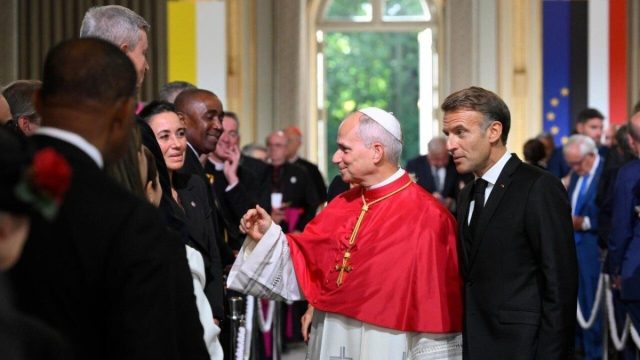
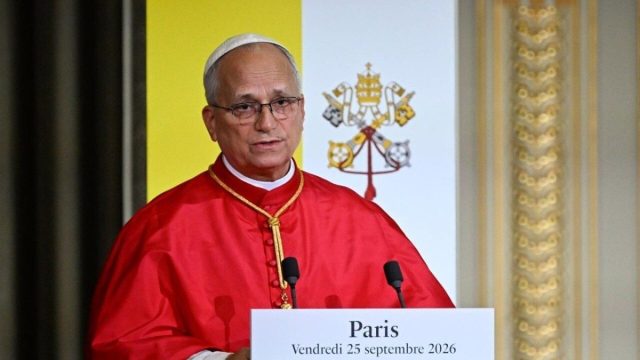
Pope Leo XIV tells French leaders the right to life underpins all other rights
In his first address at the Élysée Palace, Pope Leo XIV called for a ban on nuclear weapons, praised France's role in peacemaking and said protecting life is the basis of every other human right
Pope Leo XIV landed at Paris-Orly airport and traveled about 19 kilometers into the center of the French capital. Bells rang as he passed, and people applauded. At the Élysée Palace, the official residence of the president of the Republic, Emmanuel Macron and first lady Brigitte Macron welcomed him with military honors on the red carpet.
After their private meeting, Leo XIV spoke to officials, business leaders, representatives of civil society and culture, and the diplomatic corps gathered in the Salle des fêtes. Shortly before, Macron had written on X that the visit "bears witness to the strength of the ties that unite the Holy See and France" and that "together we will carry a message of peace, fraternity and hope." The president called for artificial intelligence "at the service of man," warning that "the digital revolution must not enchain, but liberate."
The pope's speech set out the main themes of his teaching on building peace. Pointing to current conflicts and violence, especially in the Middle East, Leo XIV urged his listeners not to remain indifferent to "sufferings that wound human dignity and cry out to God for justice." Such sufferings, he said, "demand an authentic conversion of heart and a change of attitude" so that the "civilization of love" can be built together.
The pope called for a ban on nuclear weapons and a reduction of existing arsenals. "Peace is not a balance of forces, but is built each day through dialogue and justice," he said. He urged France not to accept war as inevitable and to "promote dialogue and diplomacy tirelessly" to preserve peaceful societies that respect the dignity and rights of the person.
Leo XIV described France's historic vocation as a "tireless architect of peace and multilateralism, particularly within our beloved Europe." He said he hoped the country, faithful to its values, would "chart the path toward a disarmed and disarming peace" and offer "responsibly its irreplaceable contribution in favor of peace."
The pope said he was glad of his family's French roots. The parents of his maternal grandmother were born in Normandy, he said, and for that reason France often has a central place in his prayers. He described the country as a "cultural, artistic and spiritual beacon, not only in Europe but also in the world," a place of the search for truth, able to "forge the intelligence of peoples, far beyond its own borders."
Calling Paris the Ville lumière, Leo XIV said French savoir-faire is "synonymous with excellence in many fields," singling out the restoration of the cathedral of Notre-Dame de Paris, which burned in 2019. He thanked Macron for the effort and for the cooperation between public and private institutions, and he made a point of thanking the workers. In the rebuilt cathedral he saw "not only the culmination of a technical feat, but the symbol of a recovered hope": proof that what has been destroyed can be reborn when everyone works together.
The pope linked these ideals to France's national motto. "Liberty, equality and fraternity are not simply words engraved on the pediments of your public buildings, but point to universal ethical demands, which also find in the Gospel message an inexhaustible source of inspiration and fulfillment," he said. He also recalled the Universal Declaration of Human Rights, which St. John Paul II called "a true milestone on the path of humanity's moral progress."
Leo XIV briefly reviewed the history of France as a "land of rich Christian roots." He pointed to humanism, "which sought to unify the Greco-Roman heritage and the Christian faith," the flowering of the Renaissance and, later, the Enlightenment, which opened the way to the "recognition of the rights of man inherent in the nature of the human person, in particular religious freedom."
Protecting life as the foundation
The defense of life ran through the speech from start to finish. The pope said that "a truly free society protects diversity through an ethical dialogue that enriches the social fabric." He said "protecting the right to life constitutes the indispensable foundation of every other human right." He encouraged those who work with the most fragile and suffering to see them as "a true school of humanity," and he stressed the "unique and irreplaceable value of every human being."
Leo XIV warned against blind confidence in science and technology, a subject he had already addressed in his encyclical Magnifica humanitas. He pointed to the danger that they turn into "profit-making enterprises that favor genetic manipulation, surrogate motherhood, the purchase of organs or the offer of a programmed death." He cited the concern of the French writer Georges Bernanos about blind obedience becoming "mistress of a paradise of machines." To face those risks, the pope said it is urgent to "form minds in an ethical discernment capable of recognizing what is morally good."
Secularism at the service of the common good
The pope defended a rightly understood secularism that, far from excluding religion, treats it as "an educational resource." True secularism, he said, "does not consist in excluding religion from the public sphere or from education, but in committing oneself to ensuring that the State and religious institutions dialogue with one another and join forces at the service of the common good." He pointed to the steady work of the Church in France and its ongoing dialogue with the government for the benefit of all.
The pope thanked France and the Catholic Church for their cooperation on behalf of Christians in the East. He praised the work of organizations such as Aid to the Church in Need and Œuvre d'Orient, which he called "a valuable contribution to dialogue between peoples and to the protection of the rights of each person." He pointed to the importance of the Fund for the Schools of the East, which since 2021 has supported more than 260 educational institutions in the Middle East, among them seven universities in Lebanon and Bethlehem University.
Closing his address, Leo XIV expressed his gratitude and said that "a Church that sought to disregard temporal affairs would not fully fulfill its vocation; and a president of the Republic who sought to disregard the Church and Catholics would fail in his duty." The speech ended with a long round of applause.