UNESCO chief tells Pope Leo XIV that nothing can replace moral conscience
UNESCO Director-General Khaled Ahmed El-Enany Ali Ezz welcomed Pope Leo XIV to the organization's Paris headquarters on September 25, 2026, 46 years after St. John Paul II's visit in 1980
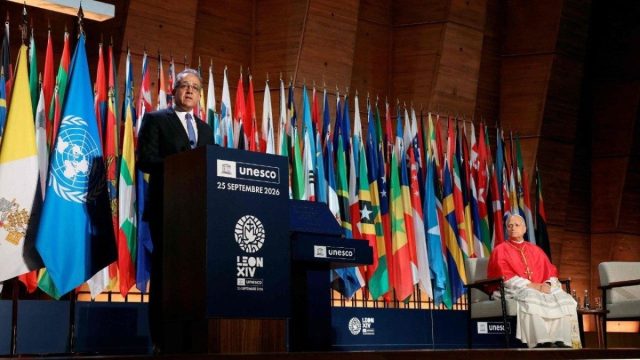
The director-general of UNESCO, Khaled Ahmed El-Enany Ali Ezz, received Pope Leo XIV at the headquarters of the United Nations Educational, Scientific and Cultural Organization in Paris on September 25, 2026. The visit comes 46 years after St. John Paul II went to the same institution, in 1980.
El-Enany said the pope's presence was a "powerful confirmation of shared values" in line with the encyclical Magnifica Humanitas. He said it was also a call to put peace, human dignity and dialogue at the center of all action taken to give younger generations hope of a better future.
El-Enany delivered his address in several languages, beginning in English and finishing in French. He called the meeting a "truly historic moment" and thanked the pope for the visit on behalf of the organization's 194 member states and some 5,000 staff. He also reaffirmed UNESCO's ties with the Holy See, a permanent observer at the organization since 1952.
UNESCO works above all with people, El-Enany said: students, teachers, scientists, researchers, artists and local communities. Its mission, he said, is to help them develop their potential and to defend their rights and their dignity, with particular attention to those living through crises or conflicts, where solidarity is most urgently needed.
He went through the organization's areas of work. Education, he said, is the essential pillar for cultivating "values, skills and critical thinking" and for promoting "peace, human rights and sustainable development." He spoke about the need to counter hate speech and to promote ethical, open science serving the common good. Culture, he said, builds "bridges between peoples and nations" by encouraging intercultural dialogue and respect for diversity.
The priorities he listed included support for Africa, the defense of the rights of women and girls, and attention to small island states threatened by climate change. He also cited active listening to young people, whose voices he described as a source of inspiration. Much of his message centered on preserving the legacy of the past and preparing new generations for the challenges ahead, from protecting the planet to artificial intelligence.
He voiced his most explicit concern about artificial intelligence. The technology must remain at the service of humanity, he said, and nothing can replace discernment, moral conscience or empathy. He pledged to ensure that artificial intelligence is "ethical, accessible, equitable and sustainable." He said he remained confident in the primacy of human intelligence, the most valuable and lasting resource, and that technological tools must be managed responsibly and for the common good.
El-Enany closed by calling for a renewed multilateralism able to meet the challenges of the 21st century without abandoning the fundamental values that have guided UNESCO since its founding.