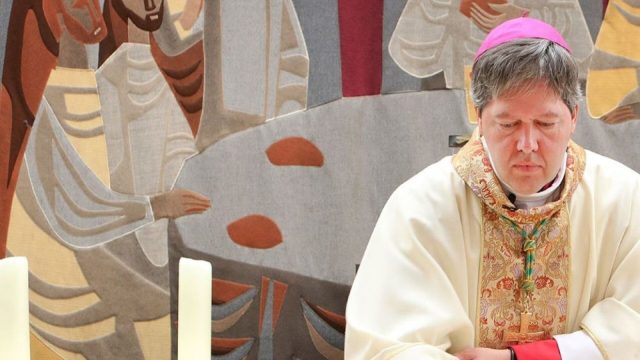
Cardinal Roche says Pope Leo XIV will not lift traditional Mass restrictions
The Vatican's liturgy chief said on October 13 that Traditionis custodes will stand under Pope Leo XIV, prompting an immediate response from Dutch auxiliary bishop Rob Mutsaerts
On October 13, Cardinal Arthur Roche, prefect of the Dicastery for Divine Worship and the Discipline of the Sacraments, ruled out any return to the earlier policy on the traditional Mass. "Traditionis custodes is not going to change. There is not going to be a return to Summorum Pontificum" under Pope Leo XIV, he said.
Roche defended the restrictions that Pope Francis imposed in July 2021. Summorum Pontificum, Benedict XVI's 2007 motu proprio, had been used in some regions "as a vehicle to promote an earlier liturgy to the detriment of the renewed liturgy," he said. In Roche's view, that situation led Francis to call the Church back to the Second Vatican Council for the sake of unity.
Cardinal Roche's warnings
Roche said that anyone who rejects the Second Vatican Council moves away from the center of Catholicism, and he called such a position "very serious." He advised the faithful not to attend the traditional Mass exclusively, saying that practice is a problem for the Church's unity.
In his conversations with groups of traditional Catholics, the cardinal said he had asked: "What is your problem? What more do you want?" He suggested the faithful already have legitimate ways to celebrate according to the older rite. Catholics should examine their conscience in light of the Church's teaching rather than their personal preferences, he said.
Roche also spoke about the Society of St. Pius X (SSPX), saying he regards the sacraments administered by its priests as invalid for lack of jurisdiction and authority. Francis had granted permission for confessions and marriages celebrated by Society priests during the Jubilee of Mercy.
The response from a bishop
Bishop Rob Mutsaerts, auxiliary bishop of 's-Hertogenbosch in the Netherlands, replied in a post on his blog titled "The threatening language of Cardinal Roche." He asked: "Why does practically every ancient Catholic liturgical tradition constitute a richness, except the ancient Roman liturgy?"
Mutsaerts wrote that the Catholic Church accommodates the Byzantine, Maronite, Armenian and Chaldean liturgies without any threat to unity. "Suddenly, liturgical diversity becomes a problem," he wrote, asking why the traditional Roman rite is treated so differently from other ancient traditions.
A doctrinal distinction
Mutsaerts drew a distinction he considers decisive for the debate. He acknowledged that anyone who denies the validity of the new Mass, rejects papal authority or holds that the Church after Vatican II is no longer Catholic takes a problematic position. But someone who loves the traditional Mass, grows in faith through it and remains loyal to the pope cannot be accused of rejecting the Magisterium, he said.
"Attachment to a liturgical tradition is not the same as rejection of the Magisterium," Mutsaerts wrote, a distinction he said risks being lost in Roche's language. He wrote that a father who takes his children to the old Mass "is simply going to Mass. He is not engaging in church politics."
The council
Mutsaerts also challenged Roche's reading of what Vatican II intended. He noted that the constitution Sacrosanctum Concilium states that all lawfully recognized rites have equal dignity and that the Church wishes to preserve and promote them. The council provided for liturgical reform while also establishing that Latin was to be preserved and that Gregorian chant held pride of place.
"Much of what is today considered typically traditionalist was completely natural for the council fathers," Mutsaerts wrote. He warned that treating Vatican II as an absolute dividing line between an old Church and a new one produces the very rupture it claims to want to avoid.
Young Catholics
Mutsaerts wrote that the traditional Mass is drawing more and more young Catholics, who deliberately choose silence, Gregorian chant and ritual precision. That suggests modernization is not always the best route for evangelization, he said. "Perhaps modern man longs for precisely what is not modern," he wrote.
The bishop proposed an alternative approach: make room for the old liturgy where it is sincerely wanted, require fidelity to communion with the Church, and correct abuses in every liturgical form with equal rigor. He closed with a direct appeal: "Your Eminence, the Church does not need to ban its past to secure its future."