Pope Leo XIV tells UNESCO that war is the most terrible of human works
Pope Leo XIV reaffirmed the Vatican's commitment to education, science and culture in an address to UNESCO, and warned about the dangers of technology cut off from ethics and truth
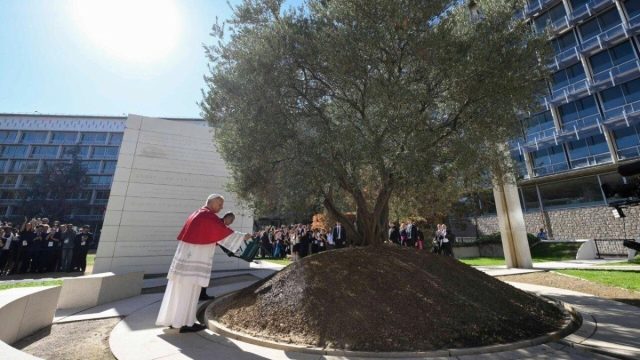
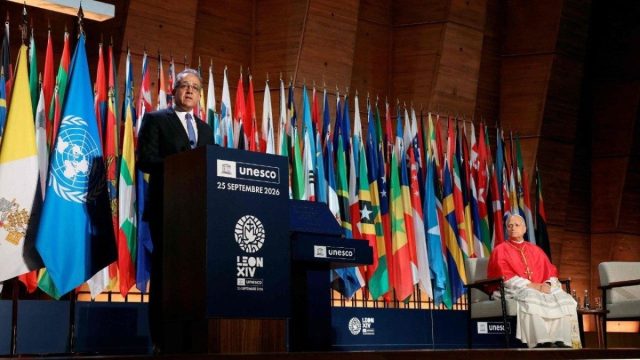
Pope Leo XIV addressed the UNESCO General Assembly in Paris on Friday, September 25, 2026, before representatives of member states, observers, international organizations, universities and civil society. He was received by Khaled El-Enany, the organization's director general. The pope focused his address on human dignity, the dangers of technology and the value of education. "Building a just world together is, indeed, the very foundation of international cooperation," he said.
Leo XIV noted that 2027 will mark 75 years of the Holy See's presence at UNESCO, a presence that "rests on the conviction that the future depends above all on respect for and the promotion of the inalienable dignity of every human being created in the image of God." He described the organization as "a privileged interlocutor at the service of the common good," adding that the Vatican's permanent observer mission has "discerned and accompanied" its initiatives since 1952.
The fundamental question: What does it mean to be human?
The pope placed at the center of his address a question he considers fundamental: "What does it mean to be human?" "Every culture is challenged by this question," he said, "which lies at the heart of every form of knowledge, every art and every religion." He said that "every human being is conceived and born," which means that "to be human is first to be a child." From that he drew an ethical conclusion: "As children, we are all brothers and sisters."
Everyone is "born naked and in need," he said, poor by birth, "in need of bread and words, of care and affection." But "as we become adults, we run the risk of forgetting it." The consequences are serious, he said: "It is precisely those in need who suffer the greatest consequences of this forgetfulness, whenever their humanity is betrayed or discarded, exploited or deceived." When that common origin is lost from view, "life is no longer understood as a gift, but as a commodity."
The pope said that "being human implies a responsibility before history." The person "is the one who grows, learns and works with hands and mind." Through that work, "we can cultivate the earth or disfigure it, create works of art or destroy them." He then said: "the most terrible of 'human works' is war, for then science itself is placed at the service of an inhuman will to destroy and to kill."
The dangers of artificial intelligence
Leo XIV devoted a substantial part of his address to the challenges posed by contemporary technology. "Over the centuries, many tasks performed by human beings have been entrusted to machines, whose capacities and applications have continued to expand," he said. "More recently, certain artificial systems have even been given the name of our human faculty of thought: intelligence."
He pointed to a paradox. "While 'intelligence' is attributed to computational systems, we find it hard to recognize the inalienable dignity of human persons, whose lives are judged by the criterion of efficiency and who, when they are considered no longer productive, are rejected and discarded," he said. "This painful reality invites us to reflect on the fragility of our human nature and on the immense dignity of every human person, a dignity that remains unchanged even in the most vulnerable circumstances, even unto death itself."
He also warned about the corruption of truth in the digital sphere. "Without truth, language is subjected to the logic of violence and to the arbitrary will of the powerful," he said. "Others are excluded in the name of profit, and the innocent are killed in the name of freedom." He called on the international community to give "particular attention to the protection of children and young people" in the digital age, so that "these technologies support their growth, education and relationships, safeguarding their freedom to think and to discern."
From Babel to Pentecost
The pope built his theological reflection around two biblical images: the tower of Babel and the square of Pentecost. "The tower of Babel represents a unity imposed through domination," he said. "This building reveals that the more power seeks to oppress, the more it weakens itself, exposing its inhuman face." He added: "Many empires have boasted of their power before being consumed by it and collapsing like a tower."
Against that model, he said, "it is the peace of Pentecost, not the domination of Babel, that makes this communion among all peoples possible." At Pentecost, he recalled, "each one present heard the message 'in his own native language.'" "Communion in no way suppresses diversity. On the contrary, it allows diversity to flourish in the harmony of voices and faces."
Leo XIV linked that reflection to the present. "The temptation of Babel reappears today in a globalization pursued without fraternity, in rapacious forms of neocolonialism, in ideological impositions and in all those 'contacts without bonds' that reduce human life to commerce," he said. "Science itself, when reduced to a technique of power, no longer serves to raise up the human person, but risks degrading the fruits of human effort."
Education, truth and justice
The pope said that "only the truth sets us free." "Those who teach and those who carry out research know that error enslaves us to ignorance and superstition," he said. He tied that to justice: "Without a shared conscience, the many channels of communication risk multiplying false information and giving currency to words empty of meaning, hindering dialogue instead of fostering it."
He praised UNESCO's Media and Information Literacy (MIL) initiative, which "promotes the responsible use of media and digital tools." "In the digital age, the vulnerability of the young must never become an opportunity for exploitation," he said.
Education, science and culture must always be "directed toward the search for the beautiful, the good and the true, so that the world may have life," he said. He asked that "care for the smallest person and for the poor" be the measure of real commitment: "They are the true test of our claims to respect human dignity."
He closed by saying he hoped the meeting would "strengthen the commitment of each one to work unceasingly so that the awareness of belonging to a single human family may become more alive, more active and more just." Leo XIV addressed "these words to all of you, to the peoples you represent, and in particular to the young. It is indeed the new generations who watch our action most closely."