Breviaries of St. Francis and St. Clare go on display together for the first time in Assisi
The Porziuncola Museum in Assisi, Italy, has brought the two breviaries together in an exhibition running until October 25, 2026, as part of the 800th anniversary of the death of St. Francis
The Porziuncola Museum in Assisi, Italy, has put the breviaries of St. Francis and St. Clare on display together for the first time, in an exhibition marking the 800th anniversary of the death of the founder of the Friars Minor.
The exhibition, "St. Francis at the Porziuncola," opened this year and runs until October 25, 2026. It is part of the events marking the eighth centenary of the death of the saint, who died on October 3, 1226, in the same Umbrian town.
The Basilica of St. Mary of the Angels was built in the lower part of Assisi by order of Pope Pius V in 1569 to protect the Franciscan sites and care for pilgrims. It houses the small Porziuncola church and the Chapel of the Transitus, where St. Francis died. The museum has recently been renovated, and a new entrance now gives access to the old Porziuncola cloister, which dates from the 15th century.
The curator, Donatella Vaccari, said the renovation has improved the visitor's experience considerably, since visitors can now walk through the shrine before entering the museum. Friar Saúl Tambini OFM, custodian of the basilica and director of the museum, said the museum holds major works and authentic examples of Franciscan iconography. It also preserves the history of the friars who lived beside the Porziuncola from the death of St. Francis until the 15th century.
One room is devoted to St. Clare. Vaccari said it contains several relics: her breviary, the small bell she used to call her sisters, the pectoral cross of St. Bonaventure and the little box that held the Sacred Host. Clare's breviary appears alongside that of Francis for the first time, showing the link between the two figures in Franciscan history.
The breviary of St. Francis, used for the liturgy and the prayers of the Franciscans, is normally kept at the convent of St. Clare and was moved to the museum for this exhibition. Tambini said the book is not only of artistic value but also of liturgical and ecclesial importance, because Francis adopted it and it helped unify prayer in the Church.
The works of Franciscan iconography in the exhibition include pieces attributed to Cimabue and to the Master of St. Francis. Vaccari said one of the most significant is a portrait of Francis considered among the most authentic known, believed to have formed part of the saint's first coffin. The portrait is itself a relic, and pilgrims can pray before it.
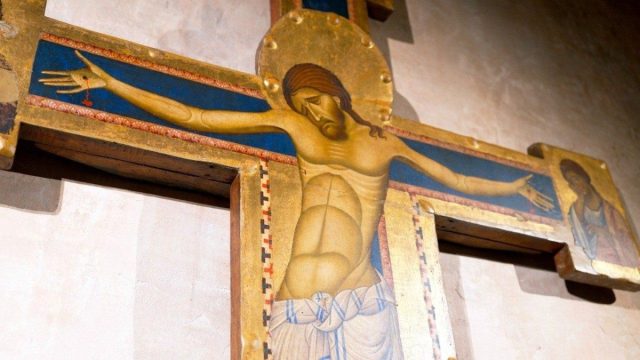
The last room holds a cross of the suffering Christ made by Giunta Pisano around 1236, which depicts the humanity of Christ. Tambini said its closeness to the place where Francis died at the Porziuncola changes the way visitors contemplate the work.
The temporary exhibition remains open until October 25 as part of the celebrations of the 800th anniversary of the death of St. Francis. Tambini encouraged everyone to visit the museum and said that after the renovation it has become a unique place of recollection, with original works of great historical and spiritual value.
The Franciscan Jubilee Year, proclaimed by Pope Leo XIV for the 800th anniversary of the death of St. Francis of Assisi, began on January 10, 2026, and will end on January 10, 2027.