Pope Leo XIV urges US Catholic donors to remember the poor
Meeting the FADICA network of American Catholic foundations on the 400th anniversary of St. Peter's Basilica, the pope thanked its members for 50 years of support and asked them to keep the poor in mind
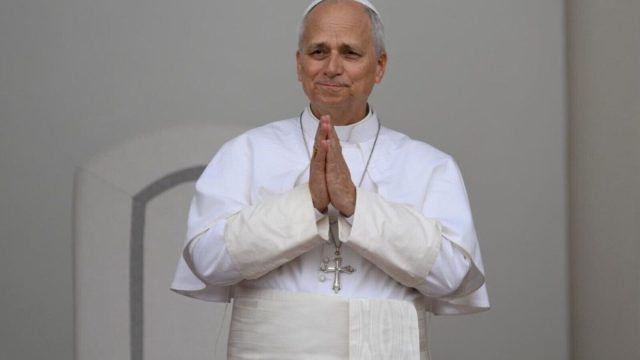
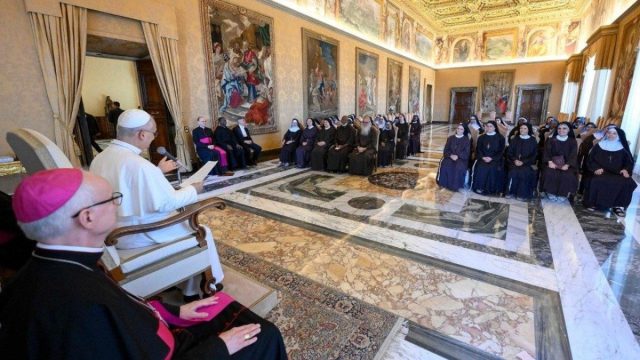
Pope Leo XIV met with a delegation from FADICA, short for Foundations and Donors Interested in Catholic Activities, at the Vatican on Wednesday, November 18, 2026. The network of US Catholic foundations and donors has funded Church activities for 50 years, including initiatives of the Roman Curia. The audience fell on the 400th anniversary of the dedication of St. Peter's Basilica. The pope used the occasion to place the network's mission within the continuity of the faith handed down since the beginnings of Christianity. In the afternoon, he celebrated a Mass in the basilica to mark the anniversary.
The pope gave a brief greeting in English. He opened by reminding his visitors of the date: "Your visit to the Vatican takes place on the very day that, 400 years ago, St. Peter's Basilica as we know it today was consecrated." Pope Urban VIII solemnly consecrated the new building on November 18, 1626. Construction had begun on April 18, 1506, under Pope Julius II.
The Church's foundation stone
From that historical starting point, the pope turned to the theological meaning of the building. "Christ entrusted the keys of the Kingdom of Heaven to that humble fisherman from Galilee," he said, referring to the Gospel of Matthew (16:18-19), "upon whose confession of faith the Church would be built." He added that "Jesus called St. Peter to be a source of strength and encouragement for the Apostles, and indeed a point of unity for the whole Church."
The basilica stands over Peter's tomb. It is decorated with depictions of these episodes and other moments in the apostle's life, and it holds the tombs of many popes. The pope called it "a living testimony to the continuity of the Church's faith, guaranteed by fidelity to the living Tradition handed down from the first of the Supreme Pontiffs to our own day." The Second Vatican Council's dogmatic constitution Dei Verbum teaches that the Magisterium, the Church's teaching authority, serves the Word of God, which it receives and faithfully preserves with the help of the Holy Spirit.
The anniversary homily
In his homily at the afternoon Mass in St. Peter's, the pope expanded on these ideas. He said the whole basilica "echoes with the question Christ asked his disciples: 'Who do you say that I am?'" "As we listen to the words of Jesus, we who come from so many different nations are taken by the hand by St. Peter, to profess together the truth that saves: Lord, 'you are the Christ, the Son of the living God,'" he said.
He described that profession of faith as the confessio Petri, the truth to which Peter bore witness together with the Roman martyrs and which "made the soil of the Vatican Hill fruitful, so that it would bear the fruit of holiness through the centuries." "Today we are that fruit, living stones, a temple of the Holy Spirit built on the foundation that is Christ," the pope said. He added that over the centuries this foundation has found expression in apostolic succession and in the living tradition of the Church.
A specific request: remember the poor
Addressing the FADICA members, the pope turned from the monument to the people in front of him. "During these 50 years you have worked generously to strengthen and carry out various programs in support of the Church as a whole, including initiatives of the Roman Curia such as those promoting Catholic education, care for creation and the defense of human dignity," he told them. He thanked them for that commitment and encouraged them to continue it. He then made the only specific request of the speech: that in the programs they fund, they keep in mind "especially the needs of the poor and the disadvantaged."
To support the appeal, the pope cited the second chapter of the Letter to the Galatians. There Paul recounts his meeting in Jerusalem with James, Cephas (Peter) and John, the "pillars" of the early community. The four join hands as a sign of communion and divide the work of preaching among them, and Paul and Barnabas are asked only one thing: to "remember the poor." On the day the basilica built over Peter's tomb marked its anniversary, the passage the pope chose for the donors was the one in which Peter, together with the other apostles, sets that single condition for his co-workers.
FADICA: 50 years of Catholic philanthropy
FADICA was founded in 1976 by a small group of Catholic philanthropists and is based in Washington. Its first president was Peter S. Robinson. Francis J. Butler led the organization from 1980 to 2012. In his farewell speech, he described a network that had grown from about a dozen foundations to more than 40, with combined assets of more than $4 billion and annual giving of nearly $400 million.
Alexia Kelley has led FADICA since 2012. According to figures released by the organization, its members now manage assets worth more than $10 billion. Among the best-known member foundations is the Raskob Foundation for Catholic Activities, set up in 1945 by John J. Raskob, the financier behind the construction of the Empire State Building. In March, at the network's 50th annual meeting, the foundation received FADICA's award for Catholic leadership.
The Holy See's finances
The Holy See has run a structural deficit for years. Peter's Pence, the collection that helps fund the Roman Curia and the pope's charitable works, took in 58 million euros in 2024 and spent 75.4 million euros.
That year, 25.2 percent of Peter's Pence donations, or 13.7 million euros, came from the United States, compared with 2.8 percent from Germany. In 2025, the US contribution reached 14.2 million euros.
Money and the building of St. Peter's
Construction of the basilica took more than a century. To pay for it, Pope Leo X revived the preaching of indulgences in 1515. The preaching of the Dominican friar Johann Tetzel in Germany was among the reasons that led Martin Luther to write his Ninety-Five Theses in 1517. The money the popes raised to build the basilica contributed to the split in Western Christianity.
Based on reporting by Juana Morales for Iglesia Noticias. This article was translated and adapted from Spanish with the help of artificial intelligence.