Pope Leo XIV addresses abortion and euthanasia at the start of his Uruguay visit
In his first speech in South America, delivered with Uruguay's president present, the pope defended life from conception to its natural end and said a secular state need not confine religion to private life
Pope Leo XIV opened his first visit to South America on Friday, November 6, with a speech to Uruguayan President Yamandú Orsi, civil authorities and the diplomatic corps gathered in Plaza Independencia in Montevideo. It was the first official event of a 12-day trip that will also take him to Argentina and Peru. He spoke about the protection of life from conception to its natural end, universal health care, work, artificial intelligence and the place of religion in a secular state, without naming any of the Uruguayan laws that cover those areas.
About 30,000 people were waiting for him after the 14-hour flight from Rome. He built the speech around the bronze frieze that runs around the pedestal of the monument to José Gervasio Artigas, the work of the sculptor Angelo Zanelli, unveiled in 1923. The remains of the national hero have rested beneath the monument since 1977. The pope treated each figure in the relief as a text to comment on, drawing a chapter of social teaching from each one.
Life from conception
The frieze shows a woman holding a newborn as the column moves forward. The pope used that image to say that the child not yet born already belongs to the human family, and that complete dependence on the mother takes nothing away from the dignity and protection that child is owed. He linked the point to the Incarnation: Jesus Christ took on that same condition of human dependence, the condition of the unborn. He offered it as an argument for the dignity of those who have not yet come into the world.
He said welcoming a new life requires the commitment of the father, the backing of the family and social conditions that make it possible to raise children. He ended with a sentence rejecting any separation between the two: "The protection of the one who is to be born and the support of those who welcome that life are inseparable." He was speaking a few meters from Orsi, in a country where abortion has been legal since 2012 under Law 18,987 and where there were 29,899 live births in 2024.
On euthanasia, the pope quoted his own encyclical Magnifica humanitas, recalling that the fundamental dignity of each person is neither acquired nor proven. He used the word suicide: "Loneliness, anxiety and the loss of hope can become so deep that a person no longer sees a reason to go on living." Uruguay's Ministry of Health counted 668 deaths by suicide in 2025, the lowest figure since 2015, though it places the country among those with the highest rates in Latin America. The pope said proper health care, family ties and the closeness of loved ones cannot be separated in the face of that reality, and that no one should end up feeling like a stranger among their own. He ended the passage by insisting that every person be accompanied "to the natural end of their life." The wording pointed directly to the euthanasia law passed by the Uruguayan Senate on October 15, 2025, the first parliamentary legal framework on euthanasia in Latin America. Orsi signed the implementing decree on April 15, 2026.
A secular state without excluding faith
Uruguay is the least religious country in Latin America. More than half the population does not identify with any organized religion, the official calendar calls Holy Week "Tourism Week," and the country's secularization began two centuries ago. The pope said the secular character of the state means guaranteeing a space where believers and non-believers live together in freedom and respect, but that this neutrality does not require religion to be shut away in private life. "This neutrality does not demand that the religious dimension remain confined to the private sphere," he said, citing the teaching of the Second Vatican Council on freedom of conscience.
He said individuals and religious communities can contribute to the common good while supporting the autonomy of civil institutions. Orsi and the pope both pointed to the Church's charitable and social contribution to the life of the country.
Work, education and renewable energy
On work, the pope returned to the formula of John Paul II's encyclical Laborem exercens: "work is 'for man' and not man 'for work.'" He warned that the advance of digitalization and artificial intelligence cannot turn the worker into a disposable part of the production process. The way a society organizes its economy, he said, has a direct effect on the living conditions of its citizens.
He said Uruguay has radically transformed its electricity generation, which now relies almost entirely on renewable sources, 98 percent in 2025. He called that result "remarkable." He also spoke about universal health care, recalling his recent surgery for a cancerous tumor in his right lung at the Gemelli Polyclinic in Rome.
A large turnout in a secularized country
Uruguay is one of the most secularized countries in Latin America, with Catholics at 33 to 35 percent according to Latinobarómetro 2024. The 70,000 free tickets for the November 7 vigil at the Estadio Centenario in Montevideo ran out in less than three hours. Guzmán Carriquiry Lecour, former secretary of the Pontifical Commission for Latin America, said he had never seen the city's public spaces so full of welcome signs. It was the first visit by a pope to Uruguay in 39 years.
Vatican statistics show a steady fall in practice. In 1980 there was one priest for every 4,940 residents; by 2024 the ratio had fallen to one for every 9,700. Marriages celebrated in the Church fell from 8,673 to 1,649, and first Communions from 15,449 in 1990 to 4,087 in 2024. The interdiocesan seminary received no new candidates in 2024.
Prayer for vocations
The pope celebrated Vespers at the Metropolitan Cathedral of the Immaculate Conception on the afternoon of November 6 before bishops, priests, deacons, religious and seminarians. The celebration had its origin in a recent episode: in 2024, when the seminary received no new candidates, many of the faithful organized to ask the Lord, in the words of the Gospel of Matthew, to send laborers into his harvest. The prayer has not stopped since, and several young people have already begun their path in the seminary or in consecrated life.
"What a joy to know that generous responses to the love of Christ continue to be born!" the pope said. He asked that the experience reach beyond Uruguay and issued a formal invitation to his brother bishops around the world: "From this Cathedral of Montevideo, I invite my brother bishops of the whole Church to promote in their dioceses days of prayer and fasting for an increase in vocations to the priesthood and consecrated life." He extended the call to parishes, families and religious communities.
In his homily the pope recalled Blessed Jacinto Vera, the first bishop of Uruguay, whose tomb is in the cathedral. A religious sister who knew him testified that he seemed always to be at prayer. "One of the secrets of evangelization is to resemble the One we proclaim," the pope said.
Meeting young people
On the night of November 6, a group of young people waited for the pope in the street outside the Apostolic Nunciature. He came out onto the balcony to greet them and found a very different atmosphere from the solemnity of Vespers: applause, shouting and young people who wanted a close look at him. "I see that Uruguay is a country of young people who have faith," he told them, before joking that the nuncio wanted to sleep.
At the vigil on November 7 at the Estadio Centenario, before tens of thousands of young people, the pope said openly that the faith is no longer passed on with the ease of earlier generations. He did not present that as a defeat. Uruguayan believers, used to living their faith in an indifferent setting, can offer something valuable to other Christian communities that are beginning to face the same situation, he said. He used the image of Bethlehem: a small town, insignificant in human eyes, but chosen by God. He encouraged the young people not to shy away from lifelong commitments: "Do not be afraid of 'forever.'" The vigil ended with a call not to settle for a routine faith: "Be saints."
Casavalle: poverty and drug trafficking
On Saturday, November 7, Leo XIV became the first pope to visit Casavalle, an area in northern Montevideo where more than 15 Church-run works operate alongside families hit by poverty and drug trafficking. Before 12,000 people, he took the parable of the Good Samaritan as the thread for a challenge to the Church, civil society and the state about their responsibility toward those who suffer.
"We cannot pass by when we know that there are children in Uruguay who do not go to school for fear of not coming back," he said. "Nor can we silence our conscience when we see that a mother does not have the means to feed her children," or ignore that there are people suffering alone in situations of vulnerability. A child in a country with so many resources should not go to bed without eating or be forced to give up an education because of violence in the streets, he said. Latin America has a homicide rate four times the world average.
The pope spoke about the Servant of God Rubén Isidro Alonso, known as Padre Cacho, a Uruguayan priest who gave his life to the poorest outskirts. Casavalle has more than 15 Church-run works serving children, young people, families and the elderly. The Liceo Jubilar Juan Pablo II has some 450 students and combines teaching with individual support, meals and emotional support. The pope welcomed a project to build housing for low-income families, promoted by the parish community with financial support from the Papal Foundation.
He called for a joint and urgent response: "We have to work together: the Church, the civil community and the state. We need to wake up from our inertia and advocate for the common good." He returned to Francis's teaching in Fratelli tutti: the inclusion or exclusion of the person suffering by the roadside defines any economic, political, social or religious project.
A Golden Rose and the faith handed on by women
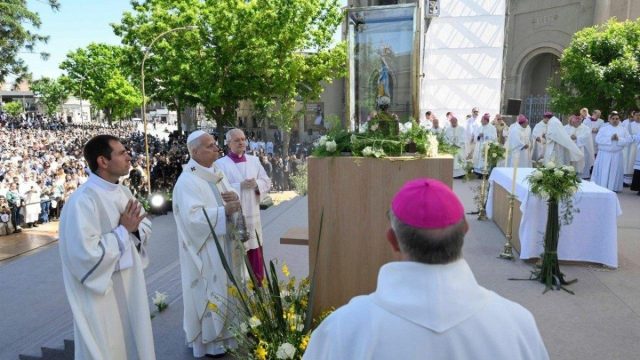
On Sunday, November 8, the pope presided at the closing Mass of his Uruguay visit before some 50,000 faithful in Plaza Asamblea, in front of the Cathedral Basilica in the Uruguayan city of Florida. The basilica is home to the National Shrine of Our Lady of the Thirty-Three, the country's patroness. The celebration centered on the handing on of the faith within families and on the part women have historically played in that work.
In his homily the pope began with two biblical women: Mary at the Visitation and Judith in the Book of Judith. He recalled Timothy, whose faith began with two women, his grandmother Lois and his mother Eunice. Uruguay also has women's names written into its history of faith: St. María Francisca Rubatto, an Italian missionary religious sister, and the blessed martyrs Dolores and Consuelo Aguiar-Mella, two sisters born in Montevideo.
Most of that history, he said, was never recorded in any book. It was passed on quietly from parents to children within families. The pope said some women held on to their faith without finding understanding or support in their own homes, and that many carry "a very concrete sorrow": they taught their children to pray, and those children do not pray today. For them he recalled the witness of St. Monica, who for years kept praying as her son Augustine drifted away, without ever losing her trust in grace. He told them: "Mothers and grandmothers: do not grow tired of handing on the faith! Preach with your life and also with your words. Persevere in prayer, in love and in hope. There are doors you cannot open, but God can."
He also spoke to men, telling them their children and grandchildren need to see that faith has a real place in the lives of the men of their family. He offered the example of St. Joseph: "Young people need to see you pray, approach the sacraments, treat your wives with respect, ask forgiveness and live honestly even when doing so demands sacrifices."
At the end of the Mass the pope placed a Golden Rose before the image of Our Lady of the Thirty-Three, taking up an old papal tradition of honoring Marian shrines. He explained the gesture: "With this gesture I wish to honor the one who is truly 'the pride of our race.'" In the prayer of consecration he invoked the Virgin as "Captain and Guide of this people" and asked her to "crush the works of the devil and preserve beloved Uruguay from all that would draw it away from Christ."
The Mass in Florida drew the largest crowd of the visit. The shrine usually receives about 10,000 pilgrims a year. At the end of the Mass the crowd chanted "Papa León, te queremos un montón" ("Pope Leo, we love you a lot"), closing three days in which his words and gestures led the country's news. On November 8 the pope left Montevideo for Buenos Aires.
Based on reporting by Laura Clavería for Iglesia Noticias. This article was translated and adapted from Spanish with the help of artificial intelligence.