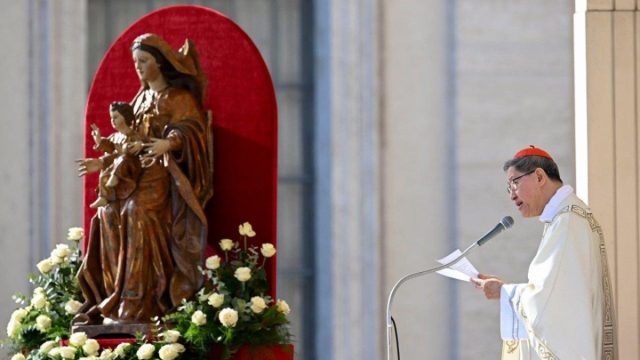
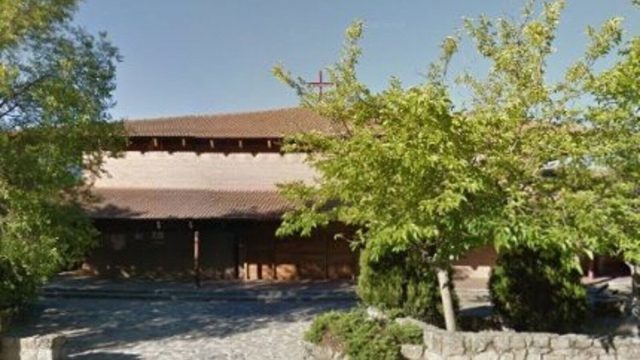
Pope Leo XIV opens Argentina trip at Don Orione home for people with disabilities
The pope made the Cottolengo Don Orione in Claypole, outside Buenos Aires, the first stop of his visit to Argentina, where he visited the chapel that holds the relic of St. Luis Orione's heart and heard the testimony of a resident, Marta Griselda Torres
Pope Leo XIV left the Apostolic Nunciature at 7:45 a.m. local time for the Cottolengo Don Orione in Claypole, a town in the district of Almirante Brown, in Buenos Aires province. The Holy See Press Office said close to 100,000 people greeted him along the route, some of whom had spent the night camped beside the barriers. He covered the last 700 meters (about 2,300 feet) in the popemobile. About 3,000 people were waiting at the gates of the complex with flags and expressions of affection.
The visit, the first stop on his trip to Argentina, was devoted to people with disabilities and to those who need permanent care. The complex covers about 50 hectares (124 acres) and is home to more than 400 people with disabilities, many of them requiring continuous assistance. Residents, health workers, religious, caregivers and staff carry out the daily work of care and support there.
The relic of St. Luis Orione's heart
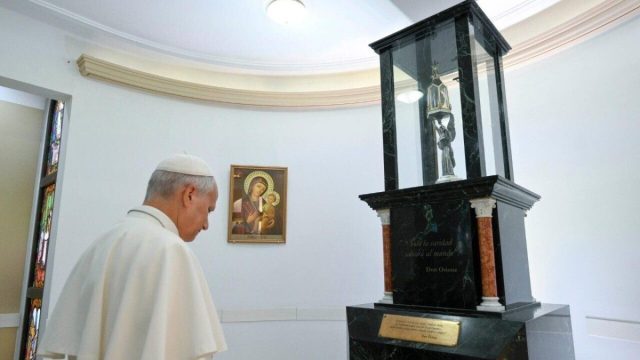
The governor of Buenos Aires province, Axel Kicillof, received the pope on his arrival, along with provincial and municipal officials. Leo XIV went to the community chapel, the main space in the complex, where the relic of the heart of St. Luis Orione, founder of the Little Work of Divine Providence, is kept. He appeared visibly moved as he entered.
In his address, Leo XIV recalled the phrase that sums up Orione's apostolate: "Charity will save the world." He quoted the words of St. John Paul II at the saint's canonization in 2004, which described him as a "strategist of charity" whose heart "knew no bounds" because it was "expanded by the charity of Christ." The pope added: "Zeal for Christ was the soul of his intrepid life, the interior impulse of an unreserved altruism and the ever fresh spring of an indestructible hope."
Leo XIV said that same zeal sustained Orione's self-giving to others and allowed him to keep hope in the face of difficulties. He closed by asking that the saint's example move the faithful to cultivate hearts formed by the love of God, firm in humility, patient in trials and ready to serve with charity.
The testimony of Marta Griselda Torres
After words of welcome from the bishop of Lomas de Zamora, Jorge Rubén Lugones, Marta Griselda Torres spoke. A resident of the Cottolengo, she uses a wheelchair and has a visual disability. She was born with cerebral palsy and was abandoned by her mother at birth. In a steady voice, she told the story of that abandonment and of how the institution gave her a family and the care she needed. "I found here not only shelter but a home where I could be Marta," she said in the pope's presence.
When she finished, the pope gave her a rosary blessed by the Vatican. The singer-songwriter Abel Pintos then performed "La Llave," a song about overcoming loneliness whose lyrics describe the move from emptiness to the company of someone whose presence lights everything up. The "key" of the title stands for vulnerability and for unconditional access to another person's heart, a love that can overcome distance and time.
The story of St. Luis Orione
The Cottolengo is tied to the figure of St. Luis Orione, an Italian priest whose idea of charity went well beyond material aid: he sought to provide a home, dignity and a sense of belonging to those whom society pushed aside.
Francis's legacy
Throughout his pontificate, Pope Francis placed the defense of the most vulnerable at the center of his teaching. He often used the idea of a "throwaway culture" to denounce the tendency of contemporary societies to set aside those who do not fit their standards of efficiency and consumption. He argued that a person's worth is not measured by productivity, economic situation or physical and intellectual abilities, and he called for the full participation of people with disabilities in social life.
Leo XIV's own pastoral work was shaped by his years in Peru and by his membership in the Augustinian order, which brought him close to vulnerable communities, impoverished areas and people in need of greater protection.
Based on reporting by Juana Morales for Iglesia Noticias. This article was translated and adapted from Spanish with the help of artificial intelligence.