
Pope Leo XIV rejects the idea that progress draws people away from God
At his general audience on Wednesday, July 23, Pope Leo XIV said human progress springs from human freedom and intelligence, and told thousands in St. Peter's Square that it must be guided by charity and serve human dignity
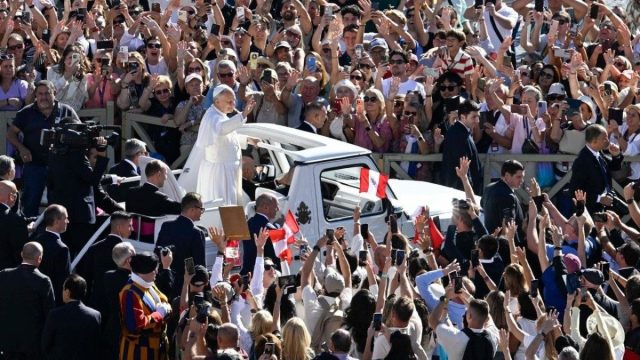
Pope Leo XIV devoted his general audience on Wednesday, July 23, to the value of human activity and its relationship with progress, drawing on the teaching of the Second Vatican Council. Speaking to thousands of faithful and pilgrims in St. Peter's Square, the pope examined how genuine progress in society must be directed toward charity and the defense of human dignity.
His catechesis focused on the pastoral constitution Gaudium et spes, and specifically on its third chapter, on "human activity in the world." The pope said progress should not be credited to forces outside the human person, but arises from human freedom and intelligence: man, created in the image and likeness of God, is the real agent of historical advance. "A great many goods which in the past man looked for above all from 'higher forces,' he now obtains for himself," he said.
The pope also pushed back against those who argue that technical and scientific development weakens the bond between man and God. He called that view a "prejudice" rooted in parts of Western culture that have lost contact with the Christian faith. "In post-Christian humanisms, the human being and God are wrongly presented as rivals," he said. He said that leads to an inevitable conclusion: denying the relationship with God amounts to giving up the transcendent value of the human person.
The pope said the Second Vatican Council gives a precise answer to those readings: human efforts to improve living conditions in fact reflect God's will. "Man's victories are a sign of God's greatness and a consequence of his ineffable design," he said.
God has entrusted human beings with the task of completing a creation that is still growing, he added. "Humanity, and with it work, progress and the autonomy of created realities, is not absorbed or annulled by the encounter with God, but rather taken up in its entirety," he said. Human work is therefore indispensable for reaching full truth and freedom in Christ.
The pope said the bread and wine offered at the eucharistic table are the fruit of human work, and that to find God a person does not need to abandon earthly occupations. "He can live his own vocation fully by doing his daily work well and sanctifying it," he said. He added that authentic progress must be guided by charity, so that it always serves to defend human dignity and improve living conditions for everyone, with particular attention to the most disadvantaged.
The pope closed by encouraging those present to share knowledge and skills so that individuals and peoples can develop their potential and, with God's help, contribute to building a more just future.


