Pope Leo XIV demands justice for murdered Indigenous leaders in Peru's Amazon
Meeting missionaries and Amazonian peoples in Pucallpa, Peru, the pope condemned illegal logging, destructive mining and violence against Indigenous leaders, and noted that the local vicariate has just 25 priests
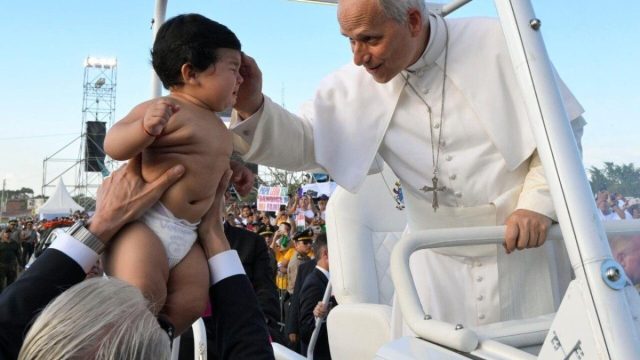
Pope Leo XIV traveled on Sunday, November 15, to Pucallpa, capital of Peru's Ucayali region, to meet missionaries and representatives of Amazonian peoples on the Puerto Callao waterfront, on the shore of Yarinacocha lagoon. He flew in from Cusco on a LATAM A320. The flight took about an hour and carried him from the Andean highlands down to the Amazon plain. He landed at 2:22 p.m. local time and was welcomed by the apostolic vicar, Augusto Martín Quijano Rodríguez, a Salesian. Local authorities estimated that about 5,000 people were at the meeting and another 20,000 lined the route.
The stage was draped with fabrics embroidered by the Shipibo-Konibo people. Delegations of the Shipibo-Konibo, Asháninka and Kukama peoples had spent several days traveling by river and road to get there. Before the pope spoke, there were dances, a play and two testimonies. One of the Shipibo-Konibo leaders present spoke of a shared hope: "We dream of the day when our children will not have to leave our communities to have a dignified life."
Violence and exploitation
The pope took that testimony as the starting point for his address. He said many Indigenous leaders had lost their lives in recent years defending their territories against the advance of extractive industries, and that "the blood of these brothers cries out to God and demands justice from men." Ucayali has its own cases. In September 2014, four Asháninka leaders were murdered in Saweto, a village near the border with Brazil. Among them was Edwin Chota, who had spent years speaking out against illegal loggers.
A second testimony described communities where reaching a hospital or a school is almost impossible, both because of the distances and because of institutional neglect. The pope also spoke about the violence and sexual abuse suffered by women, girls and adolescents, which takes place, he said, "often with the silence of complicity and impunity."
An alternative rooted in the Gospel
Citing two documents by Pope Francis, the apostolic exhortation Querida Amazonia and the encyclical Laudato si', the pope rejected the view that reduces the region to "a reserve of resources to be exploited." He listed the consequences of that model: the massive, indiscriminate clearing of forests and the poisoning of rivers by unregulated mining and oil spills. These, he said, were not accidents but the "bitter fruits" of the arbitrary exploitation of natural resources.
He also spoke of the threat of drug trafficking, which exploits young people's economic hardship to lure them with illusions of easy money and cuts them off from their cultural roots. In response, he proposed an alternative paradigm "rooted in the Gospel and respectful of the wisdom of peoples, who recognize, in different languages, how everything in the world is intimately connected." In his view, integral ecology, social justice and the spiritual life cannot be separated.
The pope said corruption and arbitrary rule undermine basic trust in human goodness. But for that very reason, he said, the Gospel becomes "an even stronger call to personal and communal conversion, offering a renewed hope of healing, consolation and reparation." He called for quality education in the languages of Indigenous peoples that values their ancestral knowledge, while still preparing new generations for global challenges.
A Church with an Amazonian face, and few priests
Turning to the pastoral situation in the Vicariate of Pucallpa, the pope said the territory has barely 25 priests. It covers more than 50,000 square kilometers (19,300 square miles), an area larger than Switzerland. He thanked the religious sisters, religious brothers and lay leaders who keep the faith alive in the most remote places "with heroic fidelity," and said their formation needs support and their "ministerial service" needs recognition.
He praised the efforts of the Ecclesial Conference of the Amazon and the Pan-Amazonian Ecclesial Network, two Church bodies that work across the Amazon region, to build a Church with an Amazonian face. He said his visit followed "in the footsteps" of Francis, who held a similar meeting with Amazonian peoples in Puerto Maldonado, in southeastern Peru, in January 2018.
Other stops
The Amazon meeting was part of a wider program. Earlier that Sunday, the pope had been in Cusco, where he led the Angelus and took part in a meeting on popular piety. The day before, November 14, he flew by military helicopter to a remote mountain area of his former diocese to honor the missionaries who evangelized the Andes over the centuries. At an open-air Mass for about 20,000 people in the Plaza de Santa Cruz, he praised the popular piety of the highland communities, where the faith, he said, "grew simple and genuine, grounded in the daily living of Gospel values."
He warned against the temptation to respond to injustice with violence. "This will never be the path of progress and peace," he said. Selfishness and evil, he said, are overcome not by brutality but by prayer, patience and perseverance in speaking out against what is wrong. During his years as a missionary in Peru in the 1980s and 1990s, the pope witnessed both terrorism by leftist groups and repression by right-wing elements, and he denounced both kinds of violence.
The schedule also included a prayer service in Zaña, near Chiclayo in northern Peru, at the shrine of St. Toribio de Mogrovejo, the Spanish missionary who was archbishop of Lima from 1581 until his death in 1606. After the meeting with Amazonian peoples, the pope went to the Villa Deportiva Regional Ucayali, a regional sports complex, where he celebrated Mass. It was the first Mass a pope has celebrated in the Peruvian Amazon.
Based on reporting by José García for Iglesia Noticias. This article was translated and adapted from Spanish with the help of artificial intelligence.