Pope Leo XIV tells Argentine officials the economy must serve people, with Milei at his side
During a two-day stop in Buenos Aires on November 8 and 9, Pope Leo XIV spoke about jobs, families, disability and corruption, and celebrated a Mass that drew about 2.5 million people
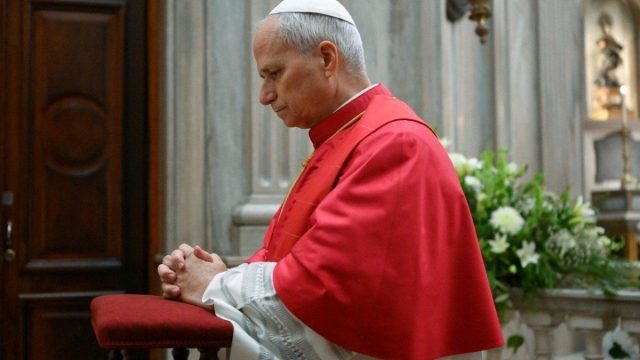
Pope Leo XIV arrived in Buenos Aires on November 8 from Uruguay. President Javier Milei was waiting at the foot of the aircraft steps at Jorge Newbery Airport. After a ceremony in the Plaza de Mayo, where the mayor of Buenos Aires, Jorge Macri, handed him the keys to the city, the pope went to the Palacio Libertad. There he addressed Vice President Victoria Villarruel, provincial governors, government officials, the diplomatic corps and representatives of civil society, with Milei beside him on the platform.
An economy at the service of the person
Speaking to the Argentine authorities, Leo XIV said: "The economy must be at the service of the person, and not the person at the service of the economy." He recognized the value of what creates opportunity and encourages private initiative, but said growth must also reach the unemployed, retirees and those who work and still cannot cover their household's basic needs. He questioned the fact that a nation has to ask itself why its young people are forced to emigrate to pursue their ambitions, and he called for investment in education, vocational training and universities.
He drew on Argentine cultural references, including Martín Fierro, Borges, the tango and mate, to describe a national identity received as an inheritance. He quoted his predecessor, Pope Francis: "May the Lord make you grow as a people." He closed with a reference to the tango singer Carlos Gardel, saying that life is short but goodness endures.
Milei, who describes himself as an anarcho-capitalist, used a more measured tone than usual during the ceremony. His human capital minister had said it was impossible for the pope to comment on local politics. Milei asked to see the content of the first papal address in advance and afterward called it "outstanding." He declined to expand on that assessment, so as not to fall "into the mud of using the speech politically." He had previously called Francis the "representative of evil on Earth"; he now paid tribute to the late pope, describing him as an "exceptional figure" and "without a doubt the most important Argentine in history."
A blessing for the vulnerable
On Monday, November 9, the first public event on Leo XIV's schedule was a visit to the Pequeño Cottolengo Don Orione in Claypole, a home for more than 400 people with severe physical and mental disabilities. Bishop Jorge Rubén Lugones of Lomas de Zamora said the choice of that place as the first stop was "a real sign," because it was a geographical and existential periphery. Brother Jorge David Silanes, the center's director, said the visit "fills us with consolation and renews our strength."
Before the meeting, two residents told the pope their stories. Marta Torres said she was born with a disability and was abandoned by her mother when she was very small. After years moving from place to place without finding one that suited her, she arrived at the Cottolengo, where she found "a home where I could be Marta." Norma Donato, a resident for 44 years, gave a testimony of hope about how fraternal love transforms life even in the most adverse circumstances.
Residents and staff wept when the pope arrived. Leo XIV embraced people in wheelchairs and said: "Your lives are not a burden on society; they are a blessing, because you can help us not to forget what the dignity of every human being is founded on." He used three towns of the Gospel to describe the ideal: Bethlehem, the "House of Bread," where Jesus was welcomed; Nazareth, where he grew up within a family and a community; and Bethany, where he knew genuine friendship without exclusion.
He quoted Pope John Paul II, who said in Osnabrück, Germany, in 1980 that those who suffer a physical or spiritual impairment should see themselves as "friends of Jesus, as especially loved by him." Leo XIV said "the progress of a nation is also measured by how it welcomes all people with disabilities and special needs." Drawing on the encyclical Magnifica humanitas, he called for building a "civilization of love," acknowledging that it is "a slower, less visible and less striking" kind of construction than others, but one directed toward a horizon of commitment and hope.
Milei's government has withheld much of the funding for disability care. With international attention on the papal visit, the authorities paid the center about $535,000 for medicines, diapers and food, covering four of the 12 months it was owed, according to Fernando Montero, who heads the center's disability services.
The Mass and the message to families
The same day, Leo XIV celebrated Mass at the Monumento de los Españoles in Buenos Aires before about 2.5 million people, the largest attendance of his pontificate. It took place where John Paul II celebrated the last papal Mass in Argentina in 1987. The government declared a national holiday so people could attend. Thousands arrived at midnight to hold a place. Isabel Martín, 73, came with her parish group hoping the pope would "touch the heart" of Milei, whose cuts have also hit pensioners.
In his homily, Leo XIV rejected the view that the Christian family is a thing of the past. "Do not give in to those who present the Christian family as something outdated," he said. "On the contrary, today more than ever it remains a pillar amid so many insecurities of our time." He listed realities that break up family life: insecure work, domestic violence, separations and addictions that "destroy the future of young people." Against them he set the certainty that "God is in our midst."
He encouraged families to hand on the faith at home through everyday practices: the blessing before meals, prayer at night, listening to one another, catechesis from grandparents, Sunday Mass. He quoted the apostolic exhortation Amoris laetitia of "our beloved Pope Francis, who was bishop of this city," recalling that the family is called to share prayer, the Word of God and the Eucharist.
Defense of work and workers
Also on Monday, Leo XIV spoke to business owners and union leaders at the Catholic University of Argentina. The audience included union officials who have called strikes against Milei, manufacturers hurt by cheap imports after tariff barriers were removed, and informal workers, whose share of the labor force has risen from 41 to 45 percent since Milei took office. Also present were the "cartoneros," the waste pickers and recyclers who were given a place of honor during the pontificate of Francis.
"To deprive a person of work is not simply to deny them an income," the pope said. "It gravely wounds their dignity, deprives them of the ability to contribute to society and plunges them into social exclusion." He defended unions as "indispensable institutions when they defend those who have no voice," and spoke up for movements of informal workers, whom the government has barred from distributing social assistance on the grounds that they create dependency on the state.
Waste pickers, farmers and artisans, he said, "do not passively wait for assistance from the state," but organize from the ground up to build community solutions. He warned that "artificial intelligence and automation without regulation can put countless jobs at risk" and called on governments to protect workers. Private property, he said, is "always subject to a social mortgage," and where domination by a few becomes the rule, work turns into exploitation. Sabrina Soledad Sapone, a union delegate, spoke before the pope: "We are living through times when work is seen as an expense or a loss, as if it were forgotten that behind every worker there is a family and human beings who feel, live and think."
Interreligious meeting and other topics
In the afternoon, Leo XIV went to the Palacio San Martín to meet representatives of Christian communities and of other religious traditions. He was received by the foreign minister, the president of the Argentine Bishops' Conference and the archbishop of Buenos Aires. The meeting was held in the Salón Libertador and included remarks by the president of the Bishops' Commission for Ecumenism. After his address, the pope lit a candle and kept a minute of silence for peace.
Leo XIV described dialogue and friendship as pillars he wants to "strengthen by building new bridges." He acknowledged the unity of Baptism with members of other Christian confessions and reaffirmed the spiritual bond that unites the Church with the people of Israel, referring to the Second Vatican Council declaration Nostra aetate. He expressed sincere respect for what is "holy and true" in other religious traditions. He described Argentina as a "melting pot of different races, cultures and religions," formed by indigenous peoples and immigrants who learned to live together "in admirable symbiosis."
He built his remarks around three roles he said religions play: guardians of human dignity, an expression of freedom in the face of the idols of domination, vainglory and war, and places where hope is cultivated. He called for the defense of life "from conception to its natural end," a reference to Argentina's abortion law, in force since 2021 and under pressure from the government, and for not destroying "the garden the Creator has entrusted to us."
Without naming Milei's environmental policy directly, the pope said the use of Argentina's natural resources, its land, water, energy, minerals and ecosystems, must benefit the communities that live in those territories. Milei denies that climate change is caused by human activity and has loosened protections for glaciers to attract mining investment. The pope listed organized crime, trafficking networks, drug trafficking, arms trafficking and corruption as serious threats, and said corruption erodes citizens' trust in institutions.
Bishop Roberto Álvarez of Rawson, whose diocese covers the Patagonian province of Chubut, said hundreds of the faithful made a 36-hour bus trip of 2,100 to 2,200 kilometers (about 1,300 to 1,370 miles) to take part in the papal events. He described Argentina as "a very fragmented country, marked by intense internal conflict, that has still not clearly defined what kind of national project it wants." He said he hoped Leo XIV would help to "disarm words and build bridges," and that the lasting legacy of the visit would be "a significant reduction in the level of conflict in political dialogue."
Based on reporting by Lucas Alonso for Iglesia Noticias. This article was translated and adapted from Spanish with the help of artificial intelligence.