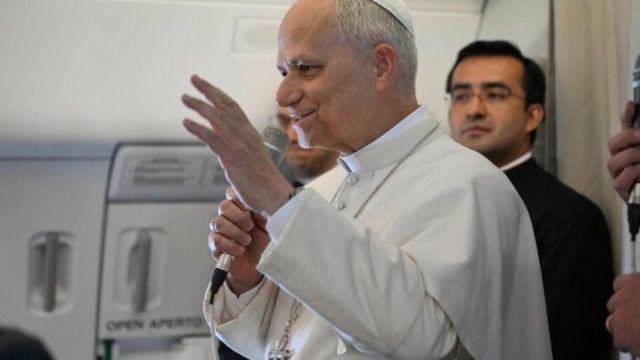
Cardinal Ratzinger's 2002 Vatican note bars Catholic support for abortion and euthanasia laws
The doctrinal note, which Ratzinger expanded on in a 2004 letter to the US bishops, says no Catholic may vote for such laws even when agreeing with a party on other social issues
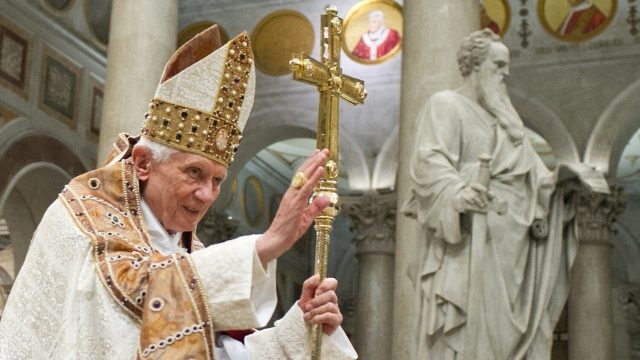
The Holy See said in November 2002 that no Catholic may use his or her vote to support laws or political programs that run counter to the fundamental principles of faith and morals.
The position is set out in a doctrinal note on the commitment and conduct of the faithful in public life, drawn up by the Congregation for the Doctrine of the Faith, the Vatican's doctrinal office. St. John Paul II approved it at an audience on November 21 of that year. Cardinal Joseph Ratzinger, who later became Pope Benedict XVI, signed it as prefect of the congregation, and Tarcisio Bertone countersigned it. The note is dated Rome, November 24, 2002, and was addressed to bishops, Catholic politicians and lay faithful active in public life.
Limits that cannot be set aside
The text starts from the premise that a well-formed Christian conscience does not allow a person to vote to pass laws or programs containing proposals contrary to the fundamental content of faith and morals. The note recognizes a legitimate plurality of political options and the freedom of the faithful to choose among those compatible with these principles. But it sets limits that it considers non-negotiable.
First among them is the defense of human life against abortion and euthanasia, issues that in the document's view allow no exceptions or compromise of any kind. Ratzinger rejected the argument of those who sought to support parties in favor of abortion by pointing to agreement on social or economic matters. When political action touches on moral principles that allow no derogation or exception, the note says, the commitment of Catholics becomes more demanding and carries greater responsibility.
The defense of life is not a religious dogma
The document rejects the idea that protecting life from conception is a religious dogma that Catholics seek to impose on the rest of society. For the Holy See, that defense is not a position reserved to believers. It is a truth inscribed in the natural moral law and in the ontological dignity of the human person, accessible to reason, to science and to objective knowledge about the human person.
Life is among the ethical principles that, by their nature and their foundational role in social life, are not negotiable. The right to life is not treated as an entitlement that depends on circumstances, but as the premise on which all other rights rest. Denying legal protection to human beings in their earliest stages, the text says, undermines the very root of justice.
A limited exception for lawmakers
The note makes a single exception, drawn from St. John Paul II's encyclical Evangelium vitae, for cases in which it is not possible to prevent or fully repeal an abortion law that is already in force or about to be voted on. In that case, the document requires that the lawmaker's personal opposition to abortion be clear and known to all. Only under that public condition may he or she licitly support proposals aimed at limiting the harm done by such a law and so reducing its negative effects on culture and public morality. Without that condition, the cooperation would be formal and culpable.
Expanded in 2004
Two years after the note, Ratzinger returned to the question of voting in a letter to the bishops of the United States, sent for their plenary assembly in June 2004. In it he wrote that a Catholic would be guilty of formal cooperation in evil, and unworthy to present himself for Holy Communion, if he deliberately voted for a candidate precisely because of the candidate's permissive stand on abortion or euthanasia.
The letter makes a distinction for someone who votes for such a candidate for other reasons. In that case, it would be remote material cooperation, which can be permitted when there are proportionate reasons. Ratzinger also distinguished the moral weight of different issues: there can be a legitimate diversity of opinion among Catholics about war or the death penalty, but not about abortion or euthanasia.
Family, education and religious freedom
The document lists the fundamental ethical demands that cannot be set aside. After life comes the family, founded on monogamous marriage between people of opposite sexes, which must be protected in its unity and stability against modern divorce laws. The text holds that other forms of cohabitation cannot be legally treated as equivalent to the family or receive legal recognition as such.
The rest of the list covers parents' freedom to educate their children, the social protection of minors, the protection of victims of exploitation and the right to religious freedom. It also includes an economy that serves the person and the common good, built on respect for social justice and subsidiarity.
Against intolerant secularism
The doctrinal note recognizes secularity, understood as the autonomy of politics from Church authority but never from the moral sphere, as a value that has been attained and recognized by the Church. At the same time, Ratzinger warned against those who, deceptively invoking tolerance, demand that Catholics give up taking part in the social and political life of their countries in line with their convictions.
The text describes as intolerant secularism any attempt to disqualify Catholics politically by denying them the legitimacy to act in politics according to their principles. The Holy See concludes that marginalizing Christianity would not serve the future of any vision of society and would put the spiritual and cultural foundations of civilization at risk.
Consistency between faith and life
The document ends by setting out a moral duty of consistency, addressed to the single, undivided conscience of the lay faithful. Commitment to one isolated issue does not excuse disregard for non-negotiable moral principles. A Christian cannot lead two parallel lives: a spiritual life on one side, with its values and demands, and a secular life on the other, made up of family, work, social relationships and political engagement.
The goal of a Christian in politics, the note concludes, is to bear witness to the consistency between faith and life, and between the Gospel and culture. In that way, professional, social and legislative activity forms a living synthesis in service of the truth about the human person and human dignity.
Based on reporting by Juana Morales for Iglesia Noticias. This article was translated and adapted from Spanish with the help of artificial intelligence.