Spain's figure of 440,000 abuse victims came from a newspaper calculation, not the ombudsman's count
The 440,000 figure routinely cited for victims of abuse in religious settings in Spain does not appear in the ombudsman's 2023 report: El País produced it by applying a 1.13 percent survey result to the adult population
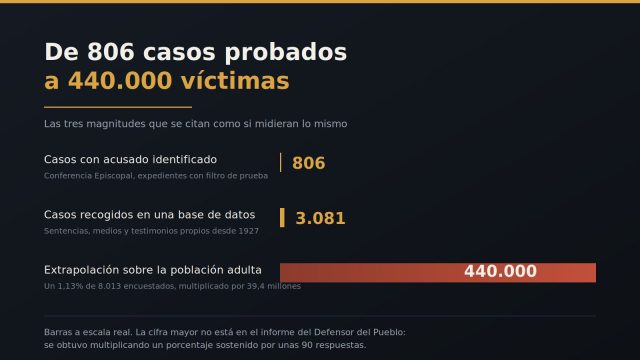
The figure of 440,000 alleged victims of abuse in Spanish religious settings does not appear in the report that the Defensor del Pueblo, Spain's national ombudsman, delivered on October 27, 2023. It is not in its 777 pages, nor in the survey behind it, nor in its conclusions. It was produced outside the document, on the day the report was presented, by applying to Spain's 39.4 million adults the 1.13 percent of respondents who said that an abuse they suffered before that age took place in a religious setting. El País did the multiplication.
Gabilondo, the ombudsman, expressly declined to extrapolate, and in October 2024 he said his work was qualitative rather than quantitative and that he had not set out to establish the number of cases recorded in Spain. The newspaper made the calculation itself and published 440,000, or 445,000 depending on the rounding, with no technical author named.
Three years later the number is still in circulation, used as though it were a count of identified victims.
The category does not refer only to priests
The "religious setting" category in the GAD3 survey does not cover priests alone: it includes lay people working in Church institutions, mainly teachers at state-subsidized Church schools. That is why the 1.13 percent is double the 0.6 percent of respondents who attributed the abuse to a priest or a Catholic religious.
The consequence is arithmetical. Applied to the 0.6 percent for clergy, the same operation would have produced about 236,000 people. The percentage used was the one that almost doubled the result, and it ran under a headline about priests. The gap between page 166 and the front page is more than 200,000 alleged victims, added without a single extra testimony.
About 90 boxes ticked
The statistical base of the figure is narrower than its size suggests. In a sample of 8,013 people, those who ticked the religious-setting box number about 90. The margin of error on a subcategory that small is wide, and multiplying it by 39 million widens the range to hundreds of thousands of people.
None of that accompanied the number. It was published to three significant figures and with no interval, a precision the instrument does not provide. No one verifies the accounts, or the definition each respondent applies to sexual abuse, a term covering everything from touching to assault with penetration. Respondents are also asked about events from decades earlier, at the height of media coverage of the subject.
Two invented victims reached Spain's parliament
How much checking went into the process that fed these counts became clear in July 2022, when a group of Catholics calling itself the colectivo Sergio Gámez invented a victim of that name and wrote to El País's inbox for abuse reports. The account described abuse by a catechist at a parish in Aluche, a district of Madrid, around 1991. The authors refused to meet in person, to be photographed or to have any contact other than email. No one asked them for more.
The non-existent case went the whole way. The paper published it on July 7, 2023 and included it in one of the reports it handed to the Spanish Bishops' Conference. The ombudsman included it in his October 27, 2023 report, on page 246, as testimony 359 and apparently also as testimony 35, which adds a duplication problem to the question of veracity. The Piarists, asked about the events, found nothing in their archives.
In May 2024 the same group revealed a second fictitious case, about a teacher at a Trinitarian school, also in Aluche. El País had already removed it from its website; the ombudsman's report still carried it. The ombudsman received the newspaper's files on four occasions, so the error at source passed downstream unchanged.
Seven figures that do not measure the same thing
Spanish Bishops' Conference, Para dar luz: 806 cases. Cases with an identified accused recorded by dioceses and religious congregations. December 2023. Verified internally, by the institution itself.
Victims Unit of the ombudsman's office: 487 victims. Testimonies gathered in interviews for the report. October 2023. Personal interview, no outside verification.
Victims Unit, updated: 674 victims. The earlier 487 plus 188 later testimonies accepted as valid. October 2024. Personal interview, no outside verification.
Cremades y Calvo Sotelo audit: 1,383 complaints and 2,056 victims. Complaints aggregated from several sources, with perpetrators undetermined. December 2023. Duplicates not fully removed.
El País database: 3,081 victims and 1,613 accused. Cases known from court rulings, media reports and the paper's own testimonies since 1927. April 2026, sixth report. Documentary and journalistic, with no outside body involved.
GAD3 survey for the ombudsman: 0.6 percent of the adult population. Respondents reporting sexual assault by a priest or religious. October 2023. Anonymous self-reporting, sample of 8,013 people.
GAD3 survey, broad religious setting: 1.13 percent of the adult population. Respondents reporting that the assault occurred in a religious setting, lay people included. October 2023. Anonymous self-reporting, sample of 8,013 people.
The table shows why the figures in circulation run from 806 to 440,000 without contradicting each other: they answer different questions. The cases verified by the bishops' conference are files with an identified accused that have passed an evidentiary filter. The complaints and testimonies received are accounts given to a newspaper, a commission or an audit, with no independent checking. The extrapolated estimate counts nobody: it calculates how many there would be. Confusion arises when all three appear in the same sentence.
An audit rejected for double counting
Inflated counts were not confined to the press. In February 2022 the Spanish Bishops' Conference commissioned an audit from the law firm Cremades y Calvo Sotelo, which delivered it on December 16, 2023, about ten months late, running to 956 pages and costing around 1.3 million euros. It recorded 1,383 complaints and a minimum of 2,056 victims.
The bishops' conference rejected it the day it was published. It said the firm had counted separately the complaints registered in the dioceses and the 305 reported to the Dicastery for the Doctrine of the Faith, even though dioceses are required to forward every case to Rome. With that duplication corrected, the count fell to 1,302 complaints. The conference also objected that the work was a compilation of cases already published in earlier studies, with conceptual errors and no original investigation.
The 806 cases that passed an evidentiary filter
The only Spanish count that applies an evidentiary filter is the bishops' conference's own, in the report Para dar luz. Of a first block of 363 cases, 205 were proven, 70 were considered credible, 75 remained under investigation and 13 had passed the statute of limitations. To that block were added 118 cases presented only to the ombudsman, and further batches, reaching 806 cases with an identified accused.
That is the basis of the document's most contested conclusion: that abuse cases in the Church do not exceed a thousand and are almost residual compared with those committed outside it. It rests on files with names attached, not on a survey projection.
The 3.36 percent that was not multiplied
The GAD3 survey produced four percentages and only one became an absolute number. Some 11.7 percent of those interviewed said they had suffered sexual abuse before the age of 18 in any setting. Some 3.36 percent placed it within the family, almost three times the religious figure. The 1.13 percent for religious settings amounts to around 10 percent of the total reported. The family percentage was not multiplied by the adult population and reached no front page.
In France the proportion was similar: abuse in the Church, lay people included, accounted for 6 percent of all sexual assaults on minors, against the 5.5 million French people who said they had suffered such assaults in any setting.
Estimates in other countries
France, CIASE 2021: 216,000 victims of clergy and 330,000 including lay people. About 4,800 cases in Church archives. 1950-2020. Estimate based on a survey of 28,000 people by Inserm, the French national health research institute.
Portugal, 2023: at least 4,815 victims. 512 validated testimonies. Since 1950. Extrapolation from victims mentioned by those who came forward.
Germany, MHG study 2018: no population estimate. 3,677 minors in archives. 1946-2014. Archive review only.
Spain, ombudsman 2023: about 236,000 for clergy and 440,000 for religious settings. 806 cases according to the bishops' conference and 3,081 according to El País. Period not defined. GAD3 survey of 8,013 people.
The denominator completes the comparison. CIASE calculated between 2,900 and 3,200 abusers in France, between 2.5 and 2.8 percent of the 115,000 clergy of the period. El País estimates 1,613 accused in Spain out of some 110,000 religious and priests since 1940, or 1.46 percent. That is of the same order as the French figure and below it, using the newspaper's own data.
Two routes, no cross-check
Since April 2026 two reparation routes have operated side by side. PRIVA is the Church's own plan, with an independent advisory commission that has been working since September 2024 and began receiving applications in February 2025, under the bishops' conference and CONFER, the Spanish conference of religious institutes. The joint mechanism came out of the January 8, 2026 agreement between the government and the Church and was set out in a protocol signed on March 30. It opened its processing office on April 15 for victims who can no longer go to court because the offense has passed the statute of limitations or the perpetrator has died.
All those victims can use the state mechanism whether or not they have already received some form of compensation from the Church, and the ombudsman will take into account cases already settled through PRIVA. The same person can therefore appear in both registers. How many do is not on record: neither side has published the cross-check.
September 2025, first year: 89 applications, 32 from dioceses and 57 from religious congregations; 39 rulings, out of the 40 complete reports received.
Early January 2026: 110 applications; no figure published for rulings.
February 2026: 127 applications, after 17 new ones in a month; 76 rulings.
April 30, 2026: no application figure published; 83 rulings, with more than 2 million euros agreed.
April 2026 summary, the most recent released: 156 applications; 94 rulings.
That is the full record of the Church plan: 156 applications and 94 rulings in 14 months, with payments of between 3,000 and 100,000 euros depending on the severity, the consequences and the circumstances of the abuse. Past and future therapy costs are added to that, along with commitments from the institution responsible. No update has been published since April, so both figures may now be higher.
The state route changed the pace within two weeks. The processing unit of the Ministry of the Presidency, Justice and Relations with the Cortes, Spain's parliament, received 300 applications in its first 15 days of operation, twice the number PRIVA had gathered in 14 months. As of August 3, 2026, the ombudsman's Victims Unit was examining 450 files, 149 of them at the final processing stage, with 105 individual interviews up to July 31 and only four cases rejected as falling outside the protocol.
Period of activity: the ombudsman's Victims Unit, since April 15, 2026; PRIVA, since February 2025.
Applications registered: the Victims Unit, 300 in 15 days and 450 as of August 3, 2026; PRIVA, 156 in the April 2026 summary.
Progress: the Victims Unit, 149 files at the final processing stage; PRIVA, 94 reparation rulings issued.
Personal contact: the Victims Unit, 105 interviews up to July 31; PRIVA, no figure published.
Cases rejected: the Victims Unit, four ruled inadmissible; PRIVA, no figure published.
Money committed: the Victims Unit does not handle payments; PRIVA, more than 2 million euros from dioceses and congregations.
Victims present in both routes: no figure published by either.
The comparison has a limit worth stating: the ombudsman's 450 files are applications under study and PRIVA's 94 rulings are decisions already issued, so neither column amounts to a count of recognized victims. The Church plan takes about three months on average to resolve a case from the moment it receives the institution's report. The ombudsman has the same maximum period for each application, extendable by a month if the volume or complexity warrants it.
Every file in the joint system passes through the ministry's Processing Unit, an assessment by the Victims Unit and a reasoned report from the PRIVA Advisory Commission. If they agree, the proposal is final; if they disagree, a Joint Commission including victims' associations takes part, and the ombudsman decides in the last instance. In April 2026 the Council of Ministers also approved a royal decree-law exempting these payments from personal income tax, known in Spain as IRPF. The Church had been asking for the exemption, and Minister Félix Bolaños accepted it in the January agreement.