Auxiliary Bishop Mutsaerts questions synodal process in open letter to Pope Leo XIV
Auxiliary Bishop Robertus Mutsaerts of 's-Hertogenbosch, in the Netherlands, published a letter on August 13 arguing that the Church needs saints, teaching bishops and praying priests rather than a permanent synod about itself

Auxiliary Bishop Robertus Mutsaerts of the Diocese of 's-Hertogenbosch, in the Netherlands, published an open letter to Pope Leo XIV on August 13, 2026, questioning the effectiveness of the synodal process and whether it brings souls closer to Christ. The 68-year-old bishop writes that the Church does not need a permanent synod about itself, but saints, bishops who teach, priests who pray and a renewal of its evangelizing mission.
The letter opens with a question: "Does the synodal process really help bring souls closer to Christ and to eternal salvation?" For Mutsaerts this is "the decisive question," and he cites the traditional principle that "the salvation of souls is the supreme law" of the Church. He acknowledges the good intentions of those who have taken part in the process, but applies the criterion given by Christ, "By their fruits you will know them," asking what years of consultations, meetings and synodal documents have actually produced.
A synod about a synod
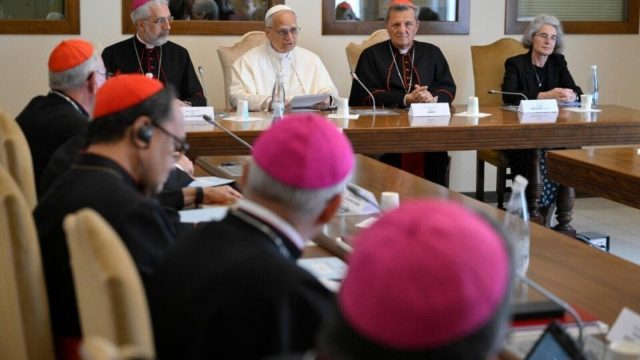
Mutsaerts writes that the Church has convened a Synod on Synodality. Historically, he says, synods were held to address particular questions, such as evangelization, marriage, the priesthood or the Eucharist, that required deliberation by the Church. "In the Synod on Synodality, the process itself becomes the object," he writes, comparing it to an indefinite meeting devoted to debating how future meetings should be held.
The risk, he says, is that "synodality risks becoming an end in itself." In the classical Catholic view, the synod was a means to an end. When that relationship is reversed, structure replaces substance. "The classical synod was a means to an end. In current synodal discourse, synodality risks becoming an end in itself. And it is precisely here that the problem begins from a classical Catholic perspective."
Truth does not emerge from consensus
At the center of the letter is a question about the nature of revelation and truth in the Church. "The Church does not begin with our dialogue. It begins with Christ," Mutsaerts writes. Christ did not found a discussion group, he says, but called the Apostles, gave them authority and sent them out to proclaim the Gospel. "The direction is fundamental. Faith does not arise because the Church first takes an inventory of what people believe and then distills a common conviction from all those experiences. Faith is received."
He continues: "Christianity by its very nature cannot be democratic. Not because democracy as a form of government is bad, but because truth does not arise from a majority decision." If 90 percent of Catholics stopped believing in the real presence of Christ in the Eucharist, he writes, that belief would still be true. "Truth is not produced by consensus."
Who is listened to first
Mutsaerts writes that listening is a necessary pastoral virtue, but warns of a danger in some synodal texts: the reversal of the order of priorities. The Church should listen first to Christ, Sacred Scripture, apostolic Tradition, the saints and two thousand years of Christianity, and then to the faithful. "But in some synodal texts this order seems to be slightly reversed. One begins with the experiences, desires, frustrations and expectations of people today and then asks how the Church should respond."
That reversal, he writes, creates a pastoral dilemma: "What happens when the desires of modern man collide with the Gospel? Then it is not the Gospel that must change; it is man who must change. In Christianity this is called conversion." The word, he says, "is heard surprisingly little in many modern ecclesial debates."
The absence of conversion
Here lies "the deepest weakness of the whole project," Mutsaerts writes. The Church does not exist primarily to confirm people in what they already are, but to lead them to Christ. The first words of Jesus' public preaching were not an invitation to express opinions about ecclesial structures, but a command: "Repent and believe in the Gospel."
The Church of the martyrs did not transform the Roman world with conversation groups about inclusivity, he writes, but by announcing Christ. The great reformers of the Church, among them Benedict, Bernard, Francis, Dominic, Catherine of Siena, Ignatius of Loyola, Teresa of Avila, John Bosco, Therese of Lisieux, Maximilian Kolbe and John Paul II, had "a strikingly simple program: to become holy." A saint, Mutsaerts writes, has "a missionary force with which no strategic document can compete."
The elephant in the room
Mutsaerts identifies a "striking discrepancy" between what is debated in the synodal process and the crisis the Church faces, particularly in the West. While participation, power relations and the responsibilities of women are discussed, "the churches are emptying. Parishes are merging. Monasteries are disappearing. Religious communities are aging. Knowledge of the Catholic faith is declining. Confession has practically disappeared for many Catholics."
"Faced with these developments, one would expect a worldwide ecclesial initiative to concern itself above all with one question: how can we win the world back for Christ?" he writes. Instead, "attention is directed mainly to structures, participation, decision-making processes, the responsibility of women, inclusion, power relations and the functioning of ecclesial bodies. These are certainly legitimate topics. But a house on fire has other priorities than household matters."
Parkinson's law applied to the Church
Mutsaerts describes what happens in institutions that lose sight of their original purpose: they begin to talk intensely about their own organization. "The less evangelization, the more committees about evangelization. The fewer vocations, the more documents about vocations. The fewer people who come to church, the longer the meetings about the nature of the Church."
This can create "the appearance of activity while reality shows the opposite. One sails without a compass." He asks: "What would happen if the same amount of time, money, spiritual energy and episcopal attention were invested in catechesis, seminaries, Catholic education, liturgy, confession, eucharistic adoration, marriage ministry and direct evangelization?"
Expectations that cannot be met
The synodal process has raised expectations by taking up for years questions on which the Church already has clear teaching: the female diaconate, the priesthood, sexual morality, homosexual relationships and decentralization. "When these topics are 'discussed' for years, the impression naturally arises that they might finally change," Mutsaerts writes. This leads to "a pastoral paradox": people are asked to express expectations that are ultimately incompatible with the continuity of Catholic doctrine.
"The Church itself has thus generated expectations that it ultimately cannot satisfy. That is not a pastoral benefit, but a recipe for frustration."
The paradox of participation
Mutsaerts writes that those who take part intensely in consultative processes are not necessarily representative of the whole Church. "The silent Catholic who goes to Mass every morning, prays the rosary and teaches catechism to his grandchildren usually does not draft a synodal report. The young Catholic who drives three hours to attend a traditional liturgy is usually not part of the diocesan working group."
A mother of six, a contemplative religious sister or a rural priest may have a faith "more deeply rooted than that of the professional participants in ecclesial assemblies." "Whoever listens only to those who take the microphone can easily forget that the people of God is much broader than the circle gathered around the consultation table."
Synodality or collegiality
Mutsaerts asks why a new, all-encompassing concept, synodality, was needed when the Catholic tradition already had a precise term: collegiality. "A concept that can mean everything ends up meaning nothing," he writes, noting that different people understand different things by synodality: for some, listening; for others, decentralization; for others, democratization; for others, reform of ecclesial ministry.
That ambiguity, he writes, creates confusion and makes it harder to assess the proportionality of what is being invested in the process.
The liturgy as indicator
Mutsaerts writes that the crisis of the liturgy has received "comparatively little central attention" in the synodal process. "Because whoever really wants to understand the state of a Church must look at its worship," he writes, citing the traditional principle: "Lex orandi, lex credendi: the way one prays expresses the faith."
When Catholics no longer understand that the Mass is the sacramental sacrifice of Christ, when the sense of the sacred disappears, when confessionals remain empty and eucharistic adoration is pushed to the margins, "the Church does not have a problem of governing structures. It has a problem of faith." A new structure of participation cannot solve it, he writes; perhaps "a rediscovery of God" can.
The Emmaus model
For Mutsaerts, the Gospel account of the disciples of Emmaus offers "the best model for an authentic Catholic synodality." Christ walks with the disciples, listens to them and corrects them. He teaches them. He makes himself known in the breaking of the bread. "This is Catholic synodality in its purest form."
What matters is what happens next: "The disciples do not remain indefinitely gathered in Emmaus evaluating their experience of the road. They get up. They return to Jerusalem. They go out to proclaim." Mutsaerts writes that "the synodal process has become stuck in Emmaus, and the question is whether it still knows how to get out of there. We are so busy discussing how the Church should walk together that we sometimes forget where it is walking."
Not another organization
Mutsaerts contrasts the spiritual crisis of the modern world with what the Church has. "People are looking for meaning. Young people are looking for identity. Loneliness is increasing. Families are breaking up. Technology penetrates ever more deeply into human existence. Pornography distorts sexuality. Materialism does not make people happy."
The Church, he writes, "possesses something extraordinary: the Gospel, the sacraments, the Eucharist, confession, two thousand years of wisdom, Sacred Scripture, the Fathers of the Church, the mystics, the saints, an incomparable tradition of art, music, philosophy, morality and spirituality. And above all, Jesus Christ."
"The world is not waiting for another organization to listen to it. There are already enough of those. The world is waiting for someone to tell it what it was created for."
A request for clarity
Mutsaerts closes with a request to Pope Leo XIV: "Give us clarity. When the world speaks full of uncertainty, let Peter speak with clarity." He asks the pope to remind the Church that revealed truth "is not a possession we can dispose of as we please, but a precious treasure we have received and must hand on intact."
He asks that priests, religious, parents and young people who seek "truth, holiness, beauty and the radical adventure of a life with Christ" be encouraged. He calls for not less structure but more holiness, not less participation but more conversion, not less dialogue but more proclamation.
"In the end, the Catholic Church does not need a permanent synod about itself. It needs saints. Bishops who teach. Priests who pray. Religious who live radically for God." He ends with words of Christ: "Christ did not send his Church into the world with the words, 'Go and organize synodal processes everywhere.' He said, 'Go into the whole world and proclaim the Gospel to all creation.' That is how the Church began."