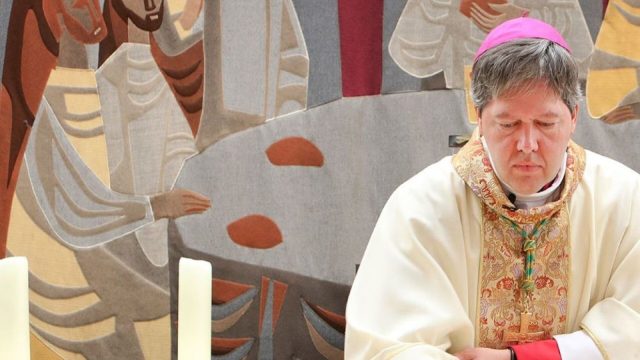
Dutch auxiliary bishop asks Pope Leo XIV whether synodality has strengthened the faith
Robert Mutsaerts, auxiliary bishop of 's-Hertogenbosch in the Netherlands, has published an open letter to Pope Leo XIV questioning the impact of the synodal processes on the vitality of the Church. His own bishop has distanced himself from it

Robert Mutsaerts, auxiliary bishop of the Dutch diocese of 's-Hertogenbosch, has written an open letter to Pope Leo XIV saying he wants the pope to speak frankly about the importance of believers holding on to ancient truths amid the challenges of modern life. The letter was published online and opens with a respectful greeting: "Holy Father, with reverence for the office entrusted to you as successor of St. Peter, and in communion with the Church that Christ built on the apostles, I address you with this open letter. I do not do so lightly."
Mutsaerts then raises a series of critical questions about the impact of the synodal gatherings, which sought dialogue with modern Catholics and with critics of the Church. He questions how effective those gatherings have been, asking: "Has faith grown? Has Christ been proclaimed more clearly? Has Catholic identity deepened? Have conversions increased? Is Sunday Mass better attended? Are there more priestly vocations? Has greater reverence for the Eucharist emerged? Has the moral teaching of the Church been clarified? Has missionary courage increased?"
Response from the diocesan ordinary
His superior, Bishop Gerard Johannes Nicolaus de Korte, responded quickly and clearly, and distanced himself from Mutsaerts's claims as the debate continued online. The letter comes amid wider debates over the use of the Latin Mass, Mass attendance trends in Western countries, tensions between Catholic politicians and Church teaching, and the blessing of same-sex unions in many European Catholic churches.
A 2019 study by the Pew Research Center found that only 31 percent of American Catholics believe the bread and wine consecrated at Mass become the body and blood of Jesus. A later study by the Center for Applied Research in the Apostolate at Georgetown University, carried out with the University of Notre Dame, put the figure higher, finding that nearly 64 percent of active, self-identified adult Catholics accept the doctrine. Both studies found that the higher the level of Mass attendance, the higher the share of those who accept this dogma of the Catholic faith. After the coronavirus pandemic, in-person Mass attendance among adult Catholics in the United States fell to 17 percent.
Debate over the Tridentine Mass
In a recent interview with EWTN, Archbishop Paul Coakley of Oklahoma City, president of the United States Conference of Catholic Bishops (USCCB), spoke about the debate over the Latin Mass. "The bishops are going to discuss this among themselves and within their own dioceses," he said. He was referring to Traditionis custodes (Guardians of the Tradition), Pope Francis's 2021 apostolic letter giving bishops the power to restrict the use of the Tridentine Mass, the rite used before the Second Vatican Council. "I'm not sure that we have heard the last word from this pontificate on Traditionis Custodes," Coakley added.
Criticism of Church bureaucracy
In his letter, Mutsaerts urged the pope to address pressing issues openly where Church teaching clashes with the spirit of the age. "The Church does not exist primarily to affirm people in what they already are," he wrote. "The first words of Jesus's public preaching are not: 'Tell me first how you feel about the current structures of the church.' But: 'Repent and believe in the Good News.' That is considerably less bureaucratic and much more radical."
Mutsaerts said large institutions that "lose sight of their original purpose" often become caught up in circular discussions about how to reform the processes that guide them. In the Church, he wrote, "the less evangelization, the more committees on evangelization. The fewer vocations, the more documents on vocations. The fewer people who go to church, the longer the meetings on how to become church. That sounds cynical, but there is a serious thought behind it: bureaucracy can create the illusion of activity while reality shows the opposite. One sails without a compass."