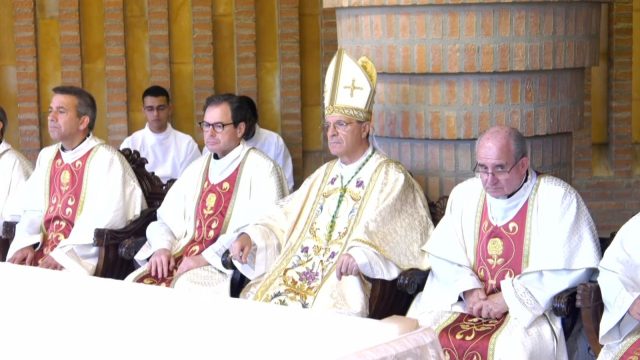
Kenyan archbishop to ordain 15 Opus Dei members from 11 countries as deacons
Archbishop Anthony Muheria of Nyeri will ordain the men, who include an American cybersecurity engineer from Notre Dame, a former Spanish Army officer and a Venezuelan lawyer who paints
A former Spanish Army officer, a cybersecurity engineer and a Venezuelan lawyer who paints are among the candidates the archbishop of Nyeri will ordain.
Archbishop Anthony Muheria of Nyeri, Kenya, will preside at the diaconal ordination of 15 members of Opus Dei from 11 countries. The candidates are Filiberto Chorques Vila (Spain), Gaspare De Lisi (Italy), Sebastián de Miguel Ibáñez (Mexico), José Miguel Gálvez Wilson (Peru), Santiago de Lasala Porta (Spain/Kazakhstan), Juan Pablo Marcos Ramos (Spain), Rémi de Martin de Viviés (France), Felix Oyende Matengo (Kenya), Alcibíades de Jesús Méndez Manzanilla (Venezuela), John Mbuvi Mutisya (Kenya), Ignacio Nozal Serrano (Spain), Jeffrey Matthew Pawlick (United States), Pablo Ignacio Sahagún Kunhardt (Mexico/Germany), Pedro Silva Lima (Brazil) and Arturo Torres García (Spain).
Journeys of faith and commitment
Pedro Silva Lima came to Opus Dei as a university student in São Paulo. He worked for several years in financial technology before moving to Rome, where he is now finishing his studies in biblical theology. One of his clearest memories is the trip he made for the beatification of Álvaro del Portillo, who succeeded Opus Dei's founder as head of the organization. "That moment had a big impact on me, because I had just moved to France for a two-year exchange, and meeting people who had come from all over the world, I could feel the universality of the Work firsthand," he said, using the name members give to Opus Dei.
Alcibíades Méndez Manzanilla was born in Maracaibo, Venezuela, and studied law in Caracas from 2012 to 2017, years marked by mass protests, political instability and a wave of emigration by young people. He worked as a lawyer in regulatory and contract law before moving to Rome to complete his Church studies, which have focused on classical and medieval philosophy. In his spare time, he paints. The instability he lived through led him to reflect on the human search for certainty. "In a world of change and polarization, with the wars and crises we see in the news every day, it is easy to feel that nothing is certain," he said. "That is why contemplating what endures, the truth and goodness of things, carries so much weight."
From the army to Church studies
Santiago de Lasala Porta trained at the military academy in Zaragoza, Spain, and served as an artillery officer in the Spanish Army, with international deployments in Kosovo and Lebanon. In 2010 he left active service to study theology at the Pontifical University of the Holy Cross in Rome, and he later earned a doctorate at the University of Navarra in Spain. He has lived in Kazakhstan since 2013. He teaches philosophy at a university in Almaty and has helped develop a university residence there linked to Opus Dei.
From African universities
John Mbuvi Mutisya was born and raised in Nairobi. A fan of soccer, music, hiking and running, he came to know Opus Dei while studying business administration. He later discovered that devotion to St. Josemaría Escrivá, the founder of Opus Dei, ran in his own family: his mother had kept prayer cards of the founder from before his beatification. After a short time in banking, he returned to Kenya and has spent the past decade in the counseling department at Strathmore University, where he has guided thousands of young people through their first decisions about life and career. He said those years of close personal relationships have shown him the value of one-on-one contact: "This new path in the priesthood will be an opportunity to 'mentor' many people, but in a different and deeper way."
A cybersecurity engineer's faith
Jeffrey Matthew Pawlick, an American, encountered Opus Dei at the University of Notre Dame, when a classmate invited him to a formation session at an Opus Dei center near campus. Before he accepted, his friend warned him: "But this is only for people who want to be saints." Pawlick hesitated for a moment, then said yes. He went on to earn a doctorate in electrical engineering at New York University, with a dissertation on cybersecurity, and spent time as a researcher at a US Army laboratory before moving to Rome, where he is studying philosophy. He describes his path as a gradual opening to God's will. "The results are always more beautiful than anything I could have dreamed of on my own," he said.
Based on reporting by José García for Iglesia Noticias. This article was translated and adapted from Spanish with the help of artificial intelligence.